Orangery and Hothouses, Ripley Castle Walled Garden
Ripley, near Harrogate (North Yorkshire)
Entry updated on October 5, 2026
- Year
- 1817-1818
- Architect
- William Belwood (orangery, c. 1785)
- Style
- Classical orangery with Ionic pilasters, glass-roofed in 1817-1818 and flanked by glasshouse ranges
- Status
- Gardens open to the public
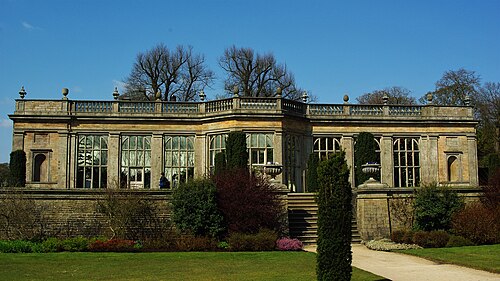
In the walled garden of Ripley Castle, the Ingilby family seat near Harrogate, a classical orangery attributed to the architect William Belwood, around 1785, was given a glass roof in 1817-1818 that turned it into a palm house, while two long glasshouse ranges linked it to its pavilions. In the nineteenth century the head gardeners ripened bananas, passion fruit, papayas and pineapples here. Listed at Grade II* and long on the Heritage at Risk Register, the group has been repaired with a £343,000 grant from Historic England, and a wide range of tender plants is still grown under its glass.
Affiliate links — booking through Verrière helps fund our research, at no extra cost to you.
History
1 min
Ripley Castle is the seat of the Ingilby family. Estate accounts show that hothouses were already being considered in 1781, when one Isaac Whitelock was paid one pound and one shilling for the plan of a hothouse. Around 1785 the York-born architect William Belwood designed the group of garden buildings for Sir John Ingilby: an orangery between two pavilions. The accounts record payments to him of at least £734.
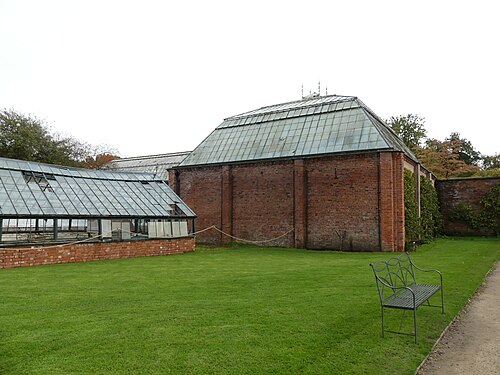
In 1817-1818 Sir William Amcotts Ingilby gave the orangery a glass roof, turning it into a palm house, and linked it to the pavilions with two long ranges of glasshouses. One pavilion served as a tea room before housing the estate fire engine; the other appears as an aviary on the 1847 map and later became a fruit store and then a squash court. A new heating system went in during the early 1870s; in the early 1880s one range was rebuilt with Helliwell's patent glazing, and in 1890 the other was offered for sale so that it too could be replaced. One of the two ranges, still shown on the 1909 map, was demolished around the time of the First World War.
The orangery, pavilions and glasshouses later spent many years on Historic England's Heritage at Risk Register. A £343,000 grant paid for repairs to the orangery, fire engine house, pavilions and bothies, and at the end of 2023 a garden historian described them as recently restored.
Architecture and engineering
1 min
Belwood's orangery has arched windows divided by fluted Ionic pilasters beneath a balustrade, and the two pavilions on either side share the same classical treatment. The glass roof added in 1817-1818 turned the masonry orangery into a true palm house at the centre of a symmetrical composition.
In March 1899 the Journal of Horticulture described eleven sections of glass: the orangery in the middle and five compartments on each side, each given over to a particular crop. As early as 1880, Morris's Picturesque Views had judged them scarcely exceeded by any in the kingdom. Only one of the two ranges survives today. The former bothies and potting sheds against the back of the orangery and glasshouses were converted to new uses in the latest campaign of works, and the roofline carries finials in the form of boars' heads and squirrels.
The orangery, fire engine house, pavilions and bothies are listed together at Grade II*, which places them among the top ten per cent of historic buildings in the country.
Plant collections
1 min
Ripley's glasshouses owe their reputation to a line of head gardeners. In 1833 Thomas Henderson was growing water-lemons (Passiflora laurifolia). His successor, G. M. Elliott, raised bananas and passion fruit for the table and became known for papaya, which he showed at the London Horticultural Society and described in a long article in Loudon's Gardener's Magazine; he also bred pineapples, including the variety 'Prince President'. The pineapple 'Ripley Queen', still grown commercially, preserves the memory of those crops.
By 1899 one section was given over entirely to 'Maréchal Niel' roses, three to early, mid-season and late grapes, and others to peaches, nectarines and figs, while pineapples had given way to winter tomatoes. Today the glasshouses hold a wide range of tender plants, many of them rehoused in 1991 from the University of Hull's botanic garden at Cottingham when it was threatened by housing development. The garden also keeps one of the National Collections of hyacinths.
Visiting
1 min
The gardens and grounds of Ripley Castle open every day, with entry through the Grindhus coffee shop, and dogs on leads are welcome, though not in the deer park. The orangery and its glasshouses stand in the walled garden; about an hour is enough to see them along with the surrounding borders and the two Belwood pavilions that frame them, one of which still houses the estate's old fire engine. A guided tour of the castle, Ripley village and, on some Sundays, the estate's monthly market round off the visit.
54.04° N, 1.57° W
Greenhouses nearby
More greenhouses — United Kingdom
Do you have a good photo of this greenhouse? Suggest it for this page →