Glasshouses of the N. A. Avrorin Polar-Alpine Botanical Garden-Institute
Kirovsk, Murmansk Oblast
Entry updated on October 5, 2026
- Year
- 1979
- Style
- Late-1970s research and collection glasshouses
- Dimensions
- 400 m² collection glasshouse
- Status
- Guided tours only, year-round
Founded in 1931 on a scheme by Professor N. A. Avrorin approved by the academician A. E. Fersman, the Polar-Alpine Botanical Garden spreads over the slopes of two Khibiny peaks about 7 km from Kirovsk; it is Russia's northernmost botanical garden (67°38′ N) and one of three in the world beyond the Arctic Circle. Its research glasshouses, including a 400 m² collection house built in 1979, hold hundreds of tropical and subtropical species. They are open all year but can be seen only on guided tours, while the outdoor park is accessible only from June to September.
Affiliate links — booking through Verrière helps fund our research, at no extra cost to you.
History
1 min
On 26 August 1931, at the Tietta mountain station, the academician A. E. Fersman approved Professor N. A. Avrorin's plan to create a polar-alpine botanical garden in the Khibiny. A botanist and geographer, Avrorin went on to work there for nearly thirty years, and the institution now bears his name. It occupies the slopes and summits of Mounts Vudyavrchorr and Takhtarvumchorr, about 7 km from Kirovsk, while its administrative centre is in Apatity.
The garden is Russia's northernmost, at 67°38′ N, and one of only three botanical gardens in the world beyond the Arctic Circle; one guide even calls it the world's first polar botanical garden. Its estate covers 1,670 hectares, 1,250 of them protected for research, and about 80 hectares are laid out as parks, nurseries and glasshouses.
The present glasshouses belong to a building campaign of the late 1970s: collection glasshouse no. 21 and greenhouses nos. 4 to 7 were completed in 1979, greenhouse no. 8 in 1982. They hold the tropical and subtropical collections that this research garden-institute maintains, sheltered from the climate of the Kola Peninsula.
Architecture and engineering
1 min
The institute's own documents describe its glasshouses by what they do rather than how they look. Collection glasshouse no. 21, built in 1979, covers 400 m²; it is supplemented by greenhouses nos. 4 to 7, of the same year, and by greenhouse no. 8, completed in 1982. All of them must keep humidity and temperature at the required levels, regulate the intake of ultraviolet light and stop the soil from cooling, three essential demands in mountains where, as one guide notes, snow can fall even in summer.
The buildings stand within the garden's roughly 80 developed hectares, alongside the nurseries and the open-air display areas. The sources consulted give neither the names of their designers nor details of their structure, whether frame, glazing or height.
Plant collections
1 min
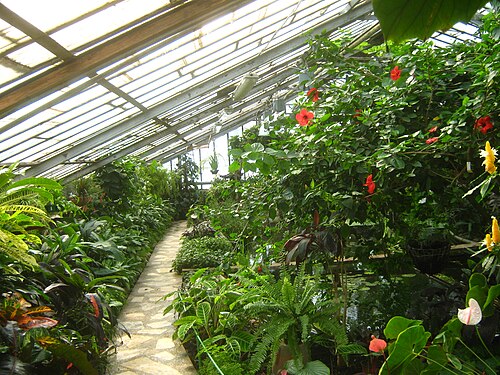
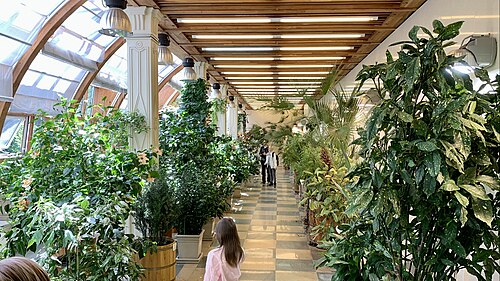
The glasshouses hold the garden's collection of tropical and subtropical plants. The institute's register counts 643 species and 195 infraspecific taxa under glass, 132 of the species rare and in need of protection; the online encyclopedia and the regional tourism portal speak of more than 1,000 species. One guide describes enormous glasshouses in which these tropical and subtropical plants are kept under special conditions.
Outdoors, the garden displays the local forest-tundra flora alongside plants acclimatised from other zones, with a rock garden and a snowdrop garden; its specialised nurseries keep more than 400 species native to the Murmansk region.
Visiting
1 min
The garden lies about 7 km from Kirovsk, on the slopes of Mounts Vudyavrchorr and Takhtarvumchorr in the Khibiny massif. The glasshouses are open all year but can be visited only with a guide, booked in advance. The park and the open-air displays, including the rock garden and the snowdrop garden, are accessible only from June to September, which makes summer the fullest season for combining the glasshouses with the outdoor collections. Even then, snow cannot be ruled out in the mountains, so warm clothing is worth bringing.
67.65° N, 33.67° E
Greenhouses nearby

More greenhouses — Russia
Do you have a good photo of this greenhouse? Suggest it for this page →
Sources (4)
- pabgi.ru/byurokratiya/unu/kollekcziya-zhivyh-rastenij-polyarno-alpijskogo-botanicheskogo-s
- ru.wikipedia.org/wiki/%D0%9F%D0%BE%D0%BB%D1%8F%D1%80%D0%BD%D0%BE-%D0%B0%D0%BB%D1%8C%D0%BF%
- visitmurmansk.info/ru/places/polyarno-alpijskij-botanicheskij-sad-institut/
- tonkosti.ru/%D0%9F%D0%BE%D0%BB%D1%8F%D1%80%D0%BD%D0%BE-%D0%B0%D0%BB%D1%8C%D0%BF%D0%B8%D0%B