Königsbrück Castle Camellia House (Königsbrücker Kamelien)
Königsbrück, Saxony

Sources checked October 2026
- Style
- Glasshouse with a sloping glazed roof and a stone back wall
- Dimensions
- ≈ 5 m × 20 m (according to Wikipedia)
- Status
- Open to the public in season (Sundays, from late January into early spring); free admission; closed the rest of the year
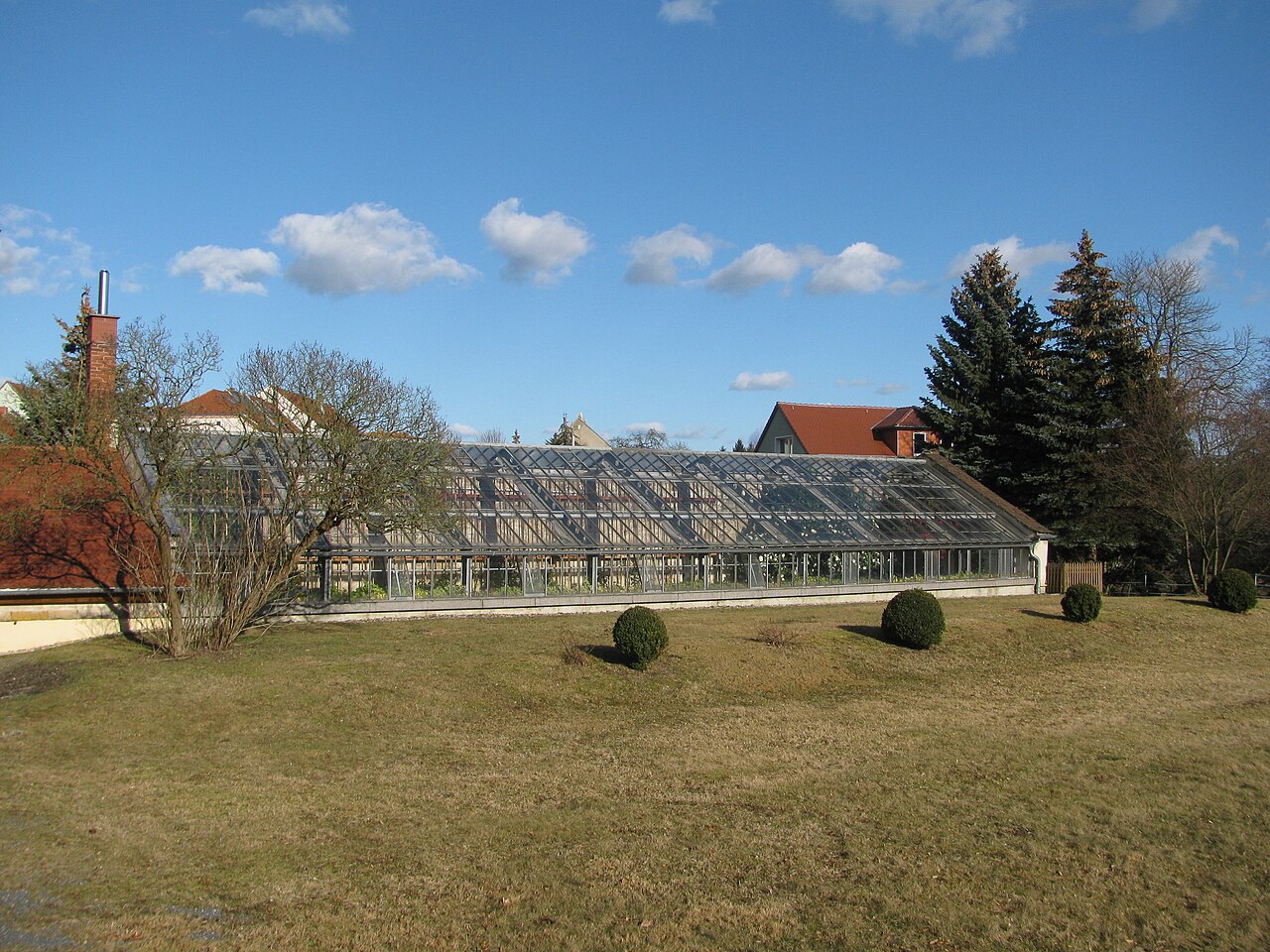
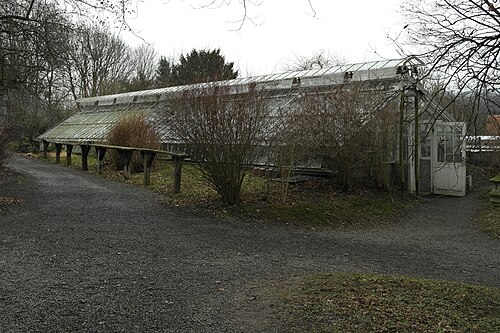
In the former castle nursery at Königsbrück, in the west of the Bautzen district, a greenhouse of about five by twenty metres shelters three Japanese camellias that Wikipedia describes as the oldest camellias standing together in Europe north of the Alps: two white-flowered 'Alba Plena' and one red 'Althaeiflora', more than five metres tall and planted, according to that source, around 1825. About thirty other camellias, among them fifteen espaliers planted in 2000, grow around them. Looked after all year by the local Heimatverein, the greenhouse opens to the public every winter for the flowering, with more than 10,000 visitors a season.
Affiliate links — booking through Verrière helps fund our research, at no extra cost to you.
History
Königsbrück castle, a former border fortress between Saxony and Bohemia, received its present main building in 1704. According to the town's page, the counts of Friesen had the garden and the orangery restored between 1728 and 1746 and two new massive greenhouses built; Wikipedia, for its part, mentions large greenhouses in 1752. In 1803 the estate passed to Peter Karl Wilhelm von Hohenthal.
On the camellias, Wikipedia suggests, without proof, that they came from the collection of the Seidel nursery in Dresden, now kept at Zuschendorf, and that the Hohenthal family brought them in the early nineteenth century; planting is dated to about 1825, with reservations. The town speaks of trunks more than 180 years old, the announcement of the 2026 season of more than 200 years, and an expert advised against any analysis that might harm the plants. A parish chronicle says a camellia house was put back in order in 1846, and in 1872 a steam boiler house with a flower-growing building is recorded.
In 1996 building work at the castle cut off the greenhouse's heating. The camellias, rooted in the masonry, could not be dug up: a mobile oil heater, paid for by the ASB and the Kamenz district office, and then volunteers of the Heimatverein kept them alive. The State of Saxony had the greenhouse refurbished in 1998. In August 2004 Deutsche Post issued a stamp and a postal stationery item for two centuries of camellias in Saxony, the envelope showing the castle gate.
Architecture and engineering
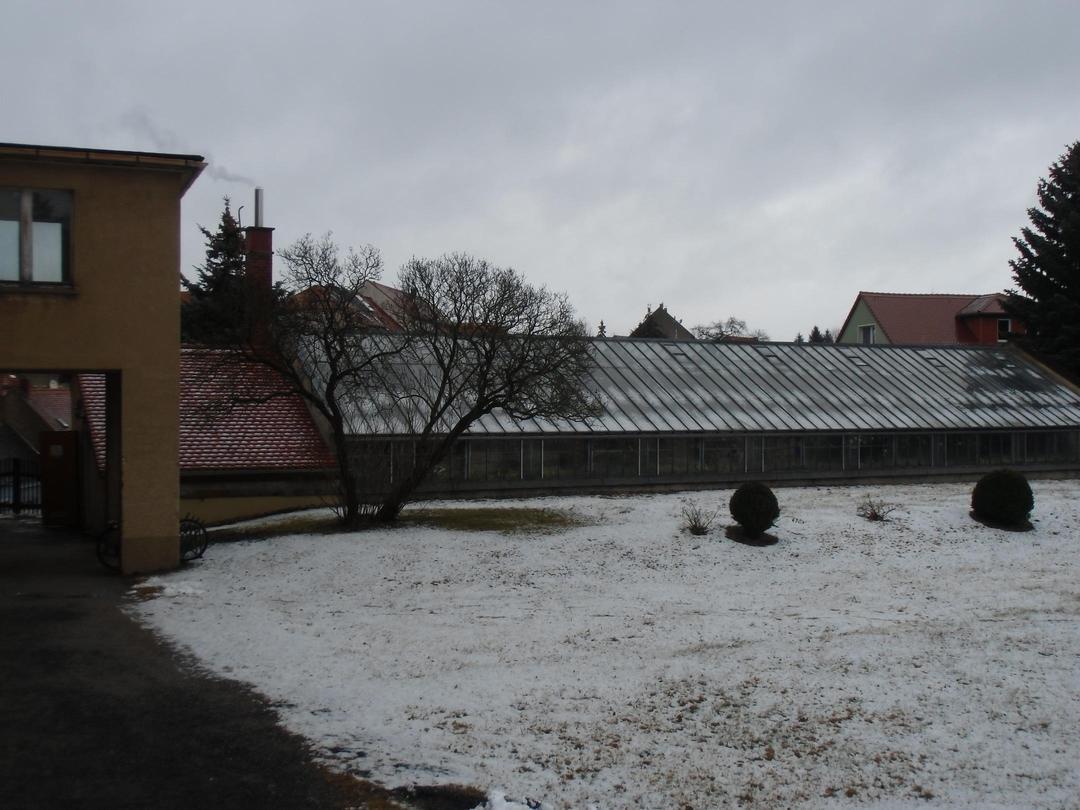
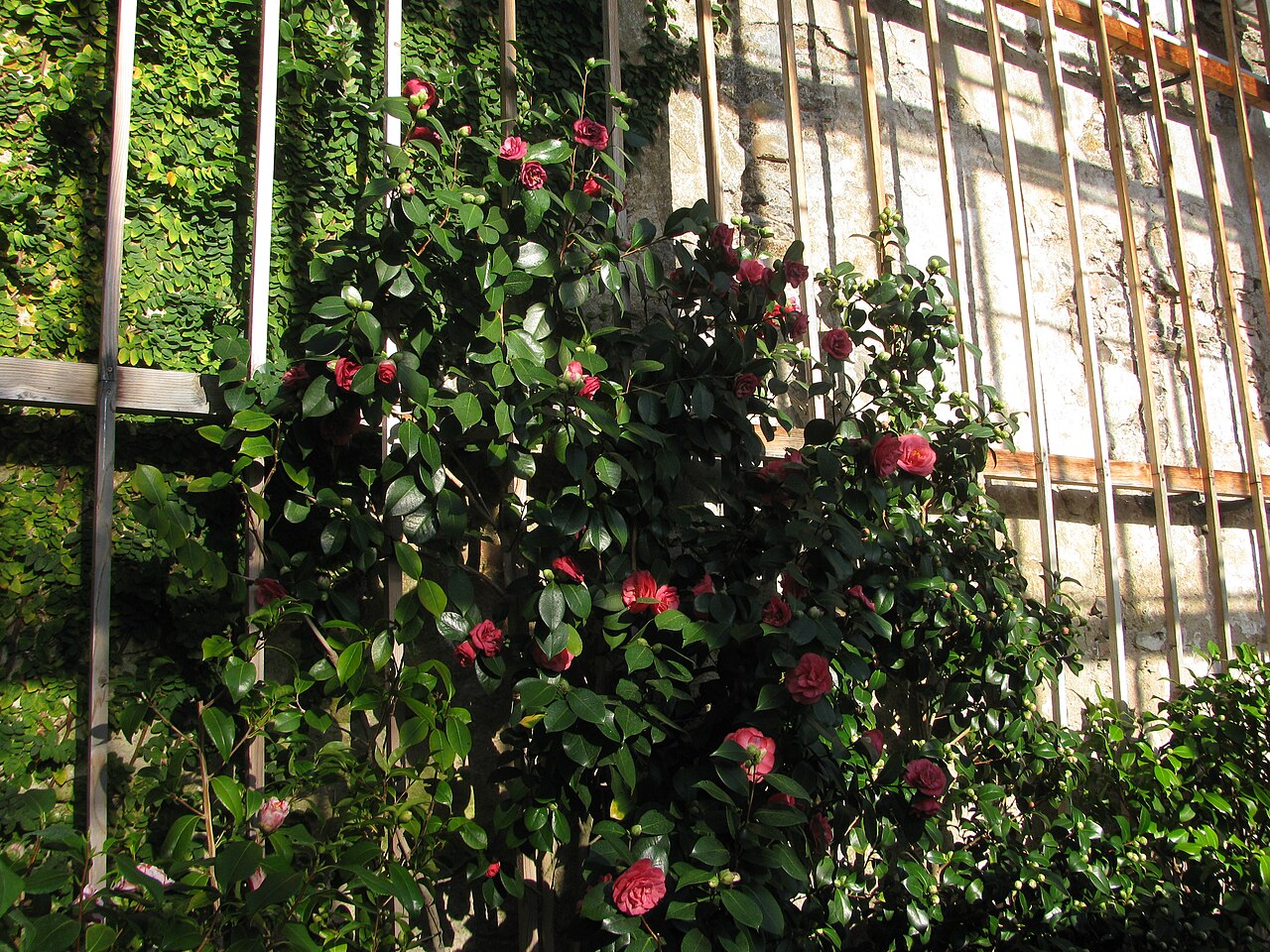
The greenhouse stands in the castle's former nursery, at Schloßberg 3a, and measures about five by twenty metres according to Wikipedia. Free photographs on Wikimedia Commons show a long sloping glazed roof, divided by a grid of glazing bars, above a low base and a glazed front; inside, the camellias stand in front of a stone wall lined with wooden battens, against which the branches are trained. Wikipedia reports that the roots of the largest specimens are held in the masonry.
A description of 1872 kept by the town refers, for a steam boiler house with a flower-growing building, to glass in iron frames, two thirds glass and one third brick, with some timber frames. After the 1998 refurbishment the house received modern heating and an automatic shading system, according to Wikipedia; the town's page adds that the temporary heating was removed and the raised bed taken out. Step-free access for visitors with disabilities has existed since 2007.
Plant collections
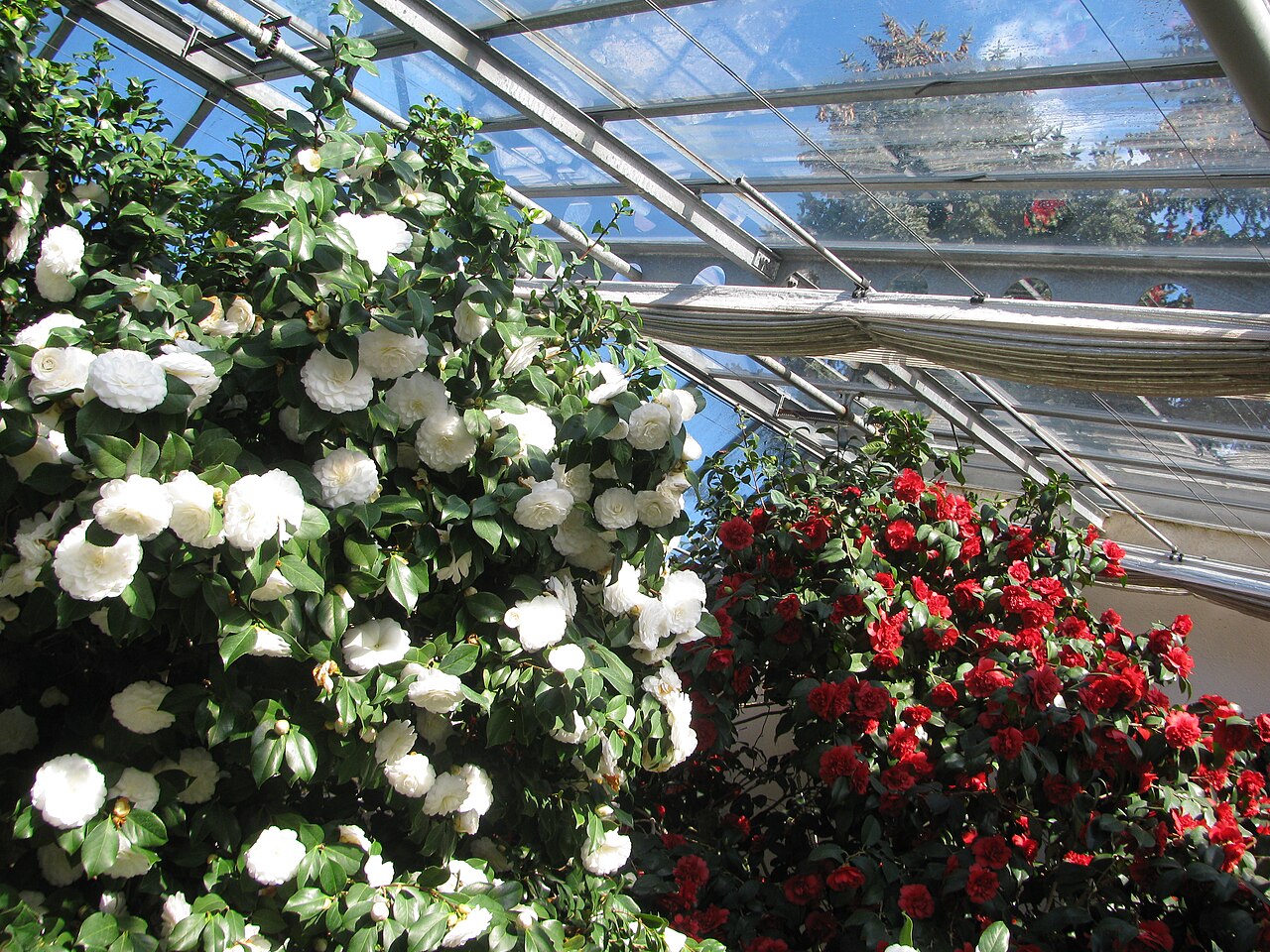
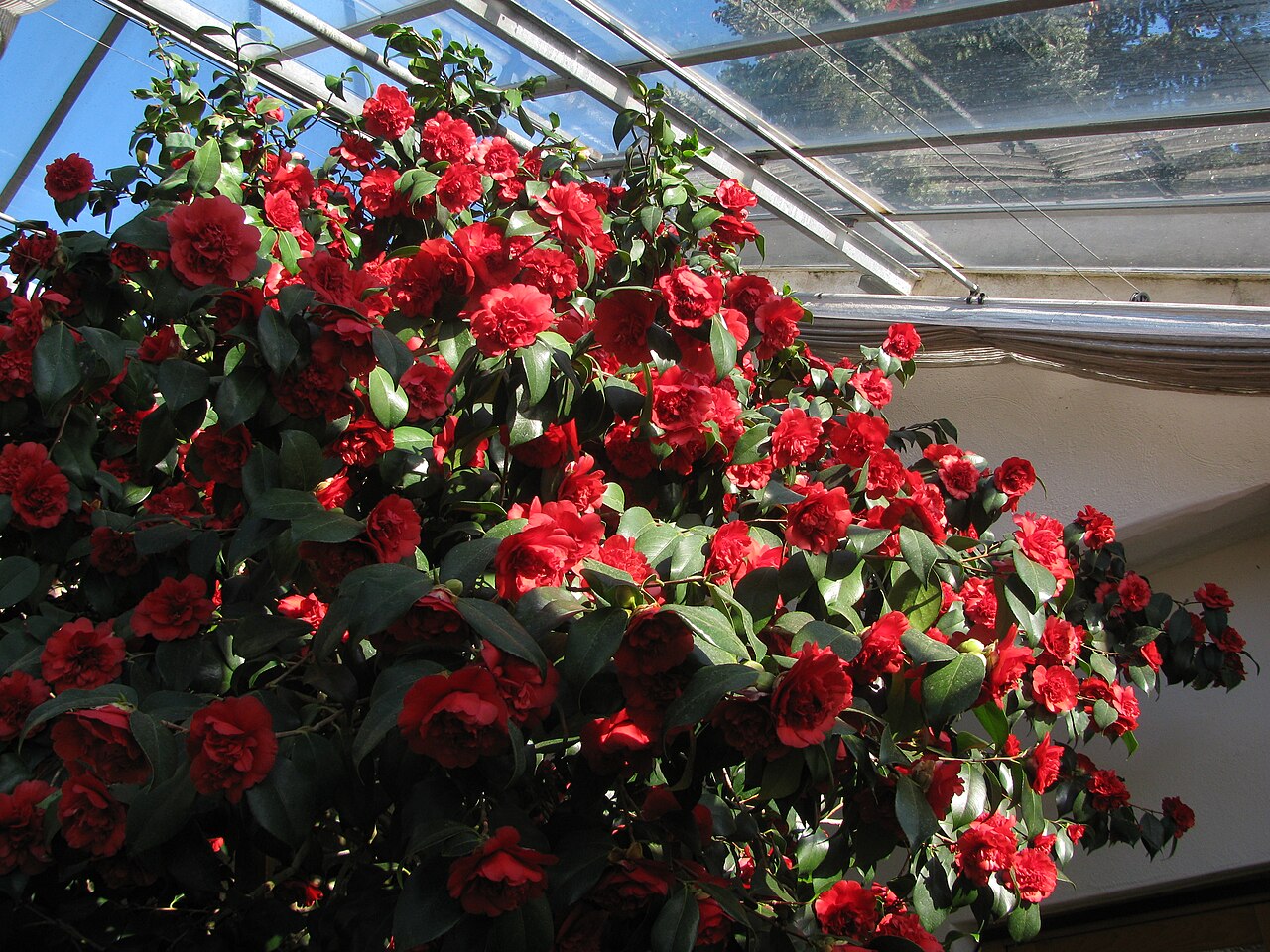
Three Japanese camellias form the heart of the greenhouse: two 'Alba Plena' with double white flowers and one 'Althaeiflora' with double red flowers, more than five metres tall, with blooms 8 to 10 cm across. The 'Alba Plena' usually flower first; the main flowering of these three specimens falls in February. Local tradition nicknames them 'Schneeweißchen und Rosenrot', after the Grimm fairy tale.
About thirty other camellias grow around them in all, according to Wikipedia: nine bushes up to two metres tall, dating from the 1920s or 1950s, and fifteen espaliers planted in 2000, which flower mainly in March. The Saxon culture ministry also mentions further specimens from the Seidel collection and rare fragrant camellias; the petals of one of them, 'minato no akebono', go into a camellia perfume made in Königsbrück. Wikipedia also notes that cuttings of the three oldest plants are sold with a certificate of authenticity.
Visiting
The greenhouse stands in the castle park, reached by the Schloßberg. It opens only during the flowering, on Sundays, from late January into early spring; in 2026 the season began on 25 January, under a heated tent set up beside the greenhouse. Groups are received on weekdays by booking through the Königsbrück-Information, and pupils from the town lead tours, including for visually impaired visitors.
The visit to the greenhouse is quick and combines easily with the town's other sights: the main church, which keeps the Baroque Schellendorff epitaph dated 1703, the Naumann mausoleum and the Via Regia architectural model museum. Königsbrück lies about 27 km north-east of Dresden.
51.26° N, 13.90° E
Greenhouses nearby
More greenhouses — Germany
Do you have a good photo of this greenhouse? Suggest it for this page →
Sources (8)
- koenigsbrueck.de/verzeichnis/visitenkarte.php?mandat=228751
- saechsischer-heimatschutz.de/termine-detail/kamelienbluete-2026-in-koenigsbrueck-beginnt.h
- medienservice.sachsen.de/medien/news/1064430/download_pdf
- de.wikipedia.org/wiki/K%C3%B6nigsbr%C3%BCcker_Kamelien
- de.wikipedia.org/wiki/Schloss_K%C3%B6nigsbr%C3%BCck
- berliner-zeitung.de/article/oberschueler-erhalten-saechsischen-denkmalschutzpreis-10388926
- commons.wikimedia.org/wiki/Category:K%C3%B6nigsbr%C3%BCck_Camellias
- wikidata.org/wiki/Q1796325
Affiliate links — booking through Verrière helps fund our research, at no extra cost to you.