Rainforest hall of Tropical Islands (former CargoLifter airship hangar)
Krausnick-Groß Wasserburg, Brandenburg

Sources checked October 2026
- Year
- 2000-2004
- Architect
- SIAT (original hangar); CL MAP (conversion, 2003-2004)
- Style
- Self-supporting steel-arch hall with a membrane envelope and an ETFE-cushion south side
- Dimensions
- Hall 360 × 210 × 107 m (about 66,000 m² floor area); about 50,000 plants of over 600 species
- Status
- Open to the public on ticket; leisure resort (pools, sauna, accommodation)
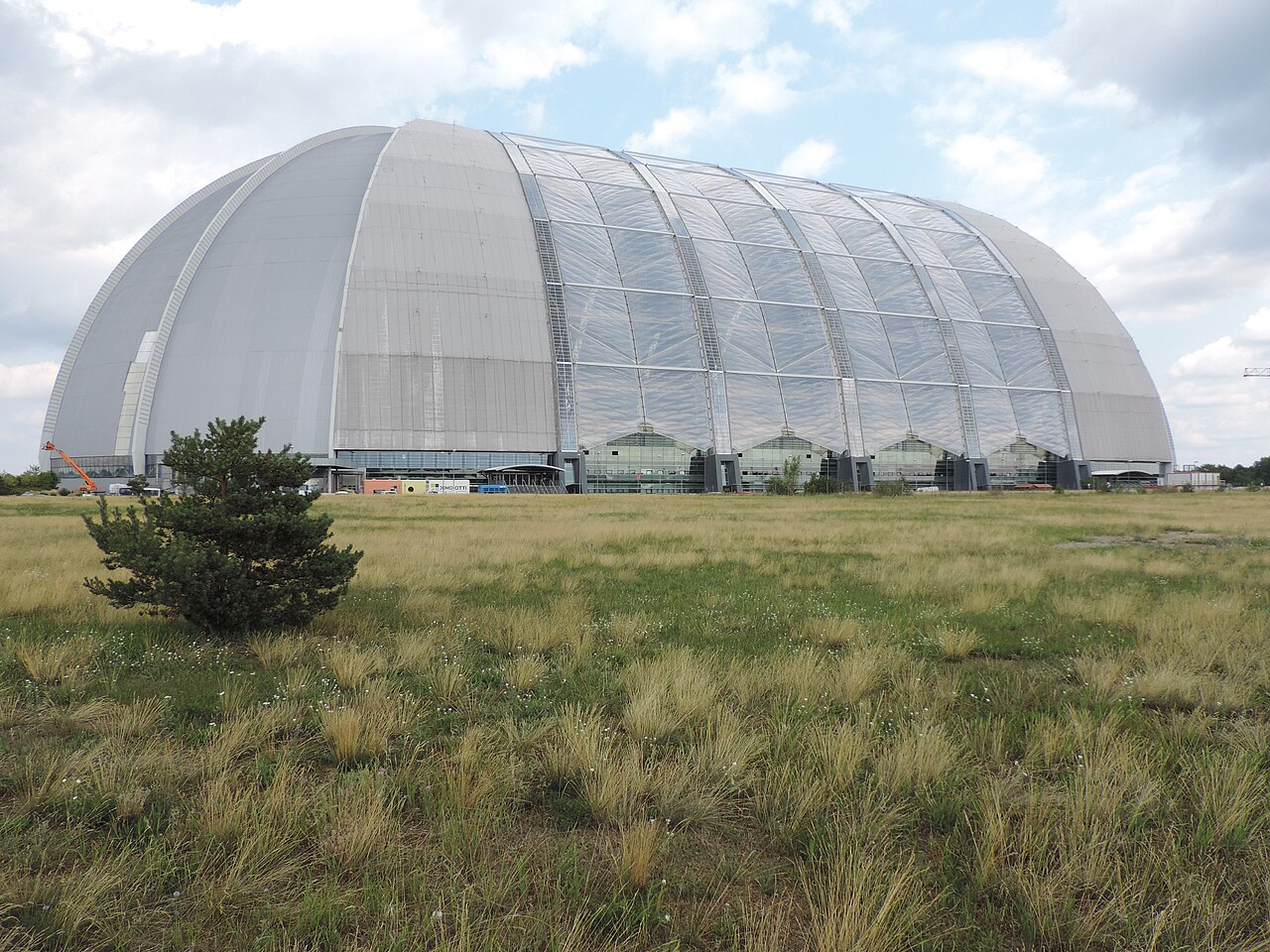
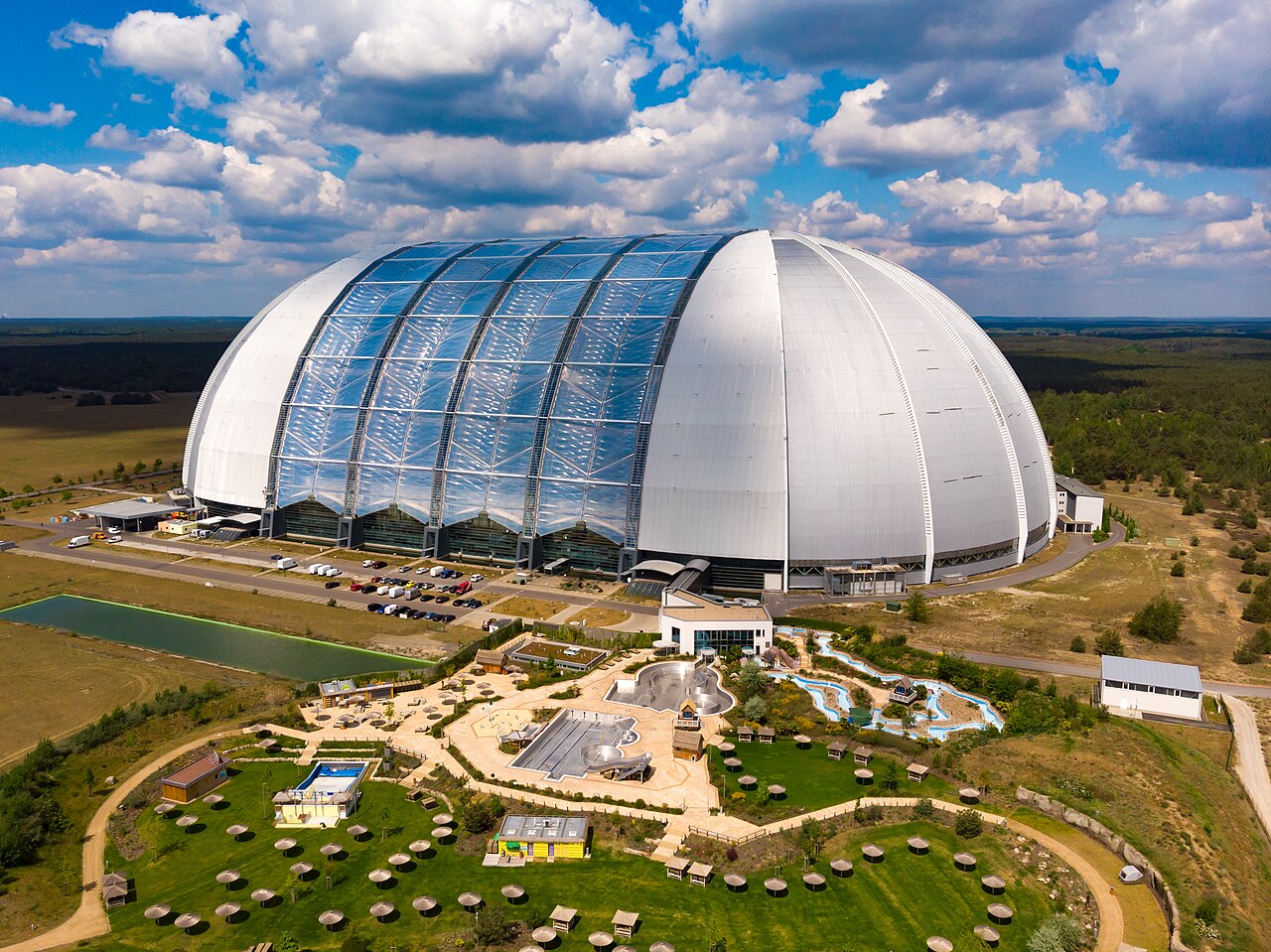
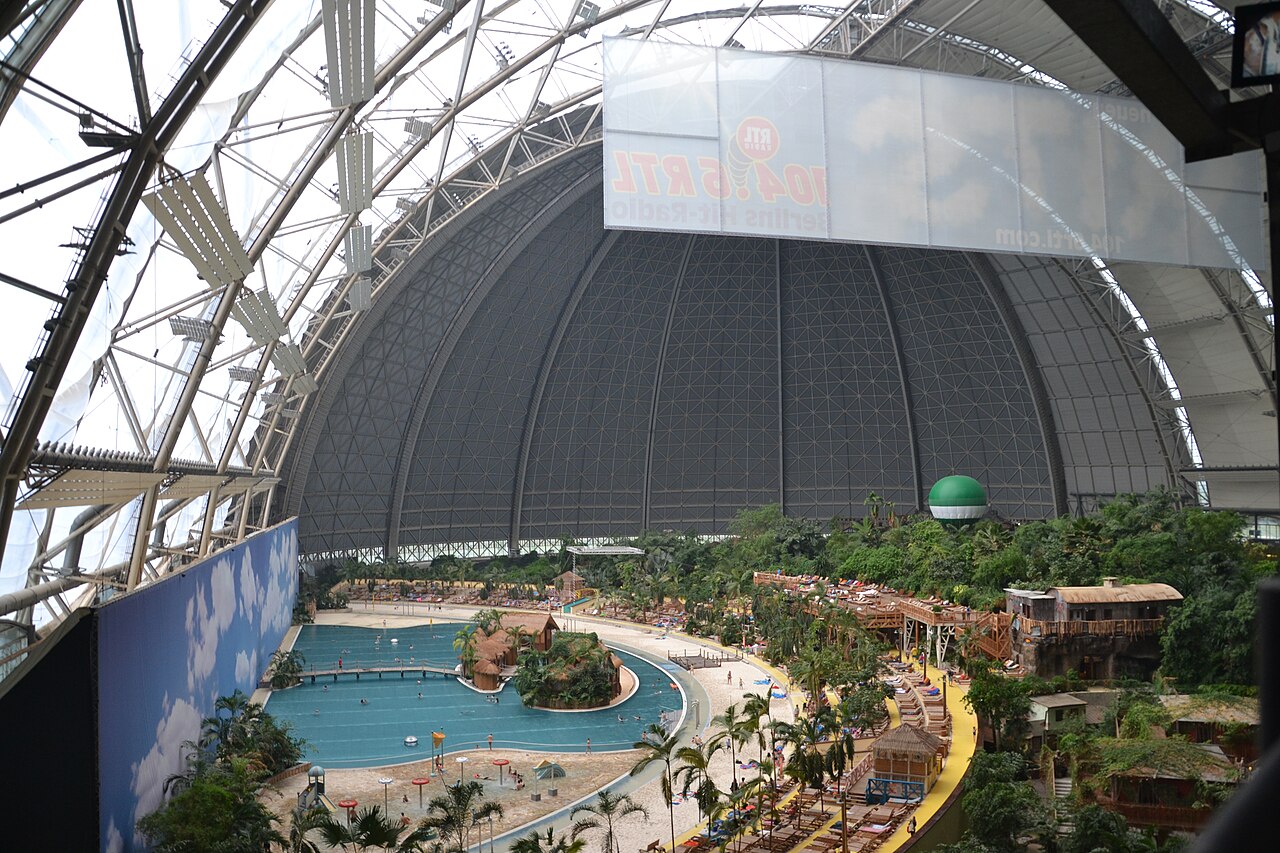
Built in 2000 for CargoLifter's airships, the Krausnick hall was sold in 2003 and opened on 19 December 2004 as the Tropical Islands resort. It is 360 m long, 210 m wide and 107 m high, covering about 66,000 m² beneath five steel arches. Its rainforest holds some 50,000 plants of more than 600 species, crossed by a bridge over a mangrove. Because the plants lacked light under the original opaque envelope, the south side, 20,000 m² in all, was redone in October 2005 with UV-transparent ETFE foil. The site is above all a leisure resort; this entry describes the hall and its vegetation.
Affiliate links — booking through Verrière helps fund our research, at no extra cost to you.
History
The hall was built for CargoLifter, a company that meant to build cargo airships. The first spade was turned in May 1998 on the Brand site; construction began in March 1999, the first of five steel arches, 107 m high, went up in October 1999, membrane cladding began in May 2000 and the hall was handed over to the company on 22 November 2000. German Wikipedia's article on the resort cites a cost of about 78 million euros, its article on the hall 150 million marks. The airship it was built for, the CL160, was never completed, and CargoLifter went bankrupt in 2002.
On 11 June 2003 the hall and about 500 hectares of land were sold for 17.5 million euros to the Malaysian Tanjong group; Brandenburg granted a 10 million euro subsidy for the conversion. CL MAP was commissioned in 2003 as general planner for the interior fit-out; by its own account, the zoning change and building permit took under nine months, followed by about seven months of works costing some 45 million euros. The permit was issued on 2 February 2004 and Tropical Islands opened on 19 December 2004.
The plants first suffered from a lack of light under the opaque dome: in October 2005 the south side received a 20,000 m² ETFE foil. The park then expanded (the outdoor Amazonia area in 2016) and passed to the Spanish group Parques Reunidos (December 2018 according to English Wikipedia, February 2019 according to the German article). A Rockwool press release dated November 2023 reports the insulation of the hall's gates, "gate by gate", continuing until 2027.
Architecture and engineering
According to German Wikipedia, the hall was planned by SIAT and built by a consortium led by Hochtief with Dillinger Stahlbau and Max Bögl. Five steel arches 200 m long, semi-cylindrical in form, span it with no interior supports; the same source describes it as the largest self-supporting building in the world. It measures 360 m long, 210 m wide and 107 m high, with a volume of 5.5 million m³ and about 66,000 m² of floor. The steel weighs 14,500 t according to Wikipedia and 14,000 t according to the park, whose roof covers about 70,000 m². A 600 t gate closes each end.
The original envelope is a 40,000 m² membrane fitted in 2000. In 2005 the south side was replaced by an ETFE construction, a UV-transparent foil, of 20,000 m² according to Wikipedia and the park, made up of 64 cushions of about 300 m² each according to CL MAP. The gates, which Rockwool describes as opaque, have been insulated since 2021; separately, the data table for the original hall lists an 11,000 m² glazed facade, without locating it. The air is kept around 26 °C with underfloor heating; humidity is 40 to 60 per cent according to German Wikipedia and about 64 per cent according to the English article.
Plant collections
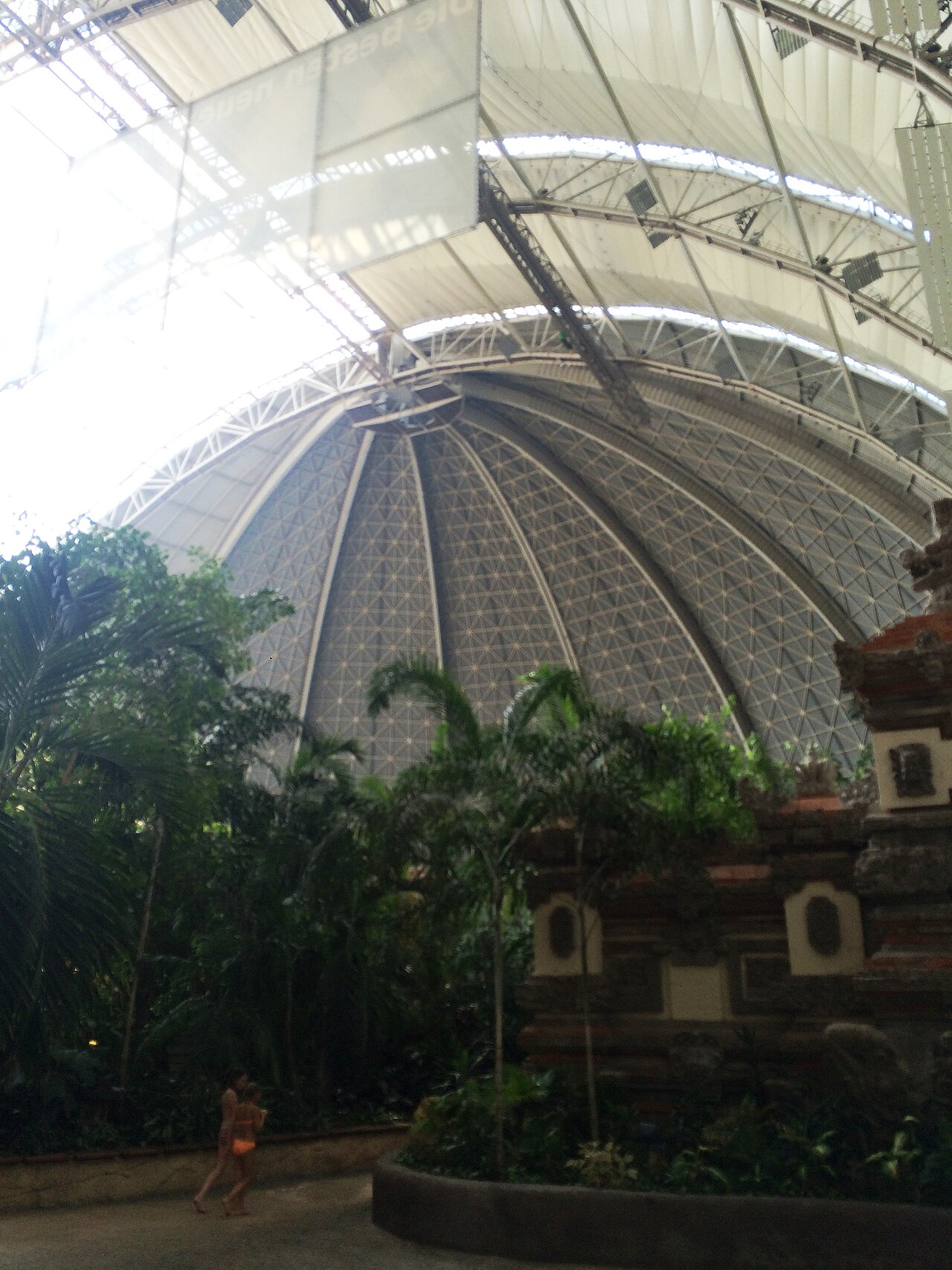
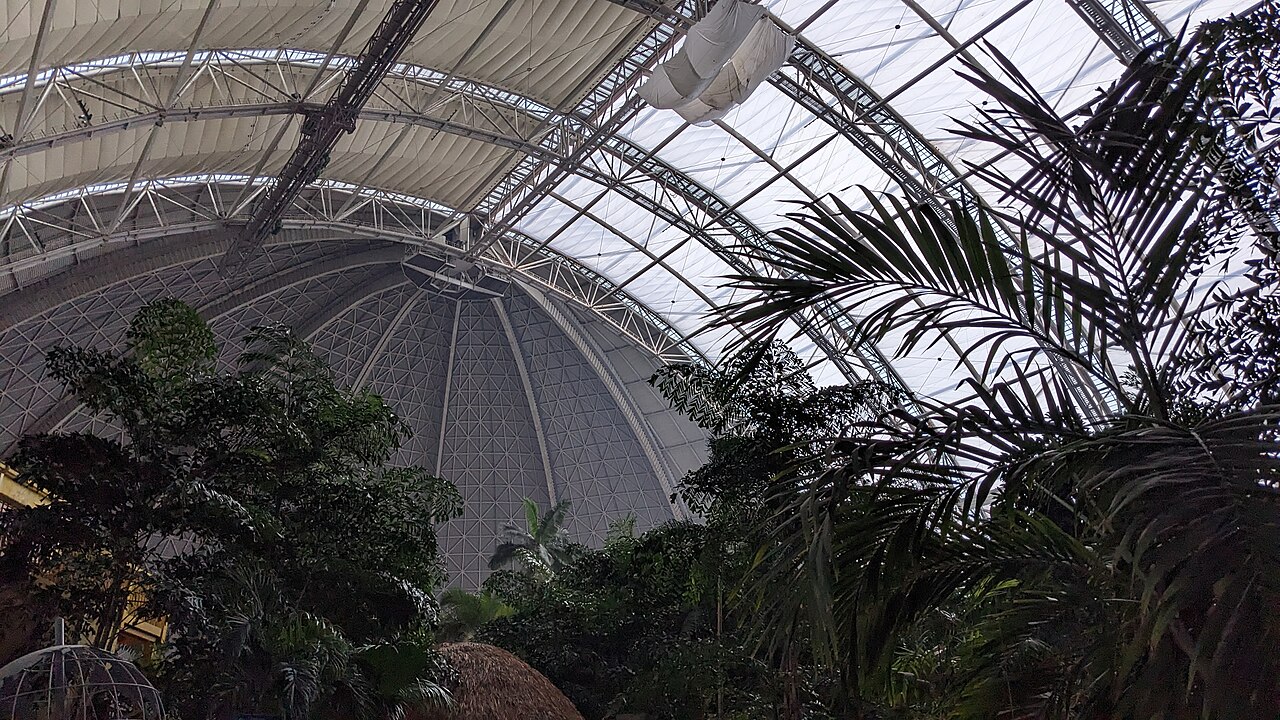
According to the park and German Wikipedia, the rainforest holds about 50,000 plants, some of them rare, of more than 600 species; the park presents it as the largest indoor rainforest in the world. CL MAP puts the share of forest and tropical vegetation in the hall at about 10,000 m². The park cites banana and jackfruit trees and mentions a mangrove crossed by a walkable bridge. It also mentions small soil animals, Surinam cockroaches and beetles, which keep the biotope in balance and which it describes as harmless.
The hall also houses animals: flamingos, turtles, peacocks, fish and a 42 m² butterfly enclosure according to German Wikipedia. The "Tropendorf" groups copies of buildings from Thailand, Borneo, Samoa and Bali. English Wikipedia adds that the dome at first let in too little light for photosynthesis, which led to the ETFE side.
Visiting
The hall is the heart of a leisure resort: the complex also includes pools, a lagoon, saunas (depending on the ticket) and accommodation. It lies about fifty kilometres south of Berlin, according to English Wikipedia. Hours are separate for each attraction; the air temperature stays around 26 °C in every season. The forest is explored on foot along its paths and mangrove bridge. The outdoor Amazonia area, 35,000 m² and opened in 2016 according to the park, extends the visit.
52.04° N, 13.75° E
Greenhouses nearby
More greenhouses — Germany
Do you have a good photo of this greenhouse? Suggest it for this page →
Sources (8)
- tropical-islands.de/unsere-attraktionen/tropical-world-gebiete/tropischer-regenwald
- tropical-islands.de/planen-sie-ihren-besuch/relevante-informationen/ueber-tropical-islands
- de.wikipedia.org/wiki/Tropical_Islands
- de.wikipedia.org/wiki/Cargolifter-Luftschiffhalle
- en.wikipedia.org/wiki/Tropical_Islands_Resort
- clmap.de/projekte/freizeitresort-tropical-islands
- rockwool.com/de/unternehmen/pressemeldungen/tropical-islands/
- openstreetmap.org/way/172508868
Affiliate links — booking through Verrière helps fund our research, at no extra cost to you.