Tropical Hall of the Balinese Garden, Gärten der Welt
Berlin-Marzahn, Berlin

Sources checked October 2026
- Year
- 2017 (Balinese garden since 2003)
- Architect
- Haas Architekten (hall); I Putu Edy Semara (Balinese built elements)
- Style
- Contemporary steel-and-glass hall with warm house and cold house
- Dimensions
- 50 × 40 m, about 1,800 m² (Baunetz); 1,200 m² tropical hall plus a 500 m² compound according to the park
- Status
- Open to the public (inside the ticketed Gärten der Welt)
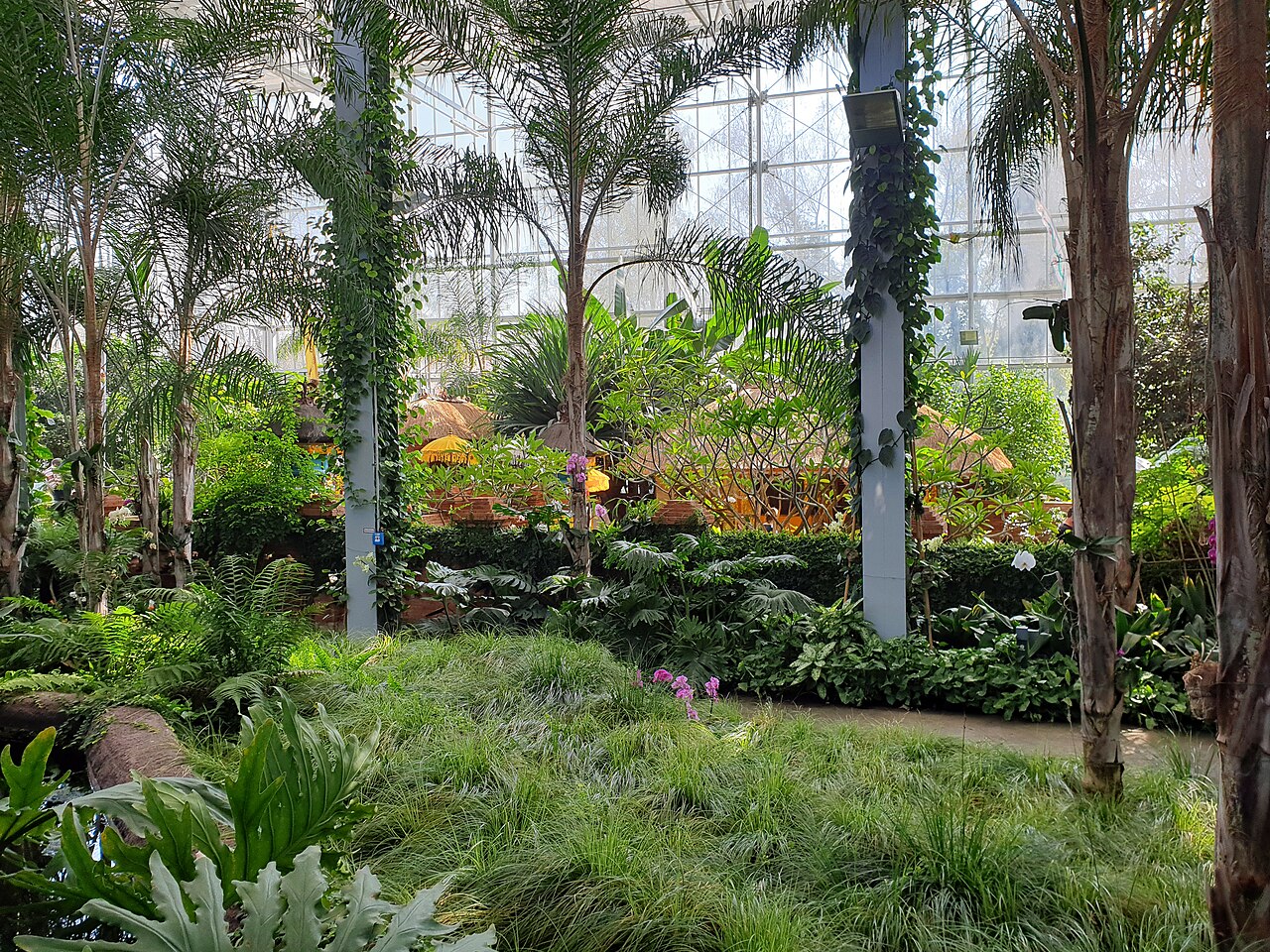
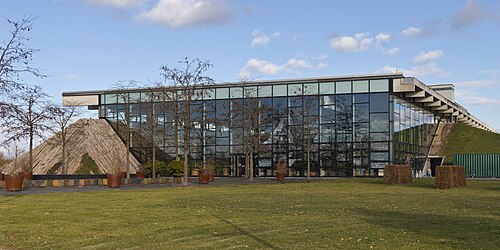
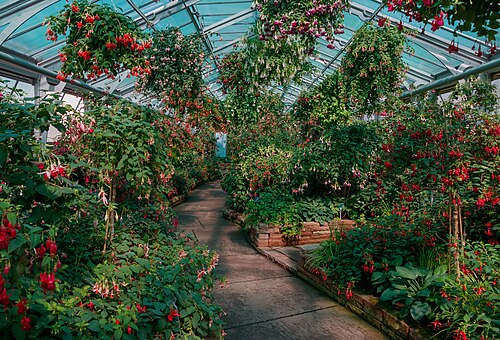
Born of the twinning between Berlin and Jakarta, the Balinese garden of the Gärten der Welt opened on 18 December 2003 in a lightweight 1990s hall, with a family compound and a temple designed by the Indonesian architect I Putu Edy Semara. For the IGA 2017 garden show, Haas Architekten designed for Grün Berlin a steel-and-glass hall of 50 by 40 metres, erected over the old greenhouse, which was then dismantled without moving the plants. Under 14 to 15 metres of headroom, terraced rice paddies, pandanus, tree ferns, hibiscus, orchids and a frangipani surround the Balinese courtyard; an adjoining cold house serves as an orangery in winter.
Affiliate links — booking through Verrière helps fund our research, at no extra cost to you.
History
The park itself opened on 9 May 1987 as the Berliner Gartenschau, a horticultural show staged for Berlin's 750th anniversary in the east of the city. Renamed Erholungspark Marzahn in 1991, it was developed from the late 1990s under the "Gärten der Welt" project, a sequence of themed gardens devoted to the garden cultures of the world, run by Grün Berlin, a company owned by the State of Berlin.
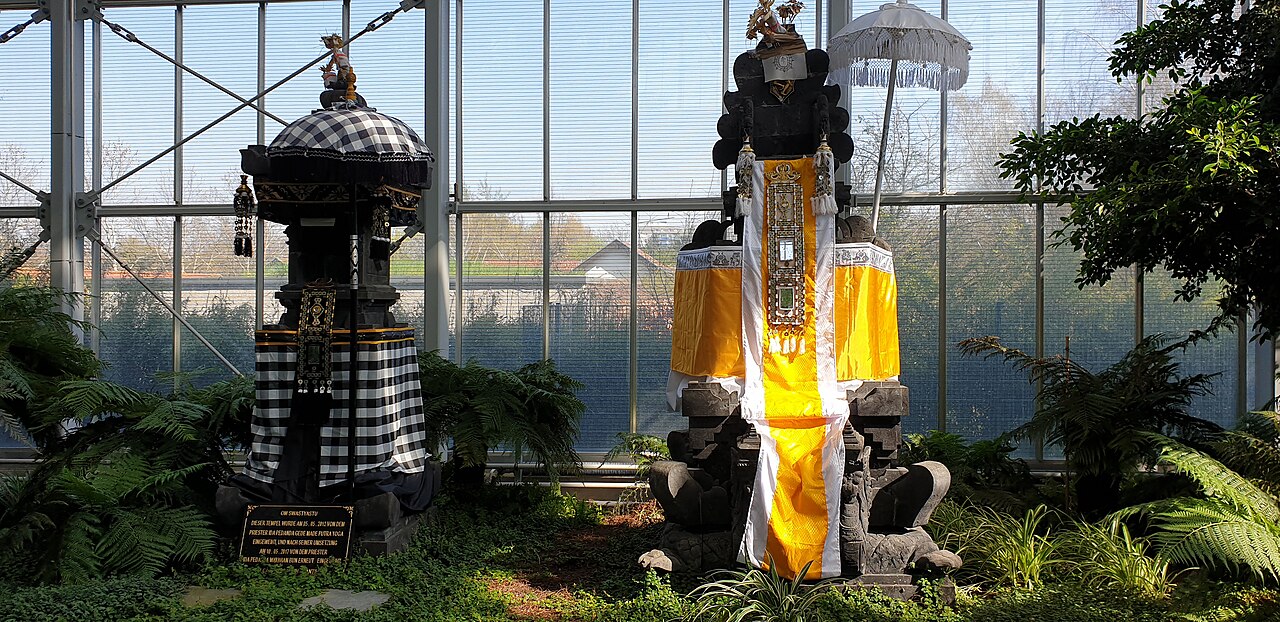
The Balinese garden, known as the "garden of the three harmonies" after the Balinese philosophy of the garden, grew out of the twinning between Berlin and Jakarta. Opened on 18 December 2003, it occupied 500 m² in a lightweight hall: a 1990s greenhouse that had become cramped, with yellowed glazing and ageing building services, heated to 28 °C. The built elements were designed by the Indonesian architect I Putu Edy Semara, largely prefabricated on Bali and assembled in Berlin by Balinese craftsmen. In 2012 two further shrines were consecrated by priests flown in from Bali.
Ahead of the Internationale Gartenausstellung IGA 2017, held from 13 April to 15 October 2017, Grün Berlin commissioned a new hall from Haas Architekten, nearly four times larger than its predecessor. It was built over the old greenhouse, which was then taken down step by step, sparing the collection a costly move into temporary quarters. The park, enlarged to 43 hectares for the show, received 1.6 million visitors that year.
Architecture and engineering
The hall described by Baunetz Wissen is 50 m long and 40 m wide, some 1,800 m², with an average height of 15 m; the park itself quotes a 1,200 m² tropical hall 14 m high, plus a 500 m² family compound, 2,000 m² in all. The steel-and-glass structure rests on a single row of central columns set 20 m apart. It is divided into a warm house, which shelters the garden, and a cold house on the east side holding the main entrance with its draught lobby, an information area, a multipurpose room and service spaces; a reinforced-concrete core there contains toilets, stores and, upstairs, the plant room.
The vertical walls are glazed with white insulating glass; the roof combines the same glass with laminated safety glass using a highly transparent interlayer, giving 84 per cent light transmission and letting through the ultraviolet the plants need. Heating runs through the steel profiles themselves, which carry water at 40 °C from a gas condensing boiler, so that no condensation forms on the inside of the glass; the steel is powder-coated against corrosion. Ventilation is natural, through motorised flaps and without fans; sensors at several heights feed a greenhouse computer that regulates airflow, lighting, temperature and humidity. According to the same dossier, heating demand fell by 92 per cent compared with the old greenhouse. The structure was engineered by the Hilbers office, the building services by CSZ Ingenieurconsult, the landscape by Breimann & Bruun, and the greenhouse was erected by GTW Gewächshaustechnik Werder with glass from Schollglas.
Plant collections
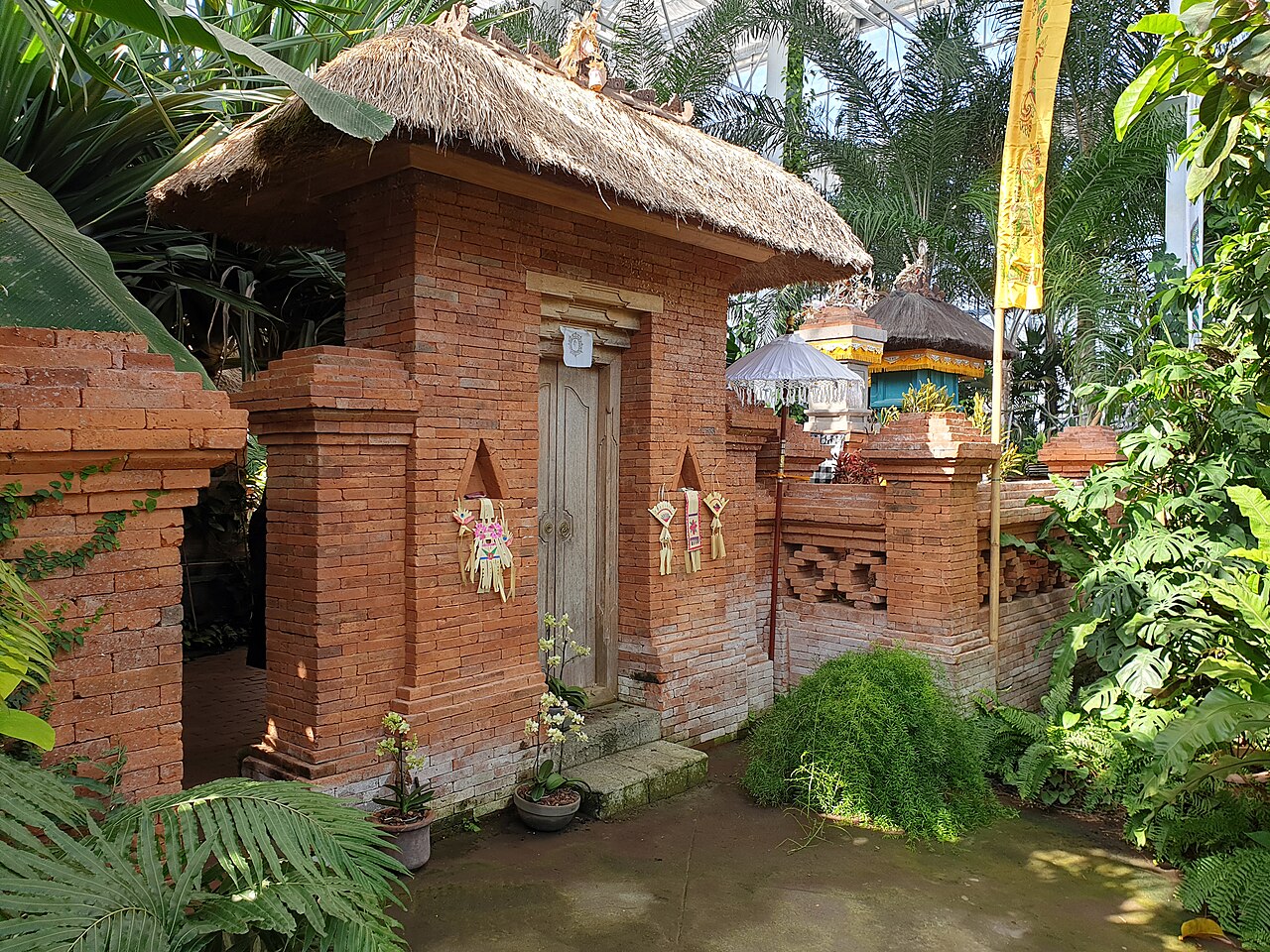
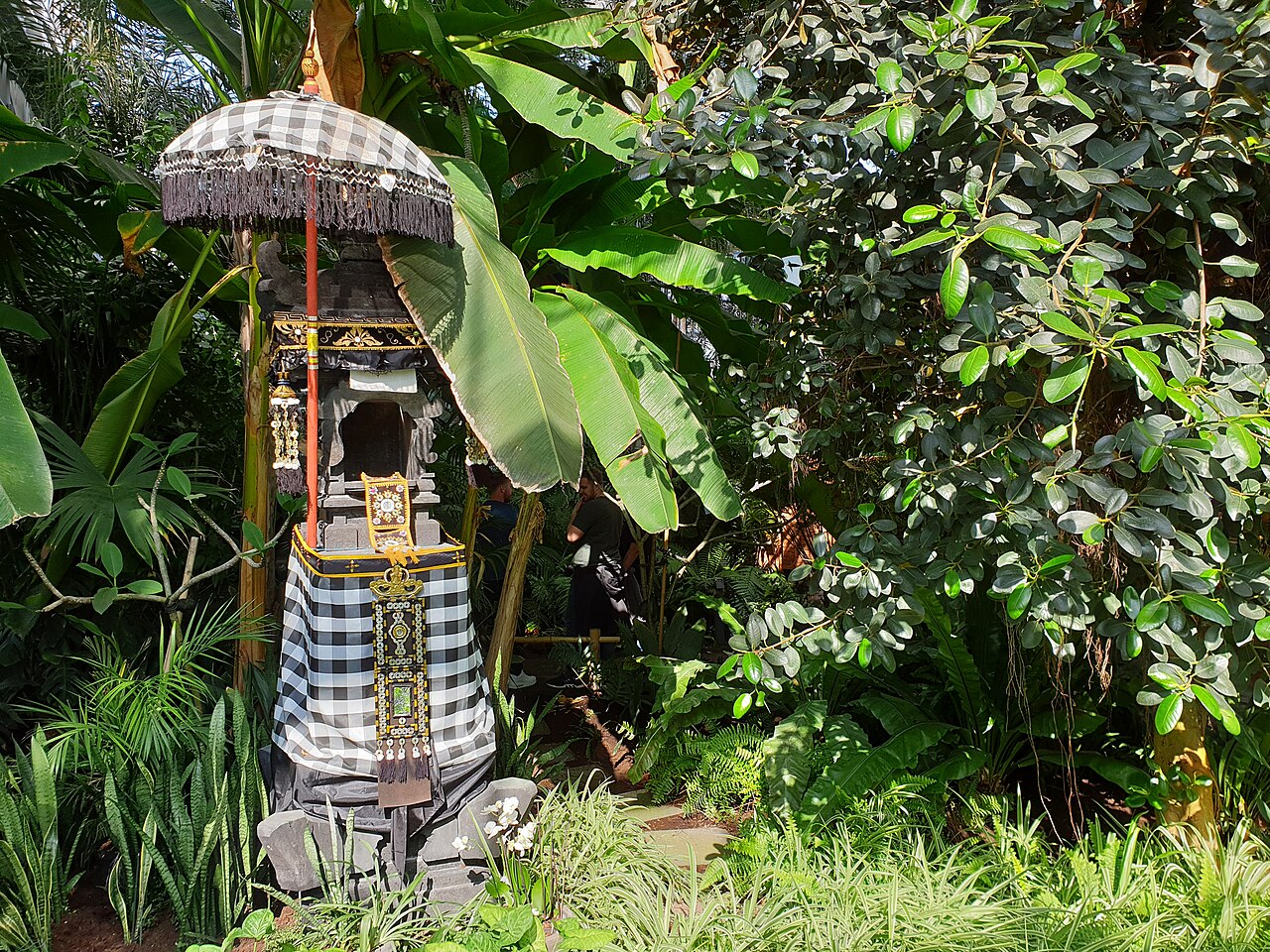
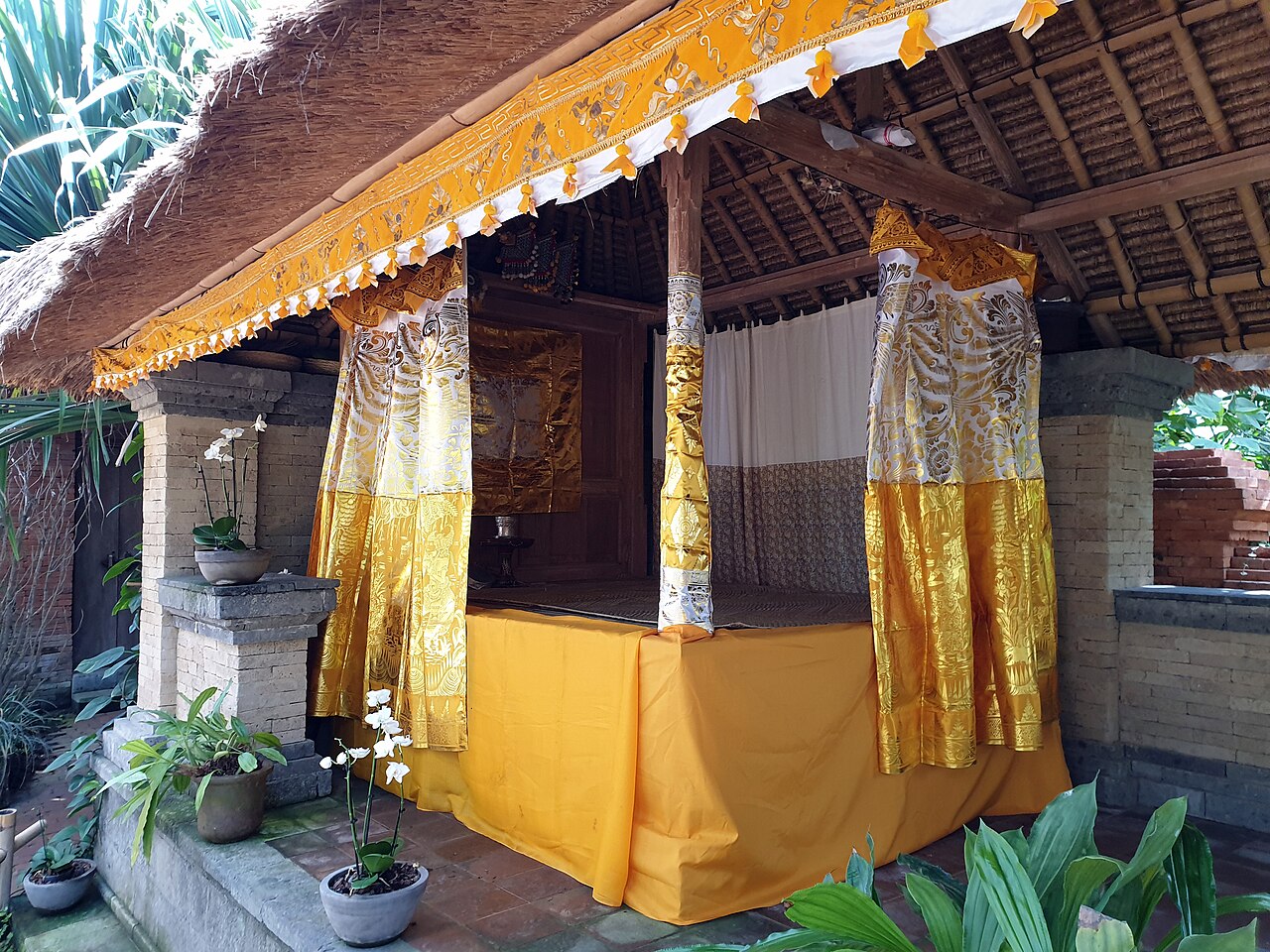
At the centre of the warm house stands a south Balinese family compound enclosed by a wall of clay bricks. It is entered through the angkul-angkul gate, a symbolic triad of base, door and crowned roof; the bale dangin pavilion was used for preparing offerings, sleeping, weaving or playing, and the paved area in front of it stands for the village square. The pura temple, described by the English Wikipedia as one of the few Hindu temples of Balinese architecture built outside Indonesia, is used by Berlin's Balinese community; flowers, fruit and incense are left at the shrines.
Around it, terraced rice paddies lined with palms look down over a dense, rainforest-like planting: pandanus, cordylines and crotons for foliage, bird's-nest ferns, tree ferns and several other fern species, hibiscus, gardenias and a range of orchids for flowers, and a white-flowered frangipani whose scent, the park says, is said to perfume the whole of Bali. The height of the new hall at last lets the trees typical of the island grow to size. The adjoining cold house hosts exhibitions in summer and serves as an orangery in winter.
Visiting
The hall stands in the northern part of the park, a few dozen metres from the north entrance on Eisenacher Straße and at the opposite end from the main entrance on Blumberger Damm. It is the only garden of the Gärten der Welt set entirely under glass, which makes it the natural stop in cold or wet weather; the narrow paths do not admit handcarts, which must be left outside. Allow half an hour for the Balinese courtyard and the jungle path, longer when the orchids and the frangipani are in flower. The visit continues with the park's other themed gardens, the garden cabinets created for IGA 2017 and the 1.5 km cable car, opened in April 2017, which links the site to the Kienberg and the Wuhletal.
52.54° N, 13.58° E
Greenhouses nearby
More greenhouses — Germany
Do you have a good photo of this greenhouse? Suggest it for this page →
Sources (7)
- gaertenderwelt.de/welt-entdecken/themengaerten/balinesischer-garten/
- baunetzwissen.de/gebaeudetechnik/objekte/sonderbauten/tropenhalle-balinesischer-garten-in-
- de.wikipedia.org/wiki/G%C3%A4rten_der_Welt
- en.wikipedia.org/wiki/G%C3%A4rten_der_Welt
- wikidata.org/wiki/Q140129802
- gruen-berlin.de/projekte/parks/gaerten-der-welt
- openstreetmap.org/way/25928414
Affiliate links — booking through Verrière helps fund our research, at no extra cost to you.