Palm Greenhouse of Kopidlno Château (palmový skleník)
Kopidlno, Hradec Králové Region
Entry updated on October 5, 2026
- Year
- 1893-1894
- Architect
- Josef Podhajský
- Style
- Greenhouse with a central pavilion and glazed dome, modelled on the Schönbrunn palm house
- Status
- Interior visits by appointment with the horticultural school; park open all year
Built in 1893-1894 to plans by Josef Podhajský for Count Erwin Schlik, this palm house in the park of Kopidlno Château, in eastern Bohemia, takes its inspiration from the great palm house at Schönbrunn in Vienna. Brick walls rendered in yellow and white frame glazed walls on a metal frame and a central pavilion crowned by a double-glazed dome. Restored in 2003 with improved heating and ventilation, it is now in the care of the horticultural school housed in the château and can be visited by appointment.
Affiliate links — booking through Verrière helps fund our research, at no extra cost to you.
History
1 min
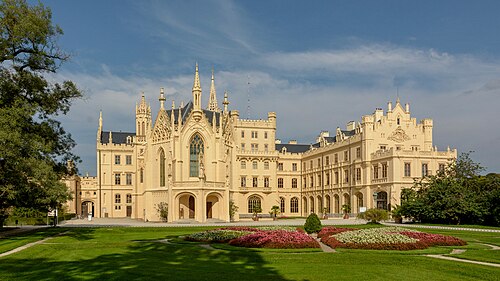
The Kopidlno estate passed in 1638 to the Schlik (Šlik) family, who held it until 1912 and rebuilt the château after the Thirty Years' War. Erwin Schlik (1854-1906), heir from 1862, carried out the last major transformation once he came of age: he added a fourth, neo-Renaissance wing facing the park and had the park reworked after consulting the landscape architect František Thomayer. The palm house, built in 1893-1894 to plans by the architect Josef Podhajský, followed on from this work; it took the great palm house at Schönbrunn as its model. By the end of the century the estate covered more than 8,600 hectares, one of the largest in eastern Bohemia.
Erwin died childless in 1906; after a six-year lawsuit, the Weissenwolff family obtained the estate in 1912. After 1945 the state nationalised the château, which the Ministry of Education assigned to horticultural teaching from 1947: in April 1948 the master school of fruit growing and horticulture, previously based in Chrudim, began classes there. The château and its park have been protected as a cultural monument since 1958.
Damaged by damp and by successive alterations, the greenhouse was reconstructed in 2003 to bring it as close as possible to its original state, with improved heating and ventilation. It remains in the care of the horticultural school, which still occupies the neighbouring château.
Architecture and engineering
1 min
The greenhouse is a free-standing, single-storey building on a roughly rectangular plan marked by a central projecting pavilion. Its masonry parts, in brick rendered yellow and white, include the triangular gables of the short sides, oriented roughly east-west and decorated with shell niches and moulded pilaster strips.
The glazed walls rest on a double-skinned metal frame filled with square panes and pierced by ventilation lights. In cross-section the volume describes a Tudor arch. At the centre rises a double-skinned glass dome topped by a square lantern and a weather vane dated 1894; metal railings and walkways run along the ridge and around the dome. Three entrances, on the north, east and west, lead inside.
The 2003 reconstruction returned the envelope to its original state while modernising the heating and ventilation.
Plant collections
1 min
The interior is divided into three climate zones: a cool section, a moderately warm section and a hot section. Together they hold a range of plants from relatively hardy species to tropical ones. The centrepieces are still the great palms that gave the building its name: the tallest reach about ten metres beneath the dome.
In the care of the horticultural school housed in the château, the greenhouse dominates the neighbouring English-style park, which the mayor of Kopidlno presented on Czech public radio in 2026 as one of the town's assets, with the greenhouse as its dominant feature. The sources consulted do not publish a species list.
Visiting
1 min
Kopidlno lies in eastern Bohemia, on the edge of the Bohemian Paradise (Český ráj). The château park is open all year, but the inside of the greenhouse can only be seen after arranging a visit by telephone with the horticultural school on weekdays, and by prior agreement only at weekends and in July and August. Even from outside, its glazed dome is the focal point of the park. A visit combines well with a walk in the park and a look at the façades of the Schlik château, which is not open for regular tours.
50.33° N, 15.27° E
Greenhouses nearby
More greenhouses — Czech Republic
Do you have a good photo of this greenhouse? Suggest it for this page →