Hana-chō-yūkan Tropical House, Igashira Park (井頭公園 花ちょう遊館)
Moka, Tochigi Prefecture
No freely licensed photo of this greenhouse yet. Do you have one? Suggest it for this page →
Sources checked October 2026
- Style
- Ring-shaped glazed dome on a lattice frame, with an inner courtyard
- Dimensions
- Ring about 72 m by 42 m (OpenStreetMap outline)
- Status
- Open to the public (closed Tuesdays; maintenance closure on 25 and 26 November 2026)
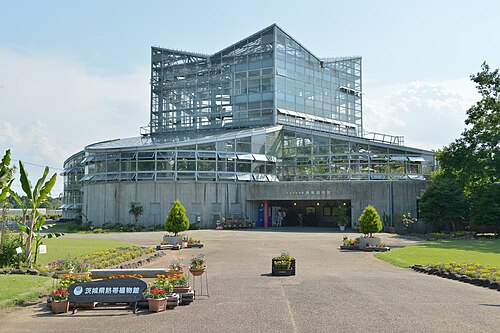
In Igashira Park, in Moka, the Hana-chō-yūkan combines a ring-shaped tropical glasshouse with a small alpine plant house, billed as the only one in the Kantō region. The glasshouse, a doughnut-shaped glazed dome around a courtyard, offers a two-level route through jungle, stream and waterfall, then a savannah zone and a butterfly zone. The official site divides the whole into five zones of plants, birds, reptiles and butterflies, from tropical climates to mountain summits.
Affiliate links — booking through Verrière helps fund our research, at no extra cost to you.
History
The Hana-chō-yūkan (花ちょう遊館) stands in Igashira Park, a 93-hectare prefectural park in Moka run by the Tochigi Prefectural Park Welfare Association and ranked among Japan's one hundred urban parks; its ten-thousand-person pool dates from 1973. The name is a pun: "hana", the flower, stands for alpine and tropical plants, and "chō" for tropical and subtropical birds and butterflies, the official site explains, grouping the tropical house and the alpine house under that name.
A blog about zoos and aquariums suggests, in April 2026, construction about 45 years ago and a reopening after renovation about 30 years ago, itself adding that this is an impression ("it seems"). A greenhouse-loving blogger noted in 2018 that the density of the jungle "tells the story" of the building.
A winter event illustrates the on-site butterfly rearing: a Christmas tree of live chrysalises, already shown in 2018 and again from 3 to 28 December 2025, with a tree of about two metres hung with about 200 chrysalises, including the golden ones of the ōgomadara. The official site also announces a maintenance closure on 25 and 26 November 2026.
Architecture and engineering
The building is a doughnut-shaped dome: a 2018 blogger describes a circular glass dome with the look of a space colony, whose vegetation can be seen from outside, and an inner courtyard framed by a tube-like route. The photographs of that article show a low dome glazed in rectangular panes on a lattice, with foliage visible through the glass. On OpenStreetMap the ring measures about 72 m by 42 m, with an inner courtyard of about 345 m².
The route runs on two levels: a high walkway looks over the jungle, a cave-like staircase descends to a second level along a stream, with bridges and a large waterfall. Plastic chain curtains separate the zones to keep birds and butterflies in, and a small isolated volume holds an aviary and the tortoise and iguana enclosures. The alpine house, at the end of the entrance, is a small glasshouse laid out like a hillside diorama with a stream and a photographic backdrop, where flowering is managed to offer blooms all year; a visitor describes a cool room.
Plant collections
The official site divides the whole into five zones, from the entrance to the alpine house: plants, birds, reptiles and butterflies are shown from the tropics to the summits. In the tropical bird zone a pair of toco toucans flies free, and the jungle holds monsteras in abundance, travellers' palms, umbrella papyrus, bird-of-paradise plants and large staghorn ferns hung high up, according to a 2018 blogger. The savannah zone is drier, with aloes, sisal and hanakirin (crown-of-thorns, a Madagascan native), and parakeets in an aviary; tortoises and iguanas live in a neighbouring enclosure.
The butterfly zone has the ōgomadara as its emblem, one of Japan's largest butterflies, found in Okinawa and other subtropical regions; its golden chrysalis measures about 3 cm and stays so for about two weeks before the butterfly emerges. Chrysalises of other species, including the asagimadara, are also reared. The alpine house, the only one in the Kantō region according to the official site, has shown the Himalayan blue poppy, reported by visitors in 2010 and 2015.
Visiting
The glasshouse appears suddenly in the middle of the park's woods, beyond the ten-thousand-person pool, a 2018 blogger recounts; behind it the park map shows a natural botanical garden, a wetland garden, a rose garden, an iris garden and a fishing pond. The park also has an 8.7 km cycling road.
The official site offers guided tours in April and May and again from October to January, on the second and fourth Sundays; the golden chrysalis exhibition takes place in December. A visitor in March 2026 spent about thirty minutes in the glasshouse and found it very warm on a day of heavy snow in Tokyo and Chiba; the same post suggests pairing it with Utsunomiya Zoo, about forty minutes away by car. The park is reached from the Moka exit of the Kita-Kantō expressway, about ten minutes away.
36.50° N, 139.99° E
Greenhouses nearby
More greenhouses — Japan
Do you have a good photo of this greenhouse? Suggest it for this page →
Sources (8)
- park-tochigi.com/igashira/kacyouyukan
- tochigiji.or.jp/event/e17373
- monstera.jp/monstera/archives/3424
- mrs.living.jp/tochigi/cb1501_suk_going/reporter/6585273
- note.com/zoo_aq_sf_oth/n/n43c1367db6a1
- kankoufan.com/contents/iteminfo.php?iid=1288
- jalan.net/kankou/spt_09209cc3310040472/
- ja.wikipedia.org/wiki/%E4%BA%95%E9%A0%AD%E5%85%AC%E5%9C%92
Affiliate links — booking through Verrière helps fund our research, at no extra cost to you.