Great Greenhouse, Tochigi Hana Center, "Tochihana-chan Dome" (とちぎ花センター 鑑賞大温室)
Tochigi (Iwafune), Tochigi Prefecture
Entry updated on October 5, 2026
- Year
- 1992
- Architect
- Unknown
- Style
- Large single-volume contemporary glasshouse
- Dimensions
- 2,225 m², 22.5 m high (22 m in other sources)
- Status
- Open to the public (free garden, paid entry to the greenhouse)
Built by Tochigi Prefecture and opened in October 1992 at the foot of Mount Mikamo park, the Tochigi Hana Center was meant both to support the local flower industry and to bring people closer to plants. Its great display greenhouse, nicknamed the Tochihana-chan Dome, covers 2,225 m² and rises 22.5 m, placing it among the largest single-building glasshouses in Japan. Some 600 tropical, subtropical and desert species grow around a pool and an artificial waterfall, and six temporary exhibitions are staged inside every year.
Affiliate links — booking through Verrière helps fund our research, at no extra cost to you.
History
1 min
The Tochigi Hana Center ("Tochigi flower centre") was built by Tochigi Prefecture and opened in October 1992. According to the Iwafune chamber of commerce, the project had two aims: to support flower growing and to nurture richer lives through everyday contact with flowers. The site lies at the foot of Mount Mikamo park, in the Iwafune district of Tochigi City.
From the outset the centre was planned as a complete complex rather than a simple pleasure garden. It brings together production facilities for training and plant propagation, the Maronie Flower Hall, exhibition greenhouses, a multipurpose hall and areas selling flowers and plants, and it runs lectures and gardening advice sessions. The great display greenhouse is its centrepiece and emblem.
The building now goes by the nickname Tochihana-chan Dome, a name it shares with the centre's flower shop and café. A Canary palm planted at the opening in 1992 serves as a living record of the years since: a red ribbon tied around its trunk marks the section it has grown in twenty-five years, a simple way of gauging the age of the house.
Architecture and engineering
1 min
The great greenhouse is a single volume of 2,225 m²; the centre and Tochigi City give its height as 22.5 m, while other descriptions round it to 22 m. All of them present it as one of the largest single-building glasshouses in Japan, a ranking that owes everything to the choice of one vast continuous space instead of a sequence of pavilions. The sources consulted name neither the architect nor the builder and do not describe the frame.
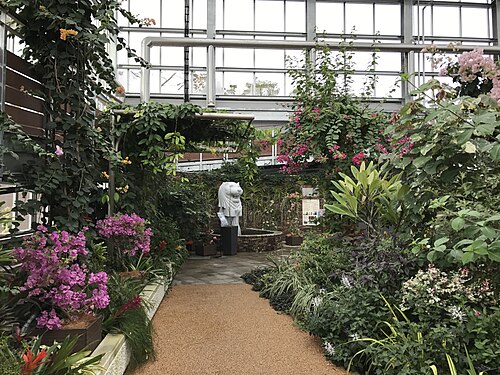
Inside, the house is laid out as a landscape. A tropical and subtropical room, a palm corner and a fern corner share the space; a waterside planting is arranged around an artificial waterfall that drops into a pool, and a path runs behind the curtain of water. Pools set at different levels give the ground some relief, and one section is given over to cacti. The greenhouse also contains two temporary exhibition rooms, the first and second themed display rooms, where the seasonal shows are mounted.
The height under the glass lets palms and large climbers grow freely, as the progress of the palm planted in 1992 shows.
Plant collections
1 min
The centre and Tochigi City quote about 600 species of tropical, subtropical and desert plants; older descriptions gave a figure of about 1,200. The star plant is the hisui-kazura (ヒスイカズラ), a climbing legume native to the Philippine islands whose jade-coloured clusters bloom from mid-March to early May. The centre also highlights the kisōtengai (キソウテンガイ), which it counts among the three rarest plants in the world.
Monsteras are given prominence, as are the cacti of the desert section, and one glasshouse enthusiast noted the snake gourd (ヘビウリ). At an event recorded in 2015, small children weighing under 30 kg could sit on the leaf of a giant water lily.
Six temporary exhibitions a year fill the indoor display rooms, featuring for example blue roses or orchids, and a tropical fruit tasting is held on the second Sunday of each month.
Visiting
1 min
The greenhouse stands at the heart of the Tochigi Hana Center, at the foot of Mount Mikamo park; the gardens are free and only the great greenhouse charges for entry. Half a day is a sensible allowance for the whole centre.
Around the greenhouse, a large bed shaped like a six-petalled flower holds about 30,000 seasonal plants, replanted three times a year, and the rose garden gathers some 600 varieties. The flowering of the hisui-kazura, from mid-March to early May, is the most sought-after moment. A visit extends naturally into the large Mount Mikamo park next door.
36.31° N, 139.63° E
Greenhouses nearby
More greenhouses — Japan
Do you have a good photo of this greenhouse? Suggest it for this page →