Moszna Castle Orangery (Oranżeria zamkowa)
Moszna, Opole Voivodeship

Sources checked October 2026
- Year
- 1896–1900
- Style
- Glazed winter garden attached to the neo-Gothic east wing of an eclectic castle
- Status
- Open to visitors; a part under renovation remains closed (notice of 18 November 2024)
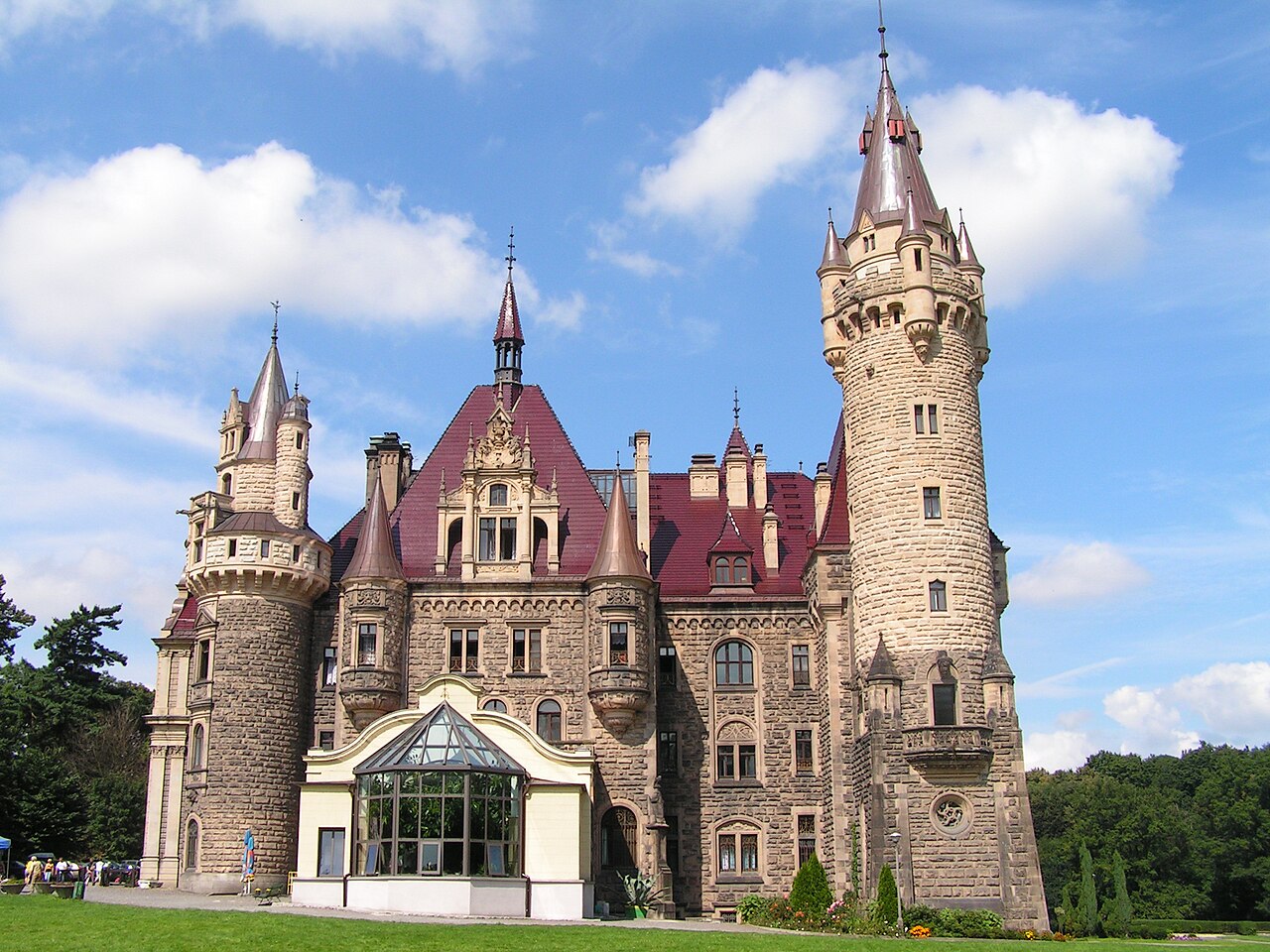
At the foot of the neo-Gothic east wing of Moszna Castle, the oranżeria (also called palmiarnia or winter garden) was built together with that wing, between 1896 and 1900, for the Tiele-Winckler family. Next to the former dining room, it let diners look at plants from another climate. None of the original specimens survives: the winter garden now holds exotic plants, among them a ficus more than seventy years old, and is one of the attractions of the park. A notice of November 2024 states that a part under renovation remains closed.
Affiliate links — booking through Verrière helps fund our research, at no extra cost to you.
History
Moszna Castle owes its present silhouette to the Tiele-Winckler family, Silesian industrial magnates who owned the estate from 1866 to 1945. After the fire of 1896, Franz Hubert von Tiele-Winckler had the Baroque residence rebuilt and enlarged: the central block was restored the same year in its original form, then a neo-Gothic wing was added on the east side, completed around 1900, before the neo-Renaissance wing of 1911-1913 (1912-1914 according to another account). The oranżeria, also called palmiarnia or winter garden, belongs to that first phase: the castle's official audio guide says it arose together with the east wing, between 1896 and 1900, and rejects the idea of a post-war addition, citing old photographs. The German Wikipedia dates it to 1900.
The same guide notes that its neighbourhood with the dining room was no accident: during meals, the family and their guests looked at plants from another climate. After the Tiele-Winckler family left in spring 1945, the castle became the property of the Polish state; it housed a state sanatorium from 1961 to 1972, then a regional prevention and treatment centre until 2013. The orangery was renovated several times after 1945, most recently in 2008 with a modernisation, and no specimen from the owners' time has been kept. Since 2013, the company Moszna Zamek, set up by the voivodeship's Marshal's Office, which owns the palace, has run the site as a visitor attraction. A notice of 18 November 2024 states that the orangery remains open to visitors, but that a part under renovation stays closed until further notice.
Architecture and engineering
The oranżeria leans against the neo-Gothic east wing of the castle, with which it is contemporary: the Polish Wikipedia describes it as built at the turn of the 19th and 20th centuries in the neo-Gothic style, and a 2017 academic article counts it, with the large terrace and the pheasantry, among the elements of the residence's U-shaped plan.
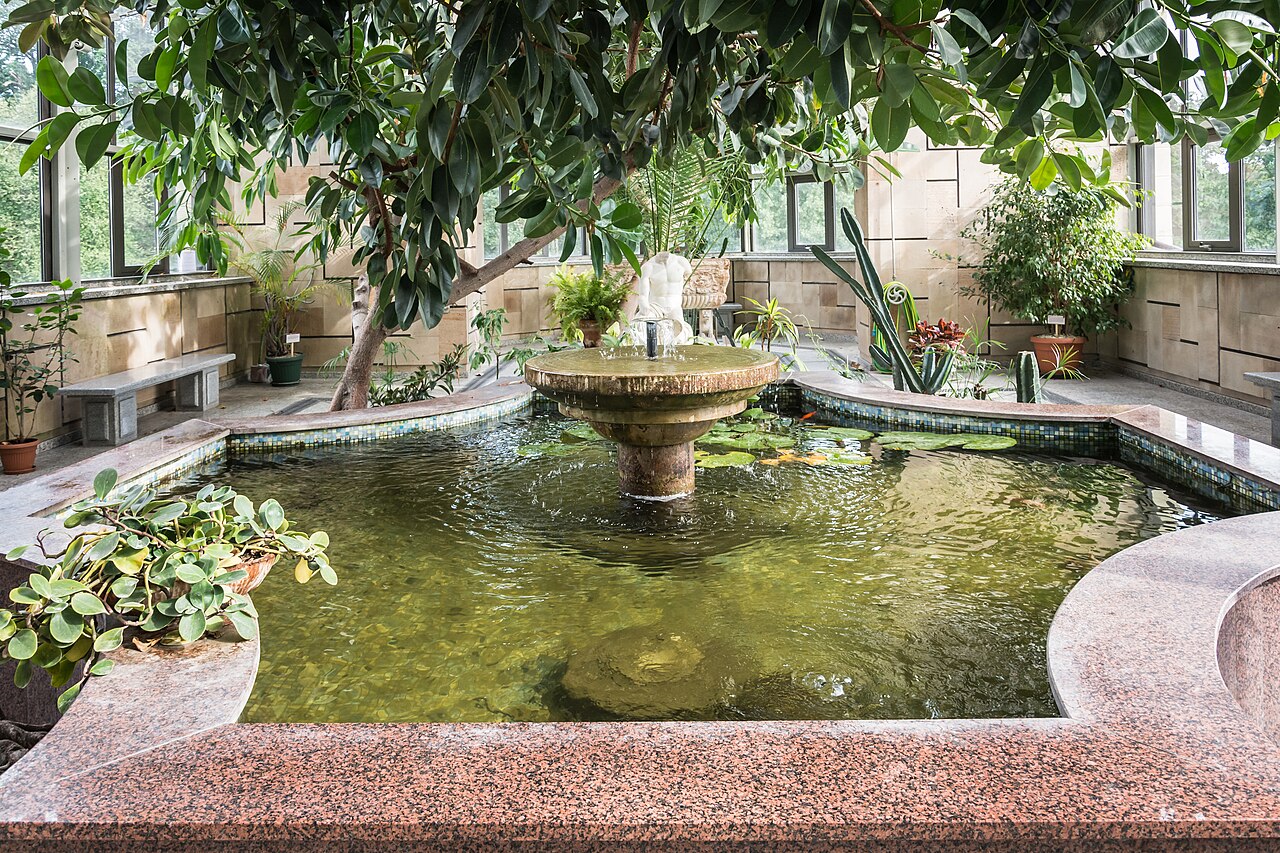
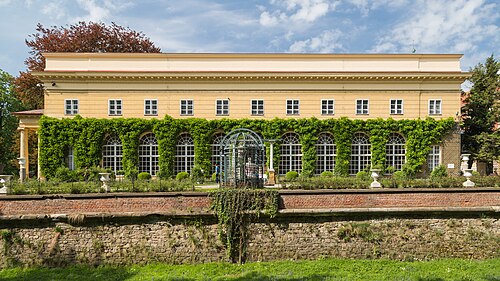
In photographs published on Wikimedia Commons, the winter garden appears as a glazed volume under a glass roof, set against the stone façade; inside, slender frames surround tall windows above pale stone sills, and a pool with a fountain occupies the centre. The official guide mentions two entrances: one from the present restaurant, the former dining room, which is no longer used, and one from outside. It states that, despite the works of 2008, the winter garden kept its original shape and character. Among the old elements is a tall, richly carved planter of Italian marble, which the guide attributes, by estimate, to the 18th century.
Plant collections
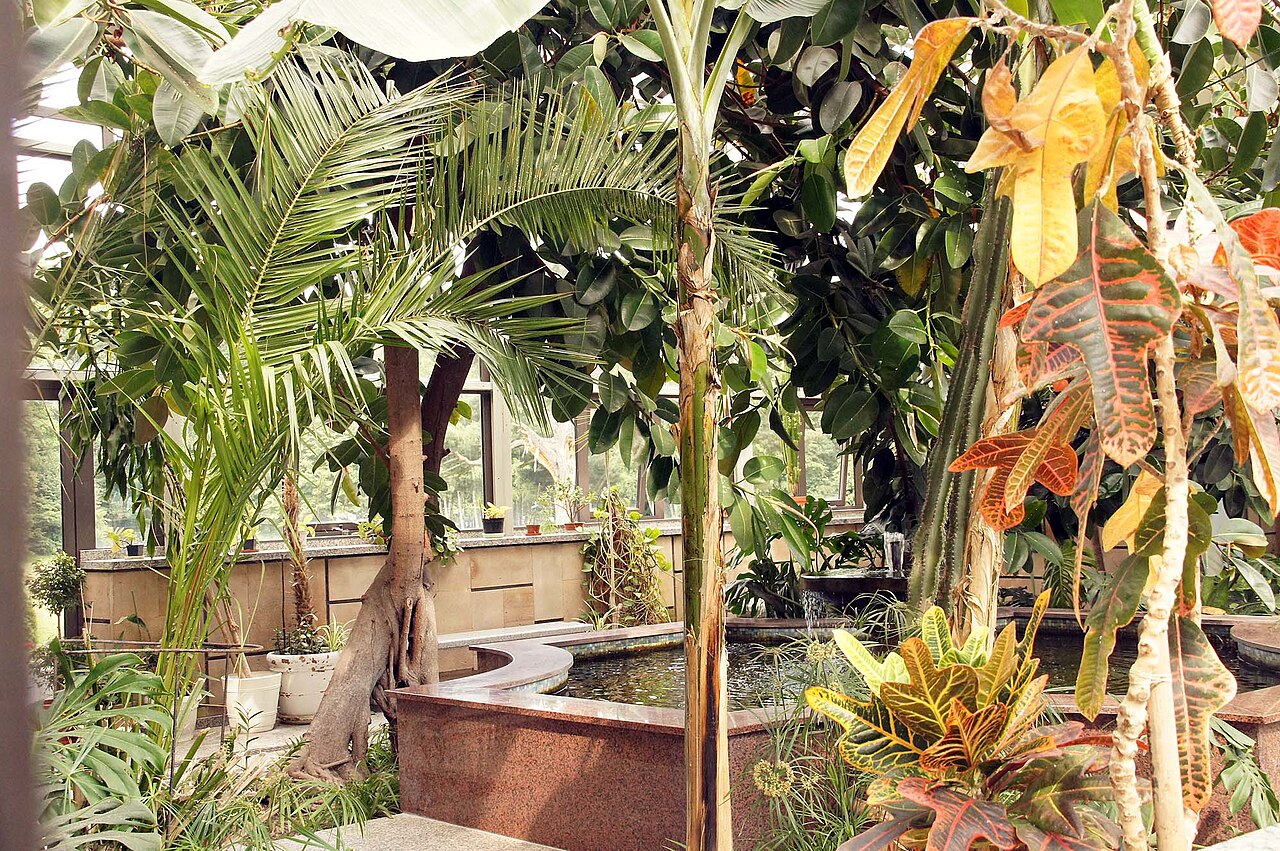
The audio guide recalls that no specimen from the Tiele-Winckler period has survived. Among the plants installed after the war, it singles out a ficus more than seventy years old; the park's official page, for its part, cites an 80-year-old ficus among the orangery's exotic plants. The page describes the orangery as a warm refuge in autumn and, in winter, as an oasis of tropical vegetation, in a park where azaleas and rhododendrons dominate in spring, lindens in summer, oaks in autumn and conifers in winter.
Photographs on Commons show, around the pool, palms, large ficus trees and plants with broad, cut leaves. The most remarkable old element remains the Italian marble planter noted by the guide, dated by estimate to the 18th century.
Visiting
The orangery is presented as part of the park: the official page cites it among the attractions of autumn and winter, and the free SmartGuide audio guide devotes an entry to it. The park is visited independently and requires an entrance ticket for the castle-and-park complex; the page also links to the visit of the castle rooms and the towers. No separate opening hours for the orangery are published, and the part under renovation was still closed according to the notice of November 2024.
The park, described as the largest in Opole Voivodeship, can be visited in any season: azaleas and rhododendrons in spring, a fountain with water-and-light shows until autumn (switched off from about November to April), then the "Ogrody Światła" light trail from 7 November 2026 to 14 February 2027.
50.44° N, 17.77° E
Greenhouses nearby
More greenhouses — Poland
Do you have a good photo of this greenhouse? Suggest it for this page →
Sources (8)
- mosznazamek.pl/zwiedzanie-parku/
- mosznazamek.pl/oranzeria-utrudnienia/
- app.smartguide.app/pl/destinations/29b4bedb-fcab-41f9-bb8f-545ba09dc358/moszna-zamek/place
- mosznazamek.pl/historia-zamku/
- pl.wikipedia.org/wiki/Zamek_w_Mosznej
- de.wikipedia.org/wiki/Schloss_Moschen
- en.wikipedia.org/wiki/Moszna_Castle
- cybra.lodz.pl/Content/15978
Affiliate links — booking through Verrière helps fund our research, at no extra cost to you.