Greenhouses of the Jagiellonian University Botanic Garden (Warszewicz Orangery)
Kraków, Lesser Poland
Entry updated on September 30, 2026
- Year
- 1787–2025
- Architect
- Andreas Milde (1882 palm house, rebuilt as a replica in 2025)
- Style
- Complex of historic and contemporary iron-and-glass greenhouses
- Dimensions
- Warszewicz Orangery: 11.6 m to the ridge (nearly 15 m with the spire); over 2,000 species and varieties under glass
- Status
- Open to the public; the Warszewicz Orangery reopened on 12 May 2025
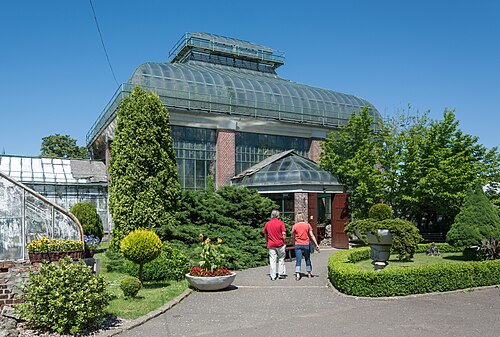
The greenhouses of the Jagiellonian University Botanic Garden were built up in layers from the first glazed structures of 1786-1787. The great iron-and-glass palm house of 1882, the work of the Viennese firm of Andreas Milde, was demolished in 1969 and succeeded by the 'Jubilee' house of 1966. A new pavilion for a Canary Island date palm about 150 years old was completed in 2019. On 12 May 2025 the Warszewicz Orangery, a replica of the nineteenth-century palm house built on its foundations, opened with cycads, orchids and protected ferns.
Affiliate links — booking through Verrière helps fund our research, at no extra cost to you.
History
1 min
The Jagiellonian University Botanic Garden was founded in 1783 and is the oldest in Poland. Its official chronology places the first two glazed structures, a tropical house and a cool house beside the palace, in 1786-1787. A new tropical greenhouse followed in 1826-1827, opposite the older orangeries, and in 1856 a row of orangeries was linked to the eighteenth-century glasshouses.
In 1882 Professor Józef Rostafiński commissioned a large iron-and-glass palm house, designed and built by the Viennese firm of Andreas Milde. By 1906 falling panes of glass had become a hazard; the building was renovated in 1913 and then raised by three to four metres in a reconstruction that the garden's chronology dates to 1925-1926 and other sources to 1928. Judged too deteriorated, it was demolished on 31 March 1969.
Meanwhile a low Dutch-style house, the 'Holenderka', had housed orchids from 1954, and a new complex named 'Jubilee' was built between 1959 and 1966 for the university's 600th anniversary. The Victoria complex was rebuilt in 1993-1998. A new pavilion for the garden's Canary Island date palm was built in 2018-2019 at a cost above 9 million zlotys. Finally, the Warszewicz Orangery opened on 12 May 2025, for about 9.7 million zlotys, of which some 6.6 million came from European funds.
Architecture and engineering
1 min
The 1882 palm house was a glass-and-iron structure of 2,152 cubic metres, according to the garden's chronology. Its 2025 replica matches the original dimensions: 11.6 m from the ground to the ridge and nearly 15 m including the spire. It stands on the foundations of the earlier building and combines a steel frame, façade glazing and a glass mansard roof. The historic entrance was conserved and restored; the building is heated by an air-source heat pump, with district heating serving the utility rooms, and air curtains protect the doors.
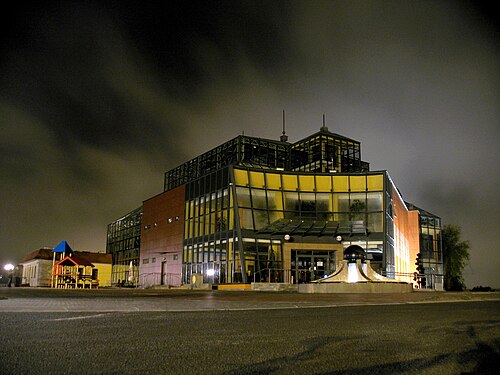
The 'Jubilee' house, opened in 1966, is a tall palm house with attached exhibition greenhouses. The pavilion for the Canary Island date palm, delivered in 2019, rises to 21 metres, seven metres taller than its predecessor. It has automated climate control, highly insulating materials, retractable shading blinds and an educational route designed for visitors with visual impairments.
Plant collections
1 min
The glasshouses hold more than 2,000 species and varieties, within some 5,000 taxa for the garden as a whole. The orchid collection, of about 500 species, is described as the oldest and largest in Poland. It owes much to Józef Warszewicz, an inspector of the garden, who brought back roughly 300 orchid species from Central and South America; the new orangery is named in his honour.
The best-known specimen is a Canary Island date palm (Phoenix canariensis) about 150 years old and 17 metres tall, presented as the oldest kept under glass in Europe. The Warszewicz Orangery shows cycads, araucarias and plants from Central and South America, including Cattleya warscewiczii, together with three protected Polish species: hart's-tongue fern (Asplenium scolopendrium), four-leaf water clover and floating fern, the last two displayed in aquaria for the first time.
Visiting
1 min
The glasshouses stand in the garden on Kopernika Street, a few minutes from Kraków's historic centre. About an hour and a half covers the date-palm pavilion, the Victoria complex and the Warszewicz Orangery, which also houses a café; the outdoor garden, more than two centuries old, rewards a longer stay.
Orchid flowering periods and the warmer months, when the paths are in bloom, suit a visit; the garden also runs educational workshops and horticultural-therapy sessions. The visit combines easily with the Planty park and the old town nearby.
50.06° N, 19.96° E
Greenhouses nearby
More greenhouses — Poland
Do you have a good photo of this greenhouse? Suggest it for this page →
Sources (7)
- ogrod.uj.edu.pl/ogrod/historia/kalendarium
- en.wikipedia.org/wiki/Botanic_Garden_of_the_Jagiellonian_University
- forumakademickie.pl/zycie-akademickie/odbudowana-oranzeria-w-ogrodzie-botanicznym-uj-znow-
- magazyncieplasystemowego.pl/architektura/nowa-oranzeria-w-ogrodzie-botanicznym-uj-z-cenna-
- lovekrakow.pl/aktualnosci/oranzeria-warszewicza-juz-otwarta-nawiazuje-do-obiektu-z-xix-wie
- dzieje.pl/rozmaitosci/w-ogrodzie-botanicznym-uj-nowa-szklarnia-dla-150-letniej-palmy
- dziennikpolski24.pl/w-oranzerii-w-krakowie-zobaczymy-rosliny-z-czasow-dinozaurow-i-wodne-p