Tropenhaus and Subtropenhaus, Oldenburg University Botanical Garden
Oldenburg, Lower Saxony
No freely licensed photo of this greenhouse yet. Do you have one? Suggest it for this page →
Sources checked October 2026
- Year
- 2006 (Tropenhaus); 2019 (Subtropenhaus)
- Style
- Contemporary glass display houses: a humid warm house and a dry house
- Dimensions
- Tropenhaus about 250 m², 8 m high; Subtropenhaus about 150 m²
- Status
- Open to the public all year, free admission
The botanical garden of the Carl von Ossietzky University goes back to 1882, when a teaching garden was laid out for the Oldenburg teacher-training college; it now covers 3.7 hectares along the Philosophenweg. Its two display houses are recent: the Tropenhaus, a glass building of 250 m² and 8 m in height opened to the public on 11 June 2006 and kept at 24 °C around a two-metre waterfall and a tropical pool, and the Subtropenhaus, some 150 m² inaugurated on 26 June 2019 for cacti, euphorbias and agaves, with small experimental stations on how plants store water. Admission is free and both houses are open all year round.
Affiliate links — booking through Verrière helps fund our research, at no extra cost to you.
History
The garden's history begins in 1882, when a teaching garden was laid out for the Lehrerseminar, Oldenburg's teacher-training college. In 1913 the drawing teacher Wilhelm Meyer took charge of an additional school garden of 14 ares; in 1916 a systematic section of 1,200 species from Oldenburg and East Frisia, arranged by family, was planted there, followed in 1932 by four plant-geography sections. The state of Oldenburg took over the garden in 1933 and Lower Saxony in 1950, the year it was enlarged to its present 3.71 hectares. The years 1966 to 1968 brought a redesign of the plant-community section (heath, bog, dunes, woodland) and the creation of the medicinal garden. In 1976 the garden was integrated into the University of Oldenburg, becoming in 1985 a scientific institution attached to biology, with a growing site at Küpkersweg that is closed to the public.
The present glasshouses date from the university era: a succulent house remodelled in 1999, a new overwintering house in 2000, then the Tropenhaus, built in under a year, fitted out and planted over the winter and opened to the public on Sunday 11 June 2006. Its funding, started by an anonymous private donation, drew 80,000 euros in sponsorship gathered by the friends' association Ilex from regional companies, the university paying the rest of the cost of the glass building. The Subtropenhaus, under construction in 2018 according to the garden's chronology, was inaugurated on 26 June 2019 in the presence of Oldenburg's mayor; it cost some 330,000 euros, funded by the university, its faculty of mathematics and natural sciences, the institute of biology and environmental sciences, the garden and the Ilex friends' circle, with plants donated by the Oldenburger Kakteenfreunde. In 2024 work began on a "Klimahuus" and on new greenhouses at Küpkersweg.
Architecture and engineering
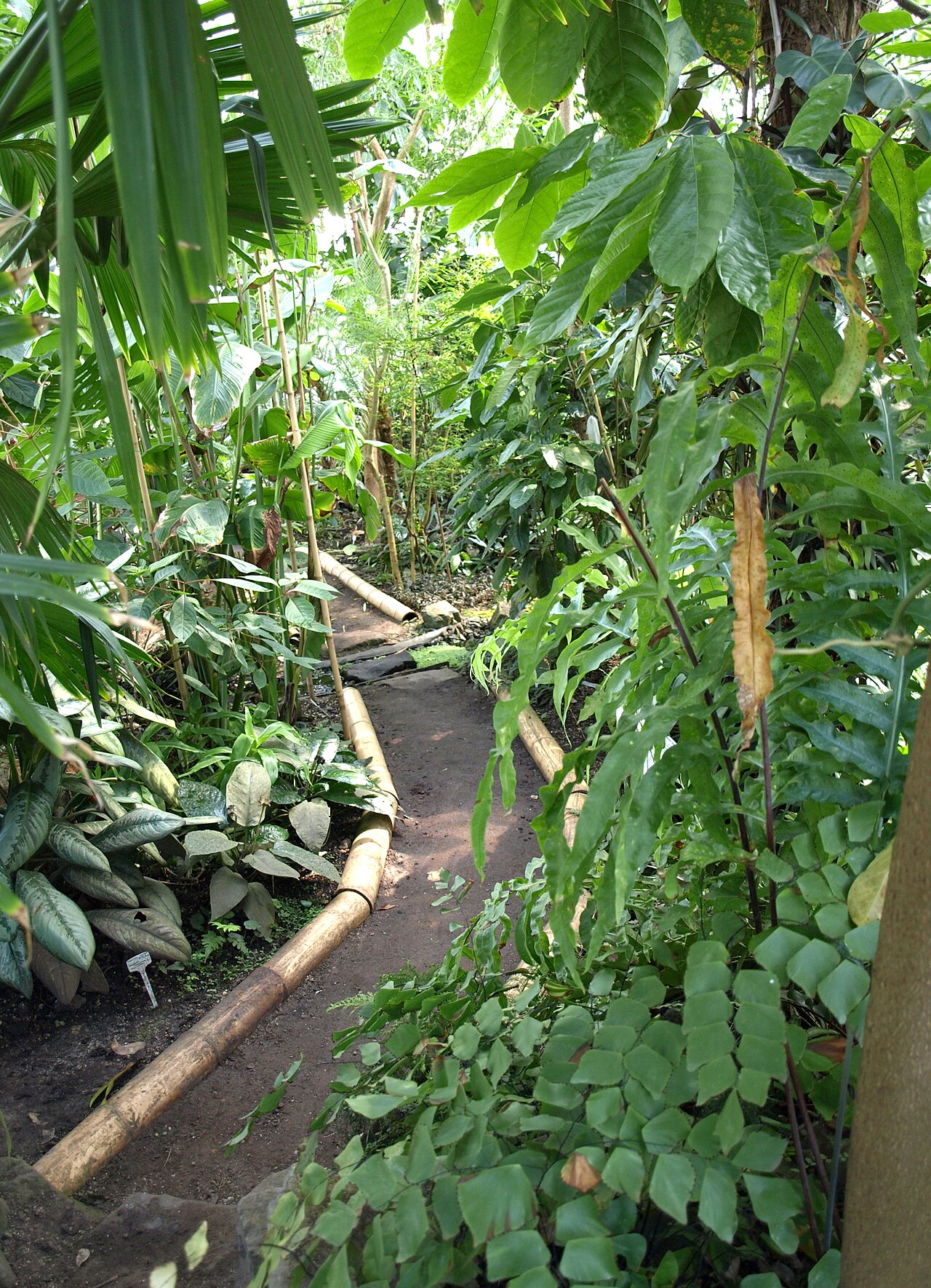
Both houses are small display glasshouses on the scale of a university garden. The opening press release of June 2006 describes the Tropenhaus as a glass building of 250 m² and 8 m in height, completed in under a year and then fitted out and planted over the following winter. The interior is held at 24 °C in an atmosphere the garden describes as always hot and very humid; a two-metre waterfall feeds a 25 m² tropical pool, and vegetation covers the ground, the walls and the tree trunks, where epiphytes take hold.
The Subtropenhaus, about 150 m² according to the 2019 press release, plays the opposite role: a dry house devoted to plants that can cope with a shortage of water, its central theme being how they save and store it. Its beds are arranged by adaptation strategy: globular cacti, plants with special ways of taking up water, rosettes of thick leaves. Small experimental stations illustrate these phenomena, and the garden's Grüne Schule has a workspace there for pupils' experiments. On OpenStreetMap the building is mapped as a greenhouse with a gabled roof about six metres high. A third glazed building, the Botanikum, is not a display house: the garden lets it out in summer for weddings and birthdays.
Plant collections
The Tropenhaus shows plants of the rainforest: orchids and ferns growing on the trees, carnivorous plants, epiphytes and water lilies, including the giant water lily the garden singles out. Tropical crops are a particular theme, with coffee, cacao, pepper and vanilla, and poison dart frogs, whose calls never stop, bring the house to life.
The Subtropenhaus gathers cacti and other plants of the dry regions close to the tropics, euphorbias and agaves, some of them donated by the Oldenburger Kakteenfreunde. Its rarest piece is Oldenburgia grandis, a South African shrub that the inauguration press release says can be seen in no other botanical garden outside its home region. A tarantula, bearded dragons and ruin lizards live there too, and visitors may prod a euphorbia or sit, almost, on one of the large cacti. According to the German Wikipedia, the succulent collection numbers some 300 plants. Outside, the garden lines up the flora of north-west Germany (more than 1,000 species), the medicinal garden, an alpinum, a Mediterranean and Caucasus section, bog and heath, aviaries and a free-roaming peacock.
Visiting
The garden lies on a geest ridge in the Haarenesch district, reached from the Philosophenweg and the Schützenweg, bounded to the south by the Leer railway line and to the west by the A28 motorway; both glasshouses stand in the public part, away from the Küpkersweg growing site, which is closed to visitors. Admission is free and both houses are open all year, which makes them a winter outing when the beds are dormant. An hour is enough for the two houses and a circuit of the garden; lovers of orchids and carnivorous plants will linger in the Tropenhaus, families in the Subtropenhaus with its hands-on stations. The garden offers paid guided tours, a smartphone audio guide and a yearly programme of events; the tower of the Alte Fleiwa, a former meat factory, closes the view to the north.
53.15° N, 8.20° E
Greenhouses nearby
More greenhouses — Germany
Do you have a good photo of this greenhouse? Suggest it for this page →
Sources (8)
- uol.de/botgarten/geschichte
- uol.de/pressemitteilungen/2006/197
- uol.de/pressemitteilungen/2019/225
- uol.de/ibu/botgarten/standort-philosophenweg/tropenhaus
- uol.de/ibu/botgarten/standort-philosophenweg/subtropenhaus
- uol.de/botgarten/oeffnungszeiten
- de.wikipedia.org/wiki/Botanischer_Garten_Oldenburg
- wikidata.org/wiki/Q4948470
Affiliate links — booking through Verrière helps fund our research, at no extra cost to you.