Crystal Palace of Petrópolis
Petrópolis

Sources checked September 2026
- Year
- 1884
- Style
- Victorian iron-and-glass engineering
- Status
- Open to the public
Built in 1884, this iron-and-glass pavilion was ordered from the Société Anonyme de Saint-Sauveur workshops in France by the Count of Eu, son-in-law of Emperor Pedro II, as a gift for Princess Isabel. Modelled on the crystal palaces of London and Porto, it first served as a venue for horticultural and agricultural shows. Threatened with demolition in the 1960s to make way for a sports complex, it was saved by local historians and listed as a historic monument in 1967. Covered over with sheet metal in 1938, it regained its glazed roof in a 1984 restoration. It now hosts exhibitions and cultural events, including the Bauernfest festival.
Affiliate links — booking through Verrière helps fund our research, at no extra cost to you.
History
The Crystal Palace owes its existence to the Count of Eu, husband of Princess Isabel, daughter of Emperor Pedro II. He ordered it from the workshops of the Société Anonyme de Saint-Sauveur in Arras, France, to give Petrópolis's agricultural shows a permanent, naturally lit pavilion in place of the temporary structure that had hosted the town's first horticultural exhibition. It was also intended as a gift to the princess, who was to grow her plants there. The building opened in 1884, but the agricultural shows did not last: the last is dated to 1886.
In 1938 the glazing was hidden behind sheet metal and brick so that the building could house the Petrópolis Historical Museum, whose collections later passed to the Imperial Museum. In the early 1960s Mayor Nelson de Sá Earp proposed demolishing it for a sports complex. Historians led by Guilherme Auler opposed the plan: the palace and its square received provisional protection on 1 September 1960 and permanent listing by IPHAN, the national heritage institute, in 1967.
In the 1970s the sports court was removed and the gardens replanned; for the centenary in 1984 the original walls were reinstated. In 2018 the site was registered as a museum by the Brazilian Institute of Museums. Excavations between May and September 2021 uncovered thousands of nineteenth-century objects, including English ceramics, German and Belgian stoneware, glass and porcelain.
Architecture and engineering
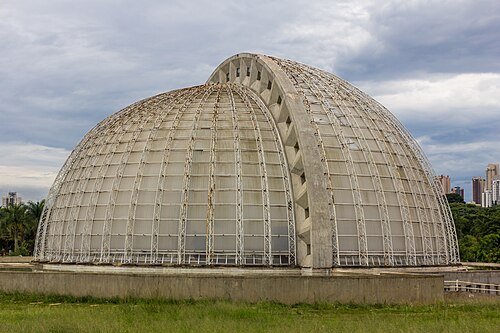
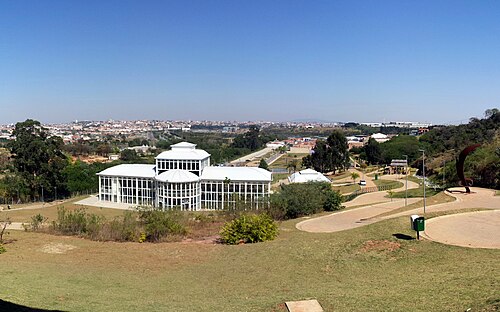
The palace is a prefabricated iron-and-glass structure shipped from Arras and assembled in Petrópolis. Its designers drew on London's Crystal Palace and on Porto's Palácio de Cristal, and the building marries Victorian taste with the construction methods of the Industrial Revolution. It is often described as the first prefabricated iron-and-glass structure in Brazil.
Its transparency was long lost: from 1938 until the restorations of the 1970s and 1984, sheet metal and brick turned the pavilion into a closed hall. The 1967 listing covers both the building and the square around it, recognising the pavilion and its garden as a single ensemble.
Plant collections
The Crystal Palace no longer holds a plant collection. Built to display local horticultural and farm produce under glass, it now serves as a venue for exhibitions and events, most notably the annual Bauernfest, which celebrates the heritage of the German settlers of Petrópolis.
The finds from the 2021 excavations, ceramics, glass and porcelain imported from Europe, bear witness to the prosperity of the area and the site's standing under the Empire.
Visiting
The pavilion stands in the centre of Petrópolis, the former summer retreat of the imperial family in the mountains above Rio. A visit is short, but the replanned gardens and the structure itself reward a walk around the outside to study the ironwork.
It pairs naturally with the Imperial Museum, which received the collections once displayed in the palace. Temporary exhibitions and the Bauernfest bring the building to life at particular times of year.
22.51° S, 43.18° W
Greenhouses nearby
More greenhouses — Brazil
Do you have a good photo of this greenhouse? Suggest it for this page →
Affiliate links — booking through Verrière helps fund our research, at no extra cost to you.