Peter Black Conservatory (Victoria Esplanade)
Palmerston North, Manawatū-Whanganui
Entry updated on October 5, 2026
- Year
- 1951
- Architect
- Unknown
- Style
- Mid-20th-century municipal glasshouse, refurbished several times
- Status
- Open to the public
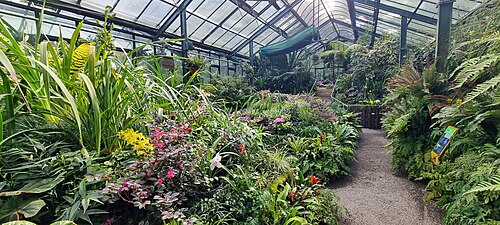
In the Victoria Esplanade, the large Palmerston North park laid out from 1897, this conservatory is named after Peter Black, the city's curator of reserves from 1908 to 1946. According to local historians it went up in 1951, a year after Black's death, in front of the begonia house opened in 1941 for the national centenary; the city council, however, dates it to 1941. Refurbished several times, with a new entrance, a new roof and a major overhaul in 2013 or 2014, it shows tropical and subtropical plants from Africa, the Americas and Oceania, with orchids as the largest single collection.
Affiliate links — booking through Verrière helps fund our research, at no extra cost to you.
History
1 min
The Victoria Esplanade was developed from 1897 to commemorate Queen Victoria's Diamond Jubilee, on land granted to the borough some twenty years earlier. In 1908 Peter Black, aged 35, became curator of reserves. Trained in horticulture at Edinburgh University under Isaac Bayley Balfour, and, according to a history of New Zealand orchid growers, at Castle Howard and Sandringham, he had worked in India, in the Australian sugarcane industry, on a rubber plantation in Samoa and in nurseries around Wellington. For some 35 years, until 1946, he reshaped the Esplanade, The Square and the city's streets.
In early 1939 Black and a committee decided to build a begonia hothouse, a winter garden, for the New Zealand centenary, the government having promised a subsidy to towns that created a memorial. The war held things up: the hothouse opened in 1941 near the children's paddling pool, together with workshops, a propagation glasshouse and a lathe house. A Manawatū historian, writing on the Horticultural Society that had backed the project, gives 1942 for its completion.
Black retired to Levin and died in 1950. A year later a large new conservatory named in his honour hid the begonia house from view. The building has since received a new entrance and a new roof; its major refurbishment took place in 2013 according to an orchid history, in 2014 according to the city council, which dates its original construction to 1941. In March 2017 the original begonia house and the worksheds behind it were cleared to make way for Wildbase Recovery, a rehabilitation centre for native birds.
Architecture and engineering
1 min
The sources consulted say little about the structure itself; neither its dimensions nor its designer are published. The 1951 conservatory was built in front of the 1941 begonia house, which it removed from public view. At the back, a private door led into a yard where that older glasshouse, workshops and storage sheds stood until March 2017.
Of the 1941 complex, the propagating glasshouse survives, built at the same time as the begonia house and separated from it by a shed; in 2017 the conservatory gardener said it would probably be kept for propagation. The conservatory has been refurbished several times, with a new entrance, re-roofing and then a major overhaul of the main glasshouse in 2013 or 2014. Inside are goldfish ponds in a tropical and subtropical atmosphere. OpenStreetMap maps it as a single-storey greenhouse building. Close by, a lathe house shelters cool-climate exotics and native plants.
Plant collections
1 min
According to the city council, the conservatory brings together tropical plants from Africa, the Americas and Oceania, among them vanilla and carnivorous pitcher plants, with interpretive signs. The New Zealand Gardens Trust adds that orchids form its largest single collection.
In 2017 the conservatory gardener, an Esplanade employee for thirty years, recalled first tending begonias and cyclamen before moving on to more exotic plants: cacao, coffee, bananas, sugarcane and orchids, his favourites. That taste echoes Peter Black's own: he imported orchids from his brother's nursery, Black and Flory, and was the first in New Zealand to propagate Camellia reticulata. A trail invites children to find the frogs hidden in the glasshouse.
Visiting
1 min
The conservatory stands in Victoria Esplanade, a 26-hectare park beside the Manawatū River, in the same corner as the Wildbase Recovery aviaries, where native birds can be seen being cared for. Entry to the gardens is free all year, and dogs are not allowed in the glasshouse. The park also offers the Dugald MacKenzie Rose Garden, opened in 1968 with more than 5,000 roses, over a thousand camellias recognised in 2025 as an International Camellia Garden of Excellence, a fernery, native bush and the Esplanade Scenic Railway, 2.2 km long.
40.37° S, 175.62° E
Greenhouses nearby
More greenhouses — New Zealand
Do you have a good photo of this greenhouse? Suggest it for this page →
Sources (6)
- pncc.govt.nz/Parks-recreation/Parks-and-reserves/Victoria-Esplanade
- stuff.co.nz/manawatu-standard/lifestyle/90464865/new-beginnings-for-victoria-esplanade
- stuff.co.nz/manawatu-standard/news/300543908/back-issues-100-years-of-the-palmerston-north
- taurangaorchids.wordpress.com/2025/05/17/peter-black-senior/
- gardens.org.nz/visit/victoria-esplanade-gardens
- manawatunz.co.nz/stories/explore-victoria-esplanade/