Pukekura Park Fernery and Display Houses
Pukekura Park, New Plymouth, Taranaki

Sources checked September 2026
- Year
- 1928
- Architect
- Mrs Lovell of Hawera (design); construction led by W. Holmes
- Style
- Semi-sunken grottoes under glass roofs
- Dimensions
- Three glass-roofed grottoes of about 60 × 40 ft (18 × 12 m) as built
- Status
- Open to the public; free guided tours
First proposed in 1918 to protect Pukekura Park's native ferns, this fernery was designed by Mrs Lovell of Hawera, modelled on the one in her own garden. Dug by hand from June 1926 and covered with glass roofs, three grottoes linked by tunnels opened on 28 January 1928 at a cost of about £1,150, all raised by public subscription. Extended with a begonia house and then the 1967 Kibby House, and rebuilt in stages in 1998, 2001 and 2013, the complex now stages seasonal displays drawn from some 50,000 plants.
Affiliate links — booking through Verrière helps fund our research, at no extra cost to you.
History
Pukekura Park opened on 29 May 1876 as a 15-hectare recreation ground and took its present name in 1907. A first outdoor fernery was laid out in 1908 by curator W. W. Smith on Manhattan Island, at the southern end of the main lake. Because ferns were often stolen there, park board member C. E. Bellringer urged in 1918 that the park build a fernery second to none in the country. Progress was slow: in 1924 William Besley set out a plan for three excavated chambers under glass roofs, and the board thanked Mrs Lovell of Hawera, who had a similar fernery in her own garden and is credited with the design. Lack of money put everything on hold in 1925.
Work finally began in June 1926 under W. Holmes of Putaruru, with Thomas Horton as overall supervisor. Six labourers dug out some 4,000 cubic yards of subsoil by spade, using it to fill a nearby swamp, now the Fred Parker Lawn, and to form a small lake. A delay in the delivery of glass meant the roofs were not finished until mid-1927. Mayor H. V. S. Griffiths opened the fernery on 28 January 1928; it had cost about £1,150, every penny raised by public subscription.
A begonia house, built in 1938 (1939 according to the district council) from materials salvaged from a Brooklands estate glasshouse, was added next. Entry became free in the mid-1960s, and in 1967 the Kibby House, given by Mr and Mrs George Kibby, replaced the begonia house. The roofs of houses 2 and 3 were rebuilt and merged in 1998, the Kibby House was rebuilt and enlarged in 2001, and the final stage of the redevelopment was completed in 2013.
Architecture and engineering
The idea behind the fernery is its setting: three caverns cut into the hillside and capped with glass roofs. Lying below natural ground level, they keep a moderate, temperate climate suited to displaying both indoor and outdoor plants. Before the chambers were dug, about 12 feet of earth was removed to form a plateau of roughly 180 by 90 feet above them.
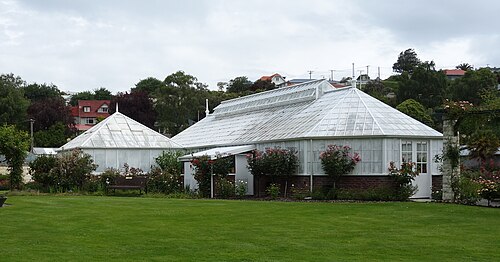
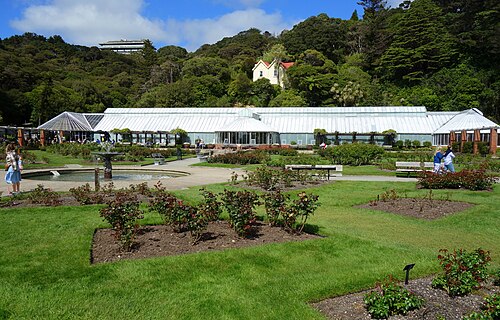
The 1924 plan called for a front chamber of 30 by 50 feet and two rear chambers of 60 by 30 feet, separated by earth walls 8 feet (2.4 m) thick to carry the glass roofs, with terraced sides covered in ferns. According to the park's history, the fernery as built consisted of three 60 by 40 ft grottoes linked by tunnels: the front chamber runs east-west, while the other two sit side by side, run north-south and lie 10 feet higher up the slope. Concrete foundations, carpentry and glazing completed the work.
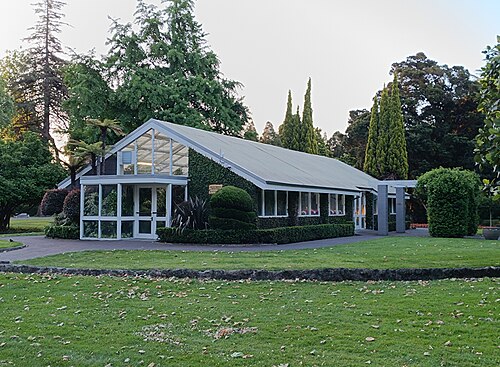
Later rebuilds have changed the volumes. Since 1998, houses 2 and 3 and the space between them have formed a single, taller structure, extended to the north by an annex and a viewing platform. The Kibby House, whose steel frame had begun to fail, was rebuilt in 2001, and in 2013 House 1 received a new roof of tinted glass, along with new boilers and automated venting.
Plant collections
The fernery was created for native flora, gathered from forests in Taranaki, the King Country, Rotorua, the Bay of Plenty and Auckland. The first planting in July 1927 comprised over 1,000 native ferns according to the district council, many donated by the Duncan and Davies nursery.
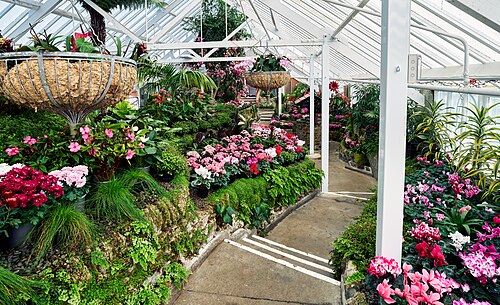
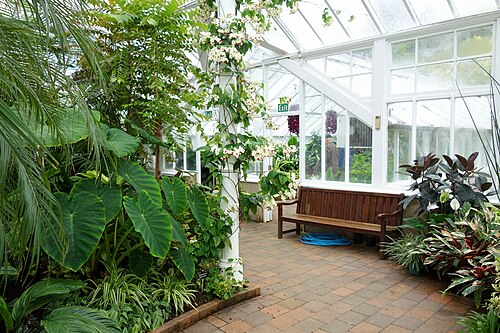
Glasshouses moved from Brooklands later brought the park's first orchids, Paphiopedilum insigne, along with tuberous begonias from Newton King's collections. From 1965, nurseryman Fred Parker gave his cymbidiums and then most of his extensive orchid collection; at its height, the park's orchid collection was one of the largest municipal collections in the country. The district council now cites some 50,000 plants, including native ferns, orchids, begonias, fuchsias, bromeliads, carnivorous plants, vireya rhododendrons and streptocarpus. Apart from House 1, every plant on display is grown in a pot and watered by hand, and the displays change with the seasons.
Visiting
The fernery lies within Pukekura Park, a 52-hectare Garden of National Significance in the heart of New Plymouth, near the Rogan Street and Fillis Street entrances; signs point the way from the Tea House on the Lake. There are two entrances: Horton Walk, which leads to the upper mezzanine with wheelchair access, and the Fred Parker Lawn. Free guided tours are offered every day.
Each season has its highlights: cymbidiums, azaleas and bulbs in spring, tuberous begonias, fuchsias and hibiscus in summer, orchids and bromeliads in autumn, cyclamen and hellebores in winter. From mid-December to late January the TSB Festival of Lights illuminates the park; the glasshouses, first lit up for the summer festival in December 1953, remain one of its most popular features.
39.06° S, 174.08° E
Greenhouses nearby
More greenhouses — New Zealand
Do you have a good photo of this greenhouse? Suggest it for this page →
Sources (6)
- npdc.govt.nz/leisure-and-culture/pukekura-park/fernery-and-display-houses/
- npdc.govt.nz/leisure-and-culture/pukekura-park/fernery-and-display-houses/history/
- npdc.govt.nz/leisure-and-culture/pukekura-park/fernery-and-display-houses/our-displays-and
- pukekura-history.co.nz/the-fernery-pukekura-park/
- en.wikipedia.org/wiki/Pukekura_Park
- wikidata.org/wiki/Q141293981
Affiliate links — booking through Verrière helps fund our research, at no extra cost to you.