Cal Poly Plant Conservatory
San Luis Obispo, California
No freely licensed photo of this greenhouse yet. Do you have one? Suggest it for this page →
Sources checked October 2026
- Year
- 2023
- Architect
- Stantec (architect); Gilbane (design-build contractor)
- Style
- Contemporary teaching greenhouses: three climate houses under glass, with a living wall on the façade
- Dimensions
- ≈ 230 m² (2,500 sq ft) under glass, in a facility announced at 5,000 sq ft
- Status
- Open to the public on weekdays, self-guided (per a 2023 source updated in 2025); hours to be reconfirmed with the university
Just north of the centre of the California Polytechnic State University campus in San Luis Obispo, the Plant Conservatory opened in April 2023 to replace the small greenhouse demolished in 2019. It has five greenhouses: three are open to the public and recreate the warm tropics, a cloud forest and a desert, while the other two serve propagation and research. The whole covers about 230 m² under glass, with laboratories and offices, and announces itself from the street with a living wall. Visits are self-guided on weekdays.
Affiliate links — booking through Verrière helps fund our research, at no extra cost to you.
History
The university's first Plant Conservatory stood in the middle of the campus: five climate-controlled greenhouses and more than 2,300 plants before its demolition, according to the student newspaper Mustang News (October 2019). It was torn down in summer 2019 to make room for the science and agriculture complex, now the William and Linda Frost Center for Research and Innovation; the collection, cut to about 1,500 plants, moved to a temporary soil-science greenhouse near the arboretum. The conservatory's director explained at the time that the old building had serious problems keeping temperature and humidity under control, and that the new one would be taller so that trees could be grown.
According to Cal Poly Magazine, the new conservatory was funded through the construction of the Frost Center. The university's facilities page names Stantec as architect, a design-build delivery by Gilbane, a budget of 4.9 million dollars and construction from March to July 2021; the opening press release speaks of 5 million dollars and of "more than two years" of planning and construction, and New Times of a groundbreaking in 2020. The exterior living wall was designed and installed by Habitat Horticulture, a company founded by an alumnus. The official opening dates from April 2023; the university then reported more than 1,000 students served in its first academic year. In June 2025 the local press announced an expected titan arum bloom, presented as the first at the conservatory.
Architecture and engineering
The complex is made up of five greenhouses. According to Cal Poly it has about 230 m² (2,500 sq ft) under greenhouse glass and an equal outdoor area; the same release describes it as a 5,000 sq ft facility with greenhouses, labs and offices. Three houses are open to visitors, each recreating a climate that contrasts with the Mediterranean one of the Central Coast: lowland tropics, elevated tropics and desert. New Times notes about 28 °C (82 °F) and 80% humidity in the warm house, with misting about every fifteen minutes, and humidity up to 100% in the cloud forest; heaters, sprinklers, fans and greenhouse glass keep these climates going. In 2019 the director announced a building taller than the old one, so that trees could be grown.
The other two greenhouses serve propagation and germination according to New Times; Cal Poly Magazine rather speaks of research greenhouses working for public and private partners. The construction brief also listed 1,000 sq ft of outdoor lath area. Outside, a wisteria-lined pavilion hosts classes, with a view of Bishop Peak, and native plants are pressed into the concrete. The living wall on the façade, 460 sq ft over two faces (54 ft 8 in and 28 ft 8 in wide by 8 ft high), carries twelve species.
Plant collections
Faculty bring back seeds from their travels, and plants have come from other universities and specialists; New Times also names the campus's former greenhouse, private collectors, the Huntington (Pasadena) and UC Davis, UC Riverside and CSU Fullerton. The opening press release lists cacao, mahogany, banana, several kinds of cactus and koa (Acacia koa), a Hawaiian endemic hardwood counted among the most valuable in the world. Cal Poly Magazine adds black pepper, vanilla, coffee, carnivorous plants and rare cacti, and mentions endangered species.
In the warm house, New Times describes plants with leaves almost as large as an adult; in the cloud forest, high-elevation tropical plants, including koa and, according to Cal Poly Magazine, a pitcher plant whose cavity full of digestive liquid New Times describes. In the desert house the same paper names Euphorbia obesa from South Africa, the "basketball plant", whose white sap can burn the eyes. Koa seed obtained from Hawaiian academics gave a tree planted on campus, which in turn produced seed, later germinated for the conservatory. Cal Poly's photographs also show orchids. In June 2025 a titan arum (Amorphophallus titanum) was announced as ready to bloom.
Visiting
The conservatory occupies Building 72, near the start of the Poly Canyon hike, on the Village Drive side. According to New Times (2023, updated 2025), visits are self-guided on weekdays, private guided walkthroughs are arranged with the curator, and only three of the five greenhouses are open. Shaded tables and chairs allow a lunch on site. A June 2025 article invited the public to explore the plants and asked visitors to park in lot H-16 and walk up from the east end of the lot.
Hours and access conditions should be confirmed before coming. The visit combines with the Poly Canyon hike, whose entrance is close by. Cal Poly Magazine announced in 2023 a botanical garden of Central Coast flora.
35.30° N, 120.66° W
Greenhouses nearby
More greenhouses — United States
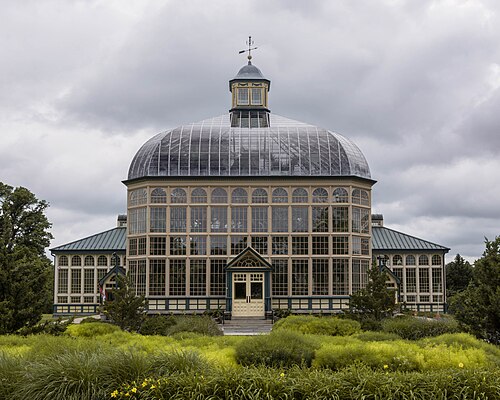
Do you have a good photo of this greenhouse? Suggest it for this page →
Sources (9)
- plantconservatory.calpoly.edu/locationdirections
- calpoly.edu/news/photo-essay-new-plant-conservatory-opens-its-doors
- ucm.calpoly.edu/news/cal-polys-new-plant-conservatory-biodiverse-species-officially-opens
- afd.calpoly.edu/facilities/planning-capital-projects/project-news/completed-projects/plant
- magazine.calpoly.edu/spring-summer-2023/greenhouse-rocks/
- newtimesslo.com/stroll-through-the-cal-poly-plant-conservatory-to-experience-a-living-muse
- mustangnews.net/1500-cal-poly-plants-will-get-a-new-permanent-home-fall-2020/
- santamariatimes.com/lifestyles/rare-blooming-of-a-corpse-flower-expected-at-cal-poly-this-
- habitathorticulture.com/project/cal-poly-conservatory
Affiliate links — booking through Verrière helps fund our research, at no extra cost to you.