UW Biology Greenhouse (University of Washington)
Seattle, Washington
No freely licensed photo of this greenhouse yet. Do you have one? Suggest it for this page →
Sources checked October 2026
- Year
- 2018 (building); open to the public since 2022
- Architect
- Perkins&Will (with the Life Sciences Building)
- Style
- Contemporary university greenhouse in concrete, steel and glass
- Dimensions
- ≈ 1,860 m² (20,000 sq ft), nine rooms
- Status
- Open to the public during weekly hours; teaching and research greenhouse
Beside the University of Washington's Life Sciences Building, this greenhouse of about 20,000 sq ft (1,860 m²) runs along the Burke-Gilman Trail. It replaced the Botany Greenhouse, where the collection had been built up over 65 years according to press reports. Concrete, steel and glass enclose nine climate-controlled rooms, four of them collection rooms (warm tropics, cool tropics, arid and a "tree of life") for some 3,000 species. A teaching and research facility, it has welcomed the public during weekly hours since 1 December 2022.
Affiliate links — booking through Verrière helps fund our research, at no extra cost to you.
History
The Biology Greenhouse continues a university tradition that the Seattle Times traces back to 1915, with an old greenhouse near Parrington Hall; the biology department speaks of nearly seventy years of activity, and GeekWire of sixty-five years for the collection. According to KUOW, the collection began as medicinal plants used by the university's pharmacology and toxicology programs. The Botany Greenhouse, built in 1949, was torn down in 2016: that year volunteers, including a dozen members of the Huskies football team, wheeled thousands of plants out by handcart to an Eastside greenhouse once operated by Molbak's, where Amazon also stored plants meant for its Spheres (GeekWire places this storage in Redmond).
The new greenhouse is part of the Life Sciences Building, designed by Perkins&Will, built from 2016 to 2018 and priced at $171 million by the Seattle Times. Professor Toby Bradshaw had helped shape the greenhouse's design more than a decade before 2022. In November 2018 Perkins&Will announced the building's opening and eventual access to the greenhouse; according to the Seattle Times, the specimens came back in the autumn before its October 2022 article, after five years in the Eastside facility.
The public was first welcomed on Thursday 1 December 2022, one afternoon a week, free of charge according to KUOW. The official visiting page now lists a weekday afternoon and the second and fourth Saturdays of the month.
Architecture and engineering
According to GeekWire, the greenhouse is a concrete, steel and glass structure of about 20,000 sq ft (≈ 1,860 m²); the Seattle Times and Perkins&Will's announcement give the same figure, whereas the SCUP award entry for the project mentions 15,000 sq ft. The University of Washington's PCAD architecture database places it southeast of the Life Sciences Building, lined up below it, and says it was designed together with it; the complex replaced older greenhouses on a narrow, sloping site above the Burke-Gilman Trail. A hallway longer than a football field, lit by daylight, serves the rooms, beneath ceilings that reach 35 feet (≈ 10.7 m) according to the Seattle Times.
Nine rooms share the volume: four collection rooms (warm tropics, cool tropics, arid, "tree of life") and five climate-controlled rooms for teaching and research, with a classroom space. Each bay is programmed independently; fans, misters, windows, shade screens and lights are computer-controlled, and sensors for temperature, humidity and light hang in the middle of each room. Perkins&Will also mentions a water-reclamation system for irrigation. The old greenhouse, by contrast, had windows opened by chains and shade cloth put up by hand.
Plant collections
The collection holds about 6,000 plants representing some 3,000 species according to KUOW and the Seattle Times (a 2023 university blog post speaks of more than 5,500 plants). The department claims a specialty in ancient plants, "living fossils" some of which date back to the Carboniferous and Cretaceous, as well as endangered species such as Deppea splendens, a Mexican plant now extinct in the wild.
The four collection rooms form the public route. In the arid room, plants are grouped by continent of origin, from the Americas on one side to Asia, Africa and Europe on the other; Welwitschia mirabilis grows there, among cacti and succulents. The cool tropics gather carnivorous plants (pitcher plants, Venus flytraps, cobra lilies); the warm tropics hold a tank of aquatic plants including lotus. The "tree of life" room retraces evolution from algae to food plants, with banana, coffee and ghost pepper. The Seattle Times also notes a large bromeliad whose core shelters frogs and damselflies, and giant ferns whose fronds measured about ten feet.
Visiting
The greenhouse occupies the Life Sciences Building, 3747 West Stevens Way NE, on the Seattle campus, beside the Burke-Gilman Trail. Visitors move freely through the four collection rooms during the weekly public sessions posted on the department's visiting page; in 2023 a university blog post stated that no reservation was needed. Groups of eight or more can request a docent-led tour, by appointment only. Accessible parking is on the south side of Kincaid Hall, near the greenhouse's west entrance.
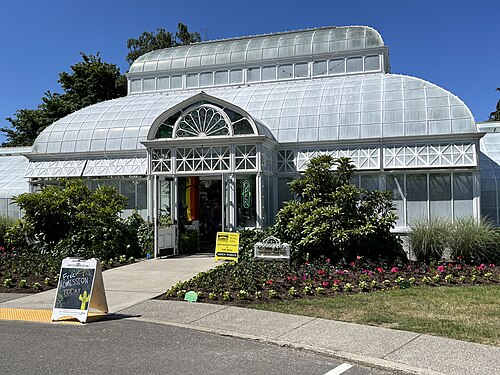
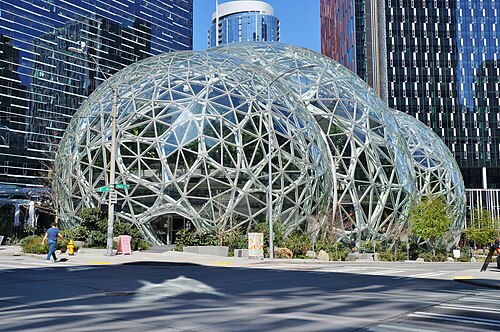
A visit combines easily with a walk along the Burke-Gilman Trail or around the campus. Other Seattle glasshouses appear in the atlas: the Volunteer Park Conservatory and Amazon's Spheres, a few kilometres away.
47.65° N, 122.31° W
Greenhouses nearby
More greenhouses — United States
Do you have a good photo of this greenhouse? Suggest it for this page →
Sources (8)
- biology.washington.edu/visiting
- biology.washington.edu/uw-biology-greenhouse
- advisingblog.ece.uw.edu/2023/05/01/uw-biology-greenhouse-a-green-oasis-on-campus/
- kuow.org/stories/where-the-wild-things-grow-a-visit-to-the-new-uw-greenhouse
- geekwire.com/2022/inside-the-univ-of-washingtons-new-greenhouse-where-a-tech-upgrade-keeps
- seattletimes.com/seattle-news/inside-uws-new-greenhouse-and-a-closeup-look-at-its-rare-and
- perkinswill.com/news/university-of-washington-life-sciences-building-designed-for-next-gen
- pcad.lib.washington.edu/building/20716
Affiliate links — booking through Verrière helps fund our research, at no extra cost to you.