Historic vegetable greenhouses of the 't Grom museum (Midzeelhoeve)
Sint-Katelijne-Waver, Antwerp Province

Sources checked October 2026
- Year
- Greenhouses of 1946 to the 1980s, rebuilt on the site from 1981
- Style
- Twentieth-century Flemish market-garden greenhouses in timber, iron, aluminium and glass
- Dimensions
- Footprint of about 2,043 m² (Flemish inventory); Mechelen greenhouse about 10 × 6 m
- Status
- Open to the public in the gardens of the 't Grom museum; greenhouses protected as a monument since 2015
On the Midzeelhoeve site, a former abbey farm that became the 't Grom vegetable museum in 2006, cold frames and greenhouses of several types trace the rise of glasshouse growing in the Mechelen market-garden region. The Mechelen greenhouse of 1946, dismantled in 1981-1982, was rebuilt with its original timber, iron and glass; a post-war nursery greenhouse was remade from measurements of the original, and a large Venlo-type house of the 1970s-80s was rebuilt in the early 21st century. Protected as a monument since 2015, the group can be seen in the museum gardens.
Affiliate links — booking through Verrière helps fund our research, at no extra cost to you.
History
Around the Midzeelhoeve farms, vegetables have been grown since at least 1712, first by tenants of the Cistercian abbey of Roosendael and later by other occupants. Greenhouses came only later, along with tools adapted to the clay soil and the crops. In the municipality the first greenhouse businesses appeared in the 1880s, during an agricultural crisis, and the Mechelen greenhouse is given as in use from about 1880 to about 1980.
The 't Grom vegetable museum was opened in 2006 by the Midzeelhoeve association. From the 1980s onwards, frames and greenhouses of different types were rebuilt on the site for documentary and teaching purposes, with, according to the Flemish inventory, great respect for the original materials and techniques. The Mechelen greenhouse, dating from 1946, comes from the Geens family at Onze-Lieve-Vrouw-Waver, where it stood on the Hagenweg; it was dismantled in 1981-1982 and rebuilt. The nursery greenhouse, built shortly after the Second World War on the Peutersweg and donated by the Smits family, proved too fragile to be re-erected: it was measured, and its profiles were remade to the original pattern. The Venlo-type double-span house, from the 1970s-80s, was rebuilt on the site in the early 21st century.
The group has been protected as a monument by a decision of 8 June 2015.
Architecture and engineering
The Flemish inventory describes four elements. The single flat frame stands on a cemented brick base and carries its original glazed lights; the double flat timber frame is recent and excluded from the protection, apart from the lights of its pitched roof, which are original.
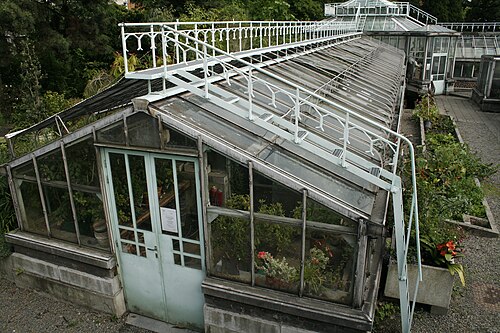
The Mechelen greenhouse, also called the cauliflower greenhouse or "kniekas", is a rectangle of about 10 by 6 m: six timber trusses on a brick plinth, joined every two metres by a ridge beam and purlins. The panes are fixed with putty in an iron frame set on a low brick base; the glass side walls break at about one metre high, hence the nickname. The timber sliding door is partly glazed.
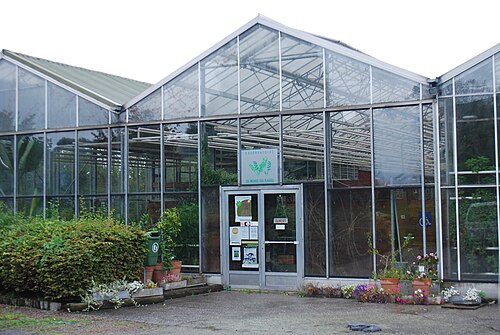
The nursery greenhouse has a tall brick base carrying a glazed iron structure on five trusses; its panes are fixed with silicone rather than putty, and the sliding door is fully glazed. The large Venlo-type house ("warenhuis") combines iron, aluminium and glass on a concrete base: four iron trusses carry a double-gabled roof fitted with ventilation windows, long narrow panes are held by rubber seals, and a wide aluminium door lets small farm vehicles in.
Plant collections
The greenhouses are still used to grow vegetables: according to the website moes-tuin.be, two historic greenhouses, one modern greenhouse and cold frames are in use. In the Mechelen greenhouse a central path of beaten earth separates two zones where cauliflower seedlings are raised in winter in the characteristic red ceramic pots until they are planted out in early spring; in spring and summer it is used for outdoor tomatoes, cucumbers and other vegetables. The nursery greenhouse is recognisable by its raised concrete benches. The museum's own website specifies that the "cauliflower greenhouse" is in fact a vine house.
Around them the museum presents four historic gardens linked by 1,200 m of paths, and a botanical garden that conserves the genetic diversity of plants: more than ten subspecies of cabbage, including the early Mechelen cauliflower, and old potatoes such as Rote Emma or Blauwe Busschots. The tomato Roem van Mechelen is among the local varieties mentioned.
Visiting
The greenhouses stand in the gardens of the 't Grom museum, at Midzelen, in the south-west of Sint-Katelijne-Waver. The website speaks of "2,000 steps in the green" and suggests exploring the estate with an audio guide or a guide. The gardens are best in the warm season: from May to October the museum opens on Saturdays too. A museum meant for doing as much as looking, it programmes exhibitions, workshops and children's activities; it occupies the Midzeelhoeve farms, one of which has housed a café-bistro since June 2006, according to Dutch Wikipedia. Around it lies a recreational green zone laid out between the Midzelen road, the Antwerp-Brussels railway, the R6 and the Heisbroekweg.
51.06° N, 4.50° E
Greenhouses nearby
More greenhouses — Belgium
Do you have a good photo of this greenhouse? Suggest it for this page →
Affiliate links — booking through Verrière helps fund our research, at no extra cost to you.