Serra dei Giardini (Serra Margherita), Castello
Venice (Castello), Veneto

Sources checked October 2026
- Year
- 1894
- Architect
- Initial design by Trevisanato, chief engineer of the city's technical department (1893)
- Style
- Liberty-style iron-and-glass tepidarium, now a café and plant shop
- Dimensions
- About 180 m², about 6 m high (La Biennale)
- Status
- Open to the public: café, potted-plant shop and botanical activities, run by the Nonsoloverde cooperative
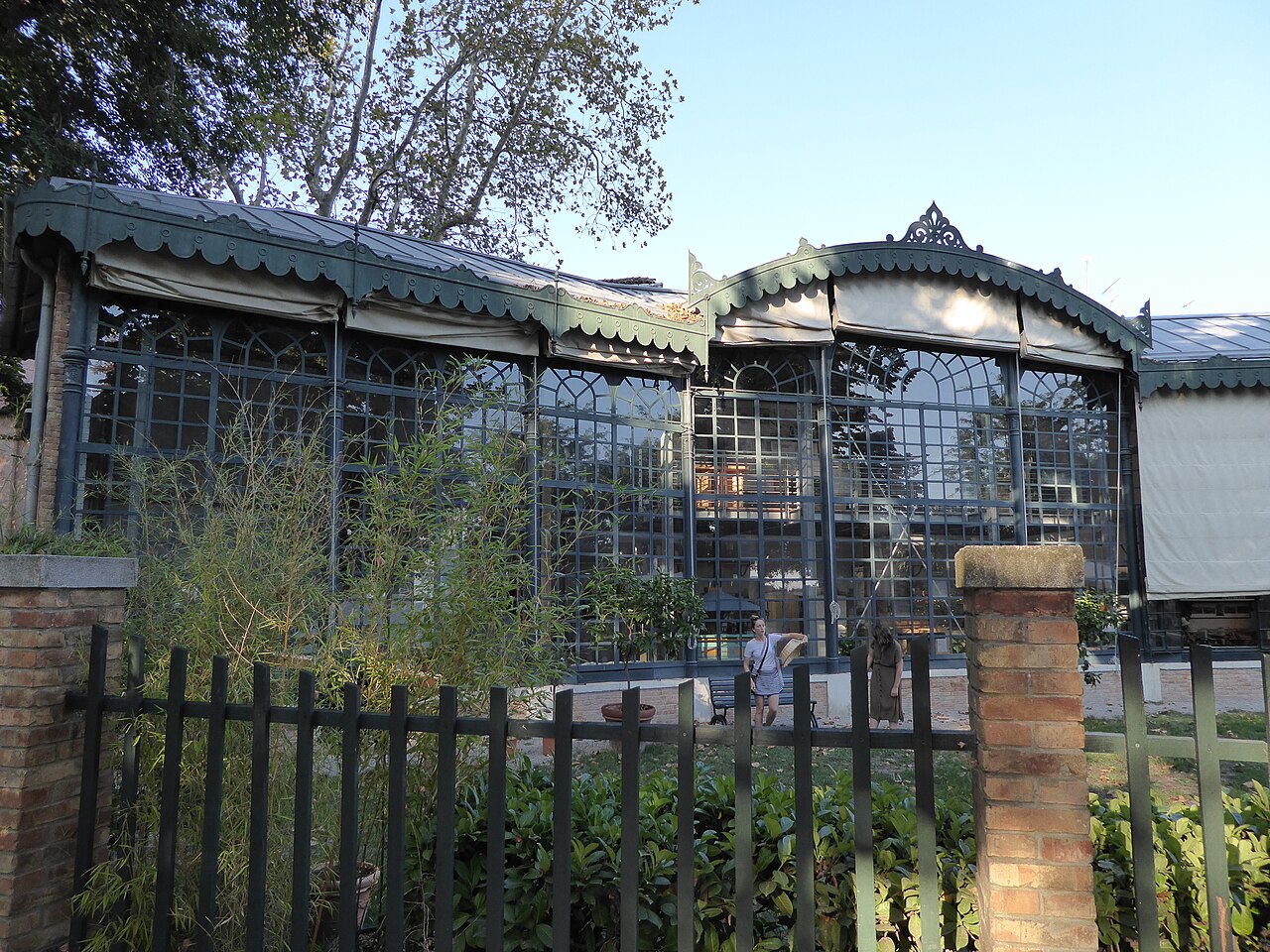
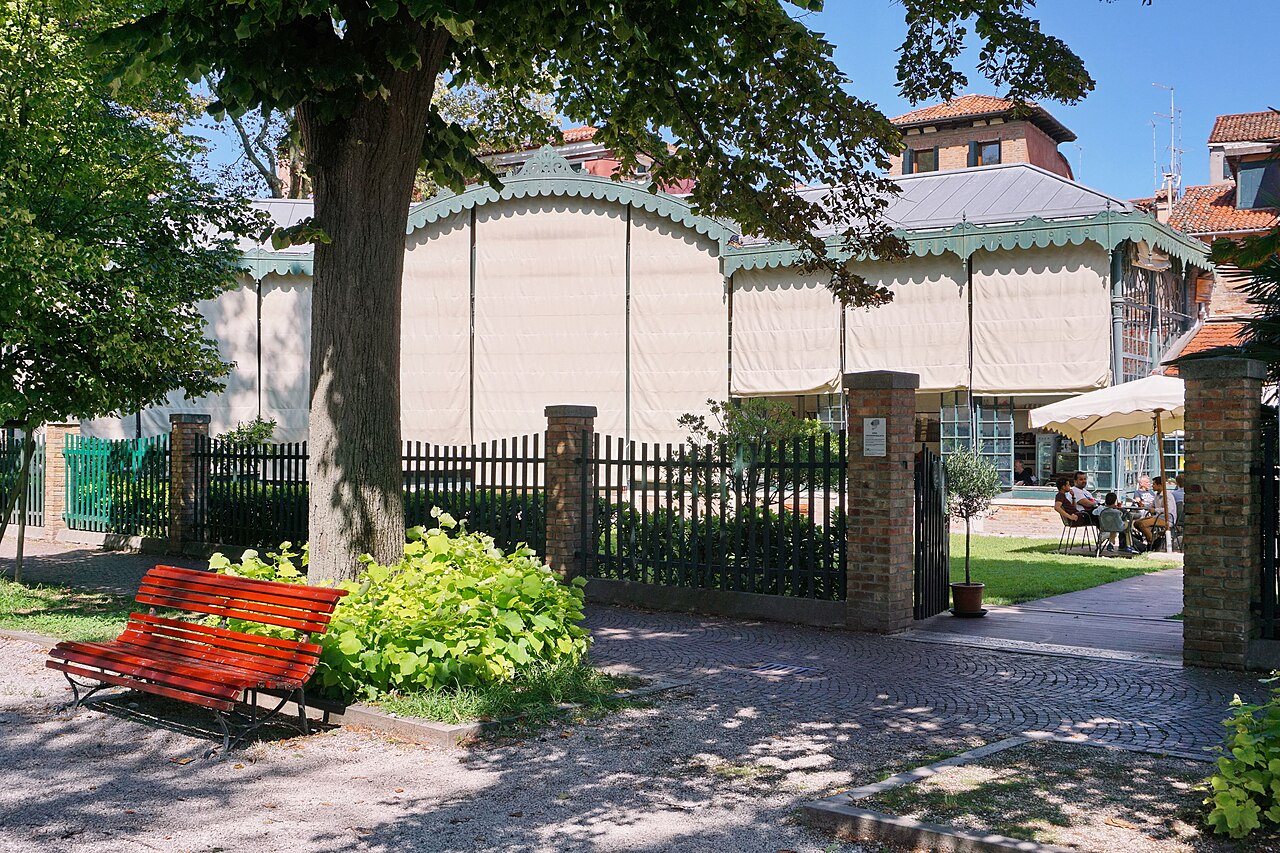
Built in 1894 at the end of Viale Garibaldi, in the Castello gardens, the Serra dei Giardini, long known as the Serra Margherita, is an iron-and-glass tepidarium designed to shelter the palms and decorative plants of the International Art Exhibition. Abandoned in the early 1990s and then restored by the City of Venice, it has been run since 2009-2010 by the social cooperative Nonsoloverde. Under its roof of about 180 m² are a café, a sale of potted plants that changes with the seasons and a programme of botanical and cultural activities.
Affiliate links — booking through Verrière helps fund our research, at no extra cost to you.
History
At the end of the nineteenth century several projects were put forward to redesign the gardens of Castello, a large green area little used because of its peripheral position. One of them provided for a greenhouse able to house the palms and decorative plants used for the International Art Exhibition. The first project, drawn up in 1893 by Trevisanato, chief engineer of the city's technical department, offered two options: an austere masonry building or a finer version in iron and glass. The second was built in 1894; the official website presents the choice as political, since it gave work to unemployed workers of the local metalworking firms, then in crisis. According to a sign at the entrance, the greenhouse predates the Palazzo dell'Esposizione (1895) and the first national pavilion, the Belgian one (1907): it is the oldest permanent structure of the original Biennale ensemble.
It stands at the end of Viale Garibaldi, where the convents of San Domenico, Sant'Antonio and Sant'Anna once rose. The suppression of the religious orders in 1809 led to the demolition of the old cloisters, and public gardens were partly laid out in 1810. For a century the greenhouse was a workplace for the municipal gardeners: cold-sensitive species were kept there in winter, and plants were produced for the flowerbeds of Venice and the Lido as well as for aristocratic ballrooms. It then went through several alterations before being abandoned in the early 1990s. Protective works and a reinforcement of the roof were carried out in spring 2006, after which the City of Venice restored it. Management passed to the cooperative Nonsoloverde, in July 2010 according to the official website, or December 2009 according to another text from the cooperative.
Architecture and engineering
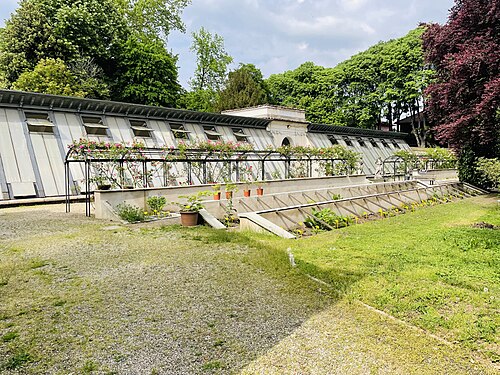
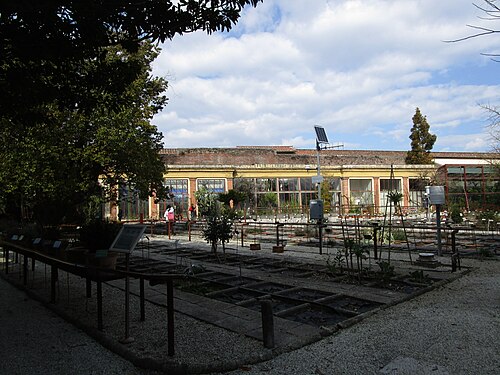
La Biennale describes a tepidarium in glass and iron of about 180 m² and about 6 m high. The façade is distinguished by a decorated arch and an iron crowning band; inside are a smooth concrete floor and a mezzanine area, with heating and air conditioning. Free photographs on Wikimedia Commons show tall glazed bays with arched glazing bars, shaded by canvas blinds under a scalloped-edged canopy. Around the building the garden divides into four spaces: the portico, the front garden, the garden in front of the bar and the side garden.
The official website, which reproduces a 2008 article by the architect Marco Ercole, says the original metal roof covering was rare in Venice, where only major buildings have similar ones, such as the Rialto Bridge or the dome of St Mark's, and stressed the importance intended for the building. The surfaces were originally painted white, like most European greenhouses of the period, as a photograph from the late 1920s shows. Before its abandonment the greenhouse received other roofing materials, concrete flower chests after the Second World War, a smaller, lower service wing in glass and iron joined by two flights of stairs, and a central-heating boiler with finned cast-iron radiators installed in 1929.
Plant collections
The greenhouse holds no permanent collection. The cooperative chose to set it up with different plants for each period of the year, in a continuous flow of origins, shapes and colours, so that the space remains in constant change. Ornamental potted plants and garden equipment are sold there; the sales fund the cooperative's social work and educational activities. The plants come mainly from nurseries in the provinces of Venice, Padua and Treviso, many of them produced by social cooperatives in the Veneto that employ disadvantaged people.
The space also serves as a tea and reading room, with magazines on gardening and nature. The programme includes environmental education for schools, workshops for families, courses for adults and exhibitions among the plants, as well as, since 2011, the art project Microclima. The City of Venice announced the start of a new season of activities on 11 September 2026, opening with a knitting meeting in the greenhouse.
Visiting
The Serra dei Giardini stands at Via Garibaldi 1254, at the end of Viale Garibaldi, between the Biennale gardens and the avenue. La Biennale gives two minutes on foot from the Giardini Biennale vaporetto stop. Visitors come mainly for the café and the plants, but the greenhouse and its gardens also host workshops, exhibitions and events, whose calendar is published by the cooperative and by the City of Venice. A 2025 article describes it as peaceful on weekdays.
The visit combines with the neighbouring Giardini della Biennale, home to the first national pavilion, the Belgian one (1907), and with the rest of the Castello district. It is best planned as a break rather than a collection visit.
45.43° N, 12.36° E
Greenhouses nearby
More greenhouses — Italy
Do you have a good photo of this greenhouse? Suggest it for this page →
Sources (8)
- labiennale.org/it/bacheca/439
- web.archive.org/web/20250712200302/https://www.serradeigiardini.org/en/history.php
- web.archive.org/web/20250517151100/https://www.serradeigiardini.org/en/greenhouse.php
- web.archive.org/web/20250811042711/https://www.serradeigiardini.org/en/florist.php
- conoscerevenezia.it/?p=41267
- live.comune.venezia.it/it/2026/09/l11-settembre-apre-la-nuova-stagione-delle-attivita-dell
- venetosecrets.com/insolito/caffe-la-serra-dei-giardini/
- web.archive.org/web/20260414022833/https://nonsoloverde.eu/ristoro/
Affiliate links — booking through Verrière helps fund our research, at no extra cost to you.