Altes Palmenhaus (Old Palm House, ORANG.erie), Tiergarten Schönbrunn
Vienna, Hietzing (Schönbrunn Palace Park)

Sources checked October 2026
- Year
- 1820
- Style
- Three-part imperial orangery with a glazed facade, converted into an orangutan house
- Status
- Open to the public within Tiergarten Schönbrunn
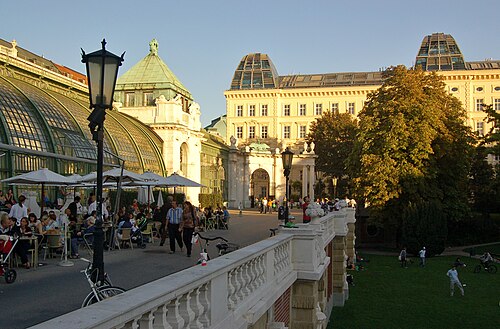
A three-part orangery built around 1820 (1821, 1828 or 1836) on the western edge of Schönbrunn Park for the plants brought back by the Austrian expedition to Brazil, the Old Palm House turned its glazed facade to the east. Overtaken by the Great Palm House of 1884, it became a film studio in the 1920s and then the first large television studio of the ORF, its glass wall being walled up. Restored from 2006 to 2009 with the glass facade rebuilt, it has housed the zoo's orangutans, a café-restaurant and a library since May 2009 under the name ORANG.erie.
Affiliate links — booking through Verrière helps fund our research, at no extra cost to you.
History
The Old Palm House of Schönbrunn goes back to Emperor Francis I of Austria, who had a three-part orangery built on the western edge of the park, along today's Maxingstraße, for the botanical acquisitions of the Austrian expedition to Brazil, a venture that lasted several years. The dates vary: the German Wikipedia article gives 1820 while noting 1828 and 1836 in other publications, among them the Dehio handbook; the zoo's historical trail dates the completion of the building to 1821. The building was extended in 1860 and, according to the zoo, housed Schönbrunn's first orangutan as early as 1878. The opening of the Great Palm House in 1884 made it redundant: two aviaries for exotic birds were added in 1889, the middle section being refitted for small tropical birds and parrots, and the greenhouse closed shortly after an administration building went up in 1910.
In the early 1920s the building became the Schönbrunner Filmatelier, run by the Schönbrunn-Film company and, from 1939, by Wien-Film; Heimkehr (1941), Wien 1910 (1943), Hallo Dienstmann (1952) and Sissi (1955) were shot there. From December 1956 the young ORF set up its first large television studio in the hall, where the news programme Zeit im Bild was produced, before handing it over in the early 1970s to the University of Music and Performing Arts. The glazed facade was walled up in the course of these conversions, around 1920 according to Wikipedia and in 1957 according to the zoo.
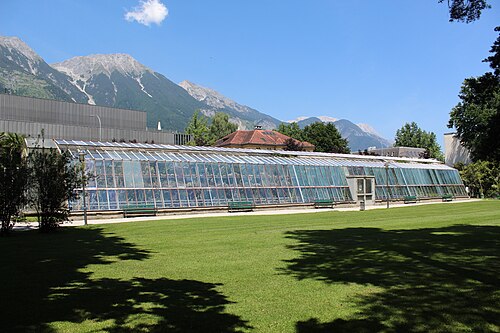
The zoo took the building over in 2000 and began a restoration in 2006 that removed the annexes and studio fittings and rebuilt the glass facade, the historic structure having survived largely intact. Reopened in May 2009 as the ORANG.erie, it has housed the zoo's orangutans ever since.
Architecture and engineering
The orangery consists of three sections aligned north to south on the edge of the imperial park, and its glazed facade, facing east, admitted only the morning light; Wikipedia notes that cultivation results were good despite this limited exposure. The building was enlarged in 1860, then completed by two aviaries in 1889 and an administration building in 1910. The studio decades altered the envelope heavily: the glass wall gave way to masonry and small extensions were attached, so that by the late twentieth century little remained to identify it as a greenhouse.
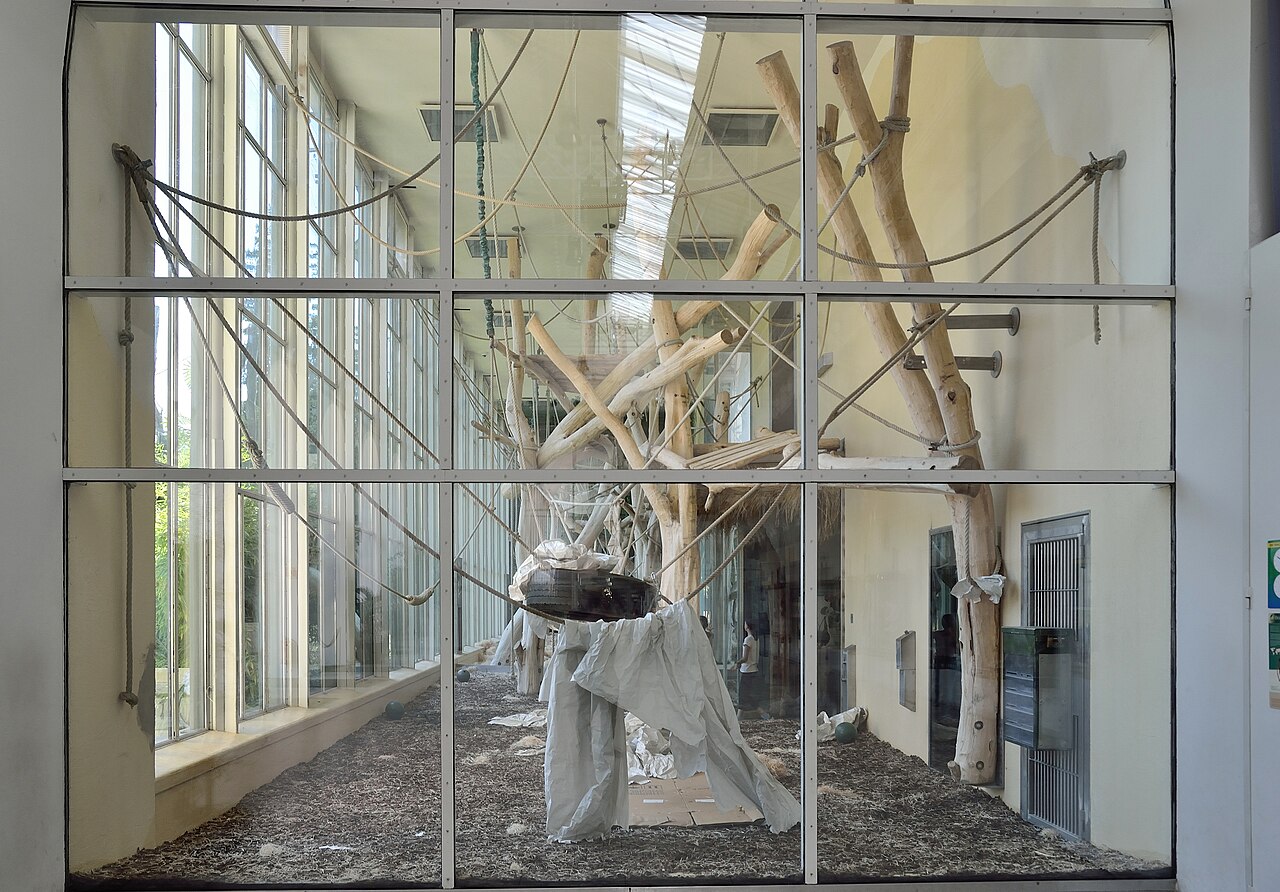
The restoration begun in 2006 reversed that process. The additions and studio installations were demolished, the glazed facade was rebuilt and the building was returned to its late nineteenth-century state, an outcome the zoo calls a sensation for heritage conservation. The interior follows the original three-part layout: to the south, the orangutans' indoor quarters, fitted with ropes and opening onto an outdoor enclosure; in the middle, the visitor area, separated from the apes by large panes of glass, together with a hall that can seat up to 300 people; to the north, the café-restaurant Atelier Nonja. A library occupies the upper floor, and a pedestrian passage, under construction beneath the botanical garden in 2009, links the ORANG.erie to the rest of the zoo.
Plant collections
The orangery was designed for plants: the specimens brought back from the Brazil expedition were grown here, and the zoo presents it as its first palm house.
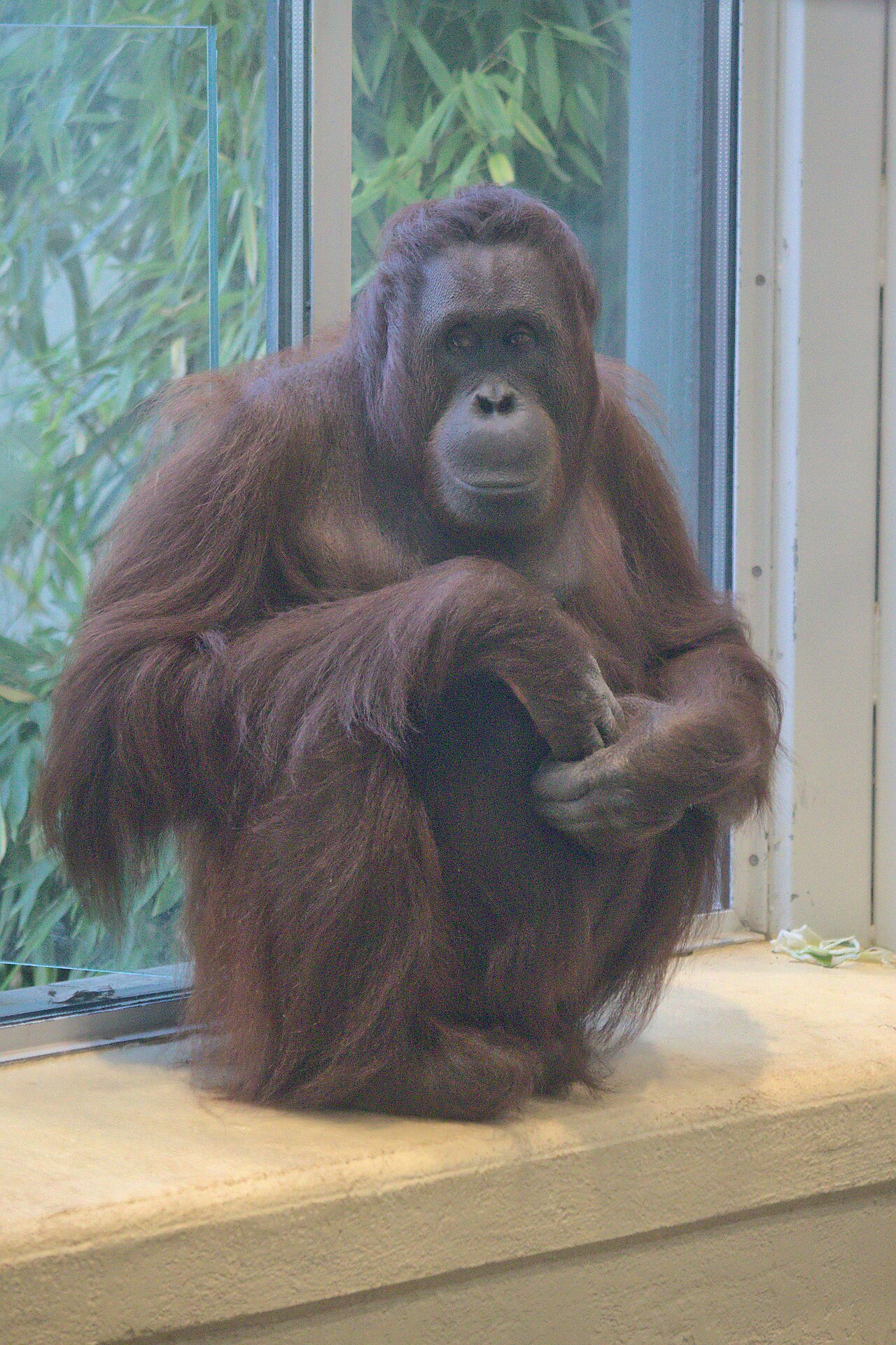
Since May 2009 the building has been home to the zoo's orangutans, who moved in from the old Affenhaus, the group being enlarged by two females at the same time; the outdoor enclosure, whose trees reached 11 m at the opening, received twelve trees of up to 13 m in 2021. The zoo recalls that its first orangutan was already lodged in this greenhouse in 1878 and that the middle section held small tropical birds and parrots after 1889. The café Atelier Nonja displays reproductions of paintings by Nonja, a female orangutan who was given brushes and paints in the 1990s. Studies by the University of Vienna have followed the group's adjustment to the new enclosure and its hormonal balance.
Visiting
The ORANG.erie stands on the western edge of the estate, along the Maxingstraße, some 150 m from the zoo's Hietzing entrance and about 200 m west of the Great Palm House of 1882; an underground passage links it to the rest of the zoo. The main reason to come is to watch the orangutans through the large panes of the central section or from the café-restaurant Atelier Nonja, which looks straight onto the group. The friends' association of the zoo holds an evening lecture here once a month in the hall. The visit combines naturally with the Desert House, the Rainforest House and the Great Palm House, a few minutes' walk away, and then with Schönbrunn Palace and its park, a World Heritage Site of which the zoo, founded in 1752, forms part.
48.18° N, 16.30° E
Greenhouses nearby
More greenhouses — Austria
Do you have a good photo of this greenhouse? Suggest it for this page →
Sources (8)
- zoovienna.at/anlagen/orangerie/
- zoovienna.at/media/uploads/dokumente/historischer_pfad_tiergarten_orang.erie.pdf
- de.wikipedia.org/wiki/Altes_Palmenhaus_(Wien-Sch%C3%B6nbrunn)
- de.wikipedia.org/wiki/Tiergarten_Sch%C3%B6nbrunn
- en.wikipedia.org/wiki/Tiergarten_Sch%C3%B6nbrunn
- geschichtewiki.wien.gv.at/Sch%C3%B6nbrunner_Filmatelier
- wikidata.org/wiki/Q439305
- openstreetmap.org/way/53127857
Affiliate links — booking through Verrière helps fund our research, at no extra cost to you.