Regenwaldhaus
Tiergarten Schönbrunn (Vienna Zoo)

Sources checked October 2026
- Year
- 2002
- Style
- Zoological tropical greenhouse recreating a Southeast Asian mountain slope
- Status
- Closed for renovation since 2022; reopening postponed to early 2027, no firm date
Opened in 2002 for the 250th anniversary of Tiergarten Schönbrunn, the world's oldest zoo still in operation, the Regenwaldhaus recreates under glass a Southeast Asian rainforest mountain slope, kept permanently above 25°C and 80% humidity. It should not be confused with the neighboring Palmenhaus, a 19th-century imperial building that belongs to the Schönbrunn gardens rather than the zoo. For more than twenty years, Batagur turtles, small-clawed otters, fruit bats, pythons and Fiji iguanas shared its warm, humid atmosphere. After two decades in operation, the building has been closed for a thorough reconstruction and is due to reopen in early 2027 with a new nocturnal exhibit devoted to fruit bats and pangolins, while retaining its role as a tropical greenhouse. The Regenwaldhaus thus illustrates the ongoing reinvention of historic zoological glasshouses.
History
The Regenwaldhaus was one of the projects with which Tiergarten Schönbrunn, founded in 1752 in the imperial park of Vienna, marked its 250th anniversary. Opened on 4 July 2002, it did not recreate a South American jungle, as most tropical halls of the time did, but a slice of Bornean rainforest in Southeast Asia. The project was driven by zoologist Harald Schwammer, then deputy director of the zoo, who conceived it as an educational showcase for rainforest conservation.
The building was designed by the architectural partnership of Neversal, Edelbacher and Hartmann for the Burghauptmannschaft, the federal agency responsible for historic state buildings, with structural engineering by KS Ingenieure and Fröhlich & Locher.
After some twenty years in a saturated, humid atmosphere, the hall needed a complete overhaul. The zoo closed it in 2022, rehoused its animals and began a general renovation with a new visitor concept. The large trees planted two decades earlier were kept in place and held above 18 °C throughout the works. Reopening, first announced for 2025 and then for early 2026, was postponed to early 2027, as reported on 13 October 2026, with no specific opening day yet; the zoo's director attributed the delay to greater structural damage than expected. The plans include Chinese pangolins, obtained through a partnership with Taipei Zoo, and an adjoining nocturnal enclosure more than eight metres high for nectar-feeding bats.
Architecture and engineering
The Regenwaldhaus is a glazed hall whose dome rises to about 15 metres. At its 2002 opening the exhibit area was given as 1,000 m², within a volume of roughly 9,900 m³. After the renovation the zoo quotes around 1,500 m² in total, of which about 900 m² is visitor space and 600 m² is plant and machinery.
The route runs across two levels with a height difference of about eight metres, evoking the flank of a tropical mountain. The climate is held year-round at a minimum of 25 °C and about 80 percent humidity, using heating in the glass roof, walls and floors, and in winter in the planting soil itself. A closed water circuit of some 160 m³ feeds streams, misting and artificial rain; the original installation could also stage a tropical storm with strobe lightning, thunder from subwoofers and downpours. The renovation adds a 150,000-litre river section and, in an adjoining steel-and-concrete structure, a nocturnal enclosure with a reversed day-night cycle, dimmed light and mist effects.
Plant collections
When it opened, the house held more than 300 plant species, orchids and understorey plants included, to convey the density of a Bornean forest. Its animals included Batagur river turtles, Asian small-clawed otters, fruit bats, pythons, Fiji iguanas and a range of birds.
The new concept centres on threatened rainforest species. The zoo lists large flying foxes (kalong), fruit doves, Lesser Antillean iguanas, frogs, northern river terrapins (Batagur), elephant shrews, tegus and, above all, Chinese pangolins, which will make Schönbrunn only the third zoo in Europe to keep the species; viewing windows are planned into their sleeping burrows. Nectar-feeding flower bats, which can visit up to a thousand blossoms a night, are to occupy the nocturnal enclosure.
Visiting
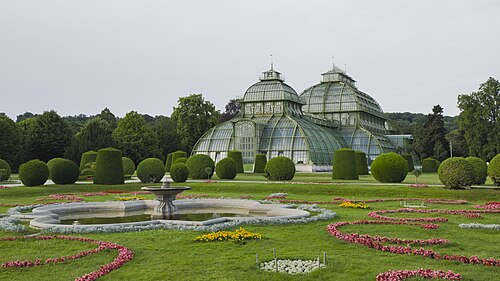
The Regenwaldhaus lies inside Tiergarten Schönbrunn, within the palace park. It should not be confused with the imperial Palmenhaus and the Wüstenhaus, which stand close by but outside the zoo. Once the hall reopens, the nocturnal section will reward a slow pace, giving the eyes time to adjust to the gloom and catch pangolins and bats while they are active. The warm, humid air makes it a welcome refuge on a cold day, and a visit combines easily with the two neighbouring glasshouses and the palace gardens.
48.18° N, 16.30° E
Greenhouses nearby
Architecture nearby
More greenhouses — Austria
Do you have a good photo of this greenhouse? Suggest it for this page →
Sources (9)
- zoovienna.at/anlagen/regenwaldhaus/
- zoovienna.at/unterstuetzen/aktuelle-bauprojekte/
- zoovienna.at/de/news/schuppentiere-werden-einziehen/
- de.wikipedia.org/wiki/Tiergarten_Schönbrunn
- sciencev1.orf.at/news/54305.html
- ksingenieure.com/de/project/regenwaldhaus-schoenbrunn-freizeit-kultur
- meinbezirk.at/hietzing/c-lokales/tiergarten-schoenbrunn-baut-acht-meter-hohe-fledermausanl
- 5min.at/wien/5202602191247/neue-fledermaus-welt-im-tiergarten-schoenbrunn/
- vienna.at/increasing-costs-schoenbrunn-does-not-rule-out-higher-admission-prices/10539461