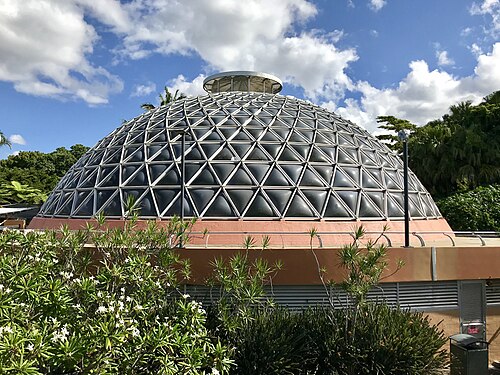
Sir Joseph Banks Glasshouse, Wollongong Botanic Garden
Keiraville, Wollongong, New South Wales
Entry updated on October 5, 2026
- Year
- 1968–1970
- Architect
- Unknown (built by Wollongong City Council)
- Style
- Gabled glasshouse divided into two climate sections
- Status
- Open to the public
Built by Wollongong City Council in 1968 with the help of a grant, the glasshouse opened in 1970 to mark the bicentenary of Captain Cook's landing in Australia and is named after the botanist Joseph Banks. It stands in the north-eastern part of a botanic garden that grew out of a gift of land by Sidney Hoskins in 1954. Split into a dry section for cacti and other succulents and a humid one for tropical plants, it also shows, in rotation, a Haworthia collection of more than 1,000 plants assembled over four decades by a collector from Kiama.
Affiliate links — booking through Verrière helps fund our research, at no extra cost to you.
History
1 min
The glasshouse belongs to a garden that began with a gift. In 1954 Sidney Hoskins gave Wollongong City Council 46 acres of land specifically so that a botanic garden could be created, and in the same year sold his manor, Gleniffer Brae, to the Sydney Church of England Girls Grammar School. Planting did not start until 1964, when the garden's first gardener laid out an azalea garden, and in 1966 the council acquired Cratloe cottage, which now houses the Discovery Centre.
In 1968 the council obtained a grant for a glasshouse and built the Sir Joseph Banks Glasshouse that same year, naming it after the man the garden calls Australia's best-known botanist. The building was opened in 1970 to mark the bicentenary of Captain Cook's landing in Australia. The garden itself was officially opened to the public in September 1970 and drew about 6,000 visitors in its first year.
In 1975 the council bought Gleniffer Brae back from the school, which allowed the grounds to grow. The garden now receives around 500,000 visitors a year, and the glasshouse remains one of its main features. It has also served as a backdrop for heritage events: during Heritage Week 2018 a historian and actor played Banks on costumed tours of the garden, and it was in the glasshouse that the local newspaper met him in character.
Architecture and engineering
1 min
The sources consulted say little about the design of the building. They name no architect or builder and give no dimensions, presenting the glasshouse simply as a council project paid for by the 1968 grant. OpenStreetMap, mapped from aerial imagery, records it as a glass building under a gabled roof in the north-eastern part of the garden.
Its internal arrangement is better documented. The house is divided into two climate sections: a dry one for cacti and other succulents, and a humid one for tropical plants. The split allows a single structure to present both the wet tropics and the world's arid regions. The building is also where the Haworthia collection is shown in rotation, its specimens changed at regular intervals. Outside, the garden's open-air collections carry the same double theme further, with a succulent section and several rainforest plantings: Illawarra, subtropical, dry and exotic.
Plant collections
1 min
According to the garden, the glasshouse brings together plants from the wet tropics, from deserts and from other warm regions: tropical and dry-tropical species on one side, and succulents from arid zones around the world, cacti included, on the other.
Its centrepiece is the Haworthia Collection. Built up over more than 40 years by Leo Cady, a collector from Kiama, it numbers more than 1,000 plants, some of them over a century old. Cady handed this private collection to the botanic garden in partnership with the Friends of Wollongong Botanic Garden. It is displayed in the Sir Joseph Banks Glasshouse in rotation: the specimens on show are changed regularly, so the display differs from one visit to the next.
Visiting
1 min
The glasshouse lies in the north-eastern part of Wollongong Botanic Garden, in Keiraville at the foot of Mount Keira, and fits easily into a walk around the grounds. The garden also has a rose garden, a herb garden, a woodland garden, an azalea bank, several rainforest areas and a creek that runs into Autumn Lake, as well as a Japanese-style wooden bridge given as a token of the sister-city link with Kawasaki. Gleniffer Brae, Sidney Hoskins's former manor, stands within the grounds and is used for functions, and the Wollongong Conservatorium of Music shares the site. Because the Haworthia display rotates, a return visit shows different plants.
34.41° S, 150.88° E
Greenhouses nearby
More greenhouses — Australia
Do you have a good photo of this greenhouse? Suggest it for this page →
Sources (7)
- wollongongbotanicgarden.com.au/collections/sir-joseph-banks-glasshouse
- wollongongbotanicgarden.com.au/collections/sir-joseph-banks-glasshouse/haworthia-collectio
- illawarramercury.com.au/story/3778145/wollongong-botanic-garden-growing-with-the-times/
- en.wikipedia.org/wiki/Wollongong_Botanic_Garden
- illawarramercury.com.au/story/5367585/wollongongs-sir-joseph-banks-not-much-like-his-names
- weekendnotes.com/wollongong-botanic-gardens/
- openstreetmap.org/way/74116611