Hirosaki City Museum (弘前市立博物館)
Hirosaki, Aomori Prefecture
Sources checked November 2026
- Year
- 1976
- Architect
- Kunio Maekawa
- Type
- Regional history and art museum
- Access
- Open to the public (city website, November 2026)
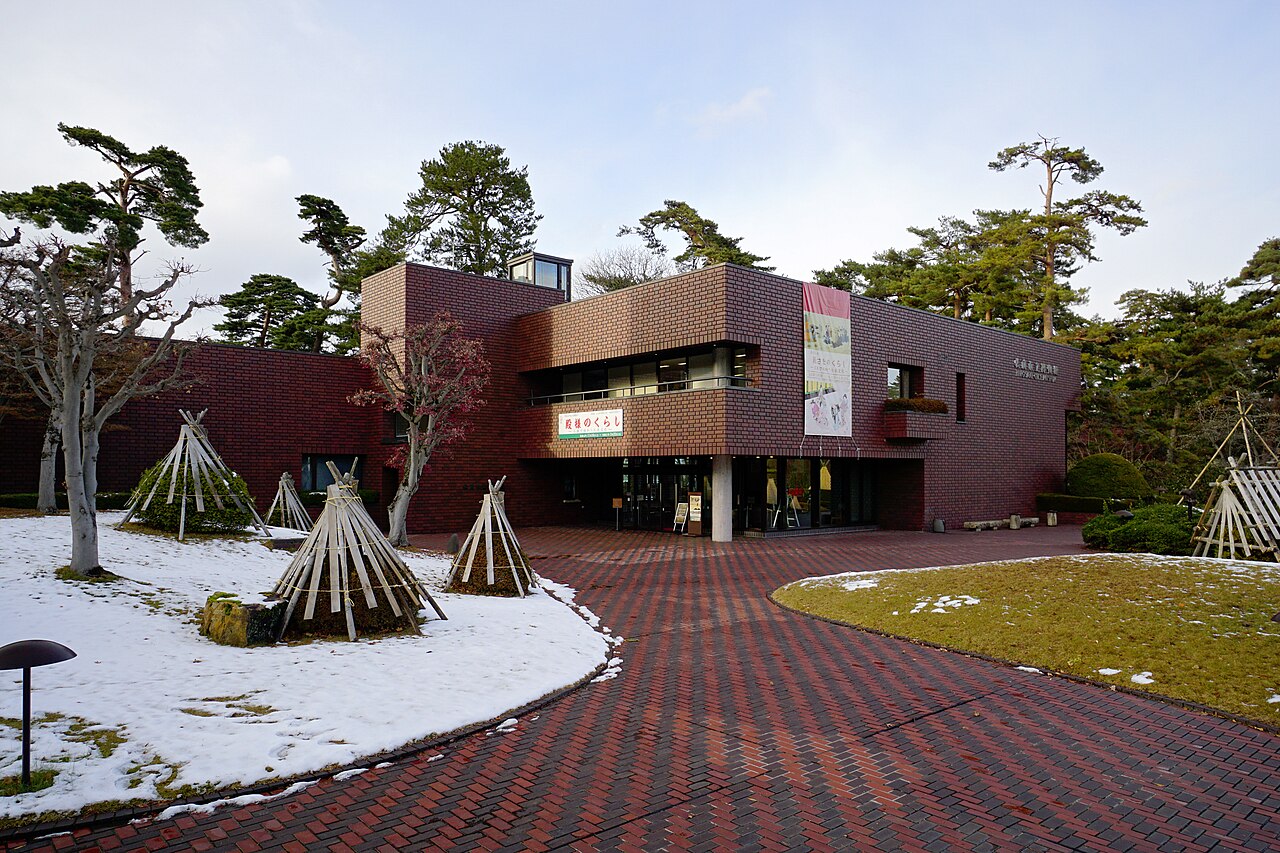
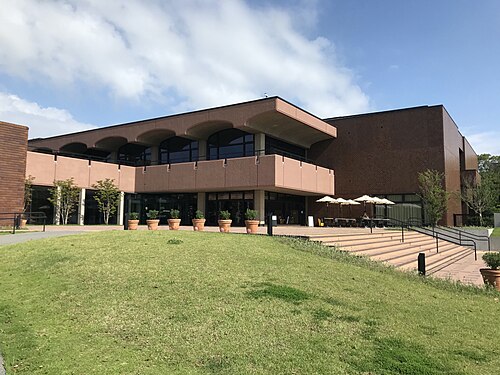
This history museum stands in a corner of the third bailey of Hirosaki Castle. Kunio Maekawa's firm handled its design and supervision; completed in 1976, it opened in 1977. Its exterior walls are made of tiles placed in the formwork before the concrete was poured.
Affiliate links — booking through Verrière helps fund our research, at no extra cost to you.
History
In 1961 the Aomori Prefectural Assembly adopted a petition to build a prefectural museum in Hirosaki. The city then examined, with the Agency for Cultural Affairs and other bodies, a site on the third bailey of the park. The project took shape in 1973, when Binsei Karōji, president of the Hirosaki Mutual Bank (today's Michinoku Bank), offered ¥100 million toward a museum to mark the bank's fiftieth anniversary. The city set the basic terms of the project that year, and a preparation office was set up in 1974.
In 1975 the city obtained permission to alter the castle's historic site, and work on the building proper began in July. The building was completed on 10 August 1976; the opening ceremony took place on 20 April 1977 and the public was admitted from the 22nd. The following year the museum became a registered museum under the Museum Act, and the front garden, laid out in 1979, completed the ensemble. After a year of renovation work, begun in December 2012, and three months left for the building to dry out, the museum reopened on 5 April 2014.
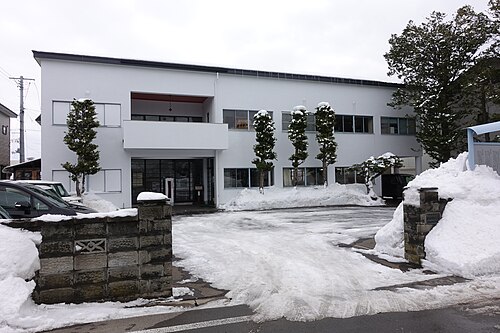
Eight buildings by Maekawa survive in Hirosaki, beginning with the Kimura Industrial Research Institute (1932), his first work. Together with the neighbouring Hirosaki Civic Hall, the museum received the BELCA prize, which honours buildings designed for longevity and continuously maintained; in 2014 the City of Hirosaki listed it among its buildings important to the townscape.
Architecture
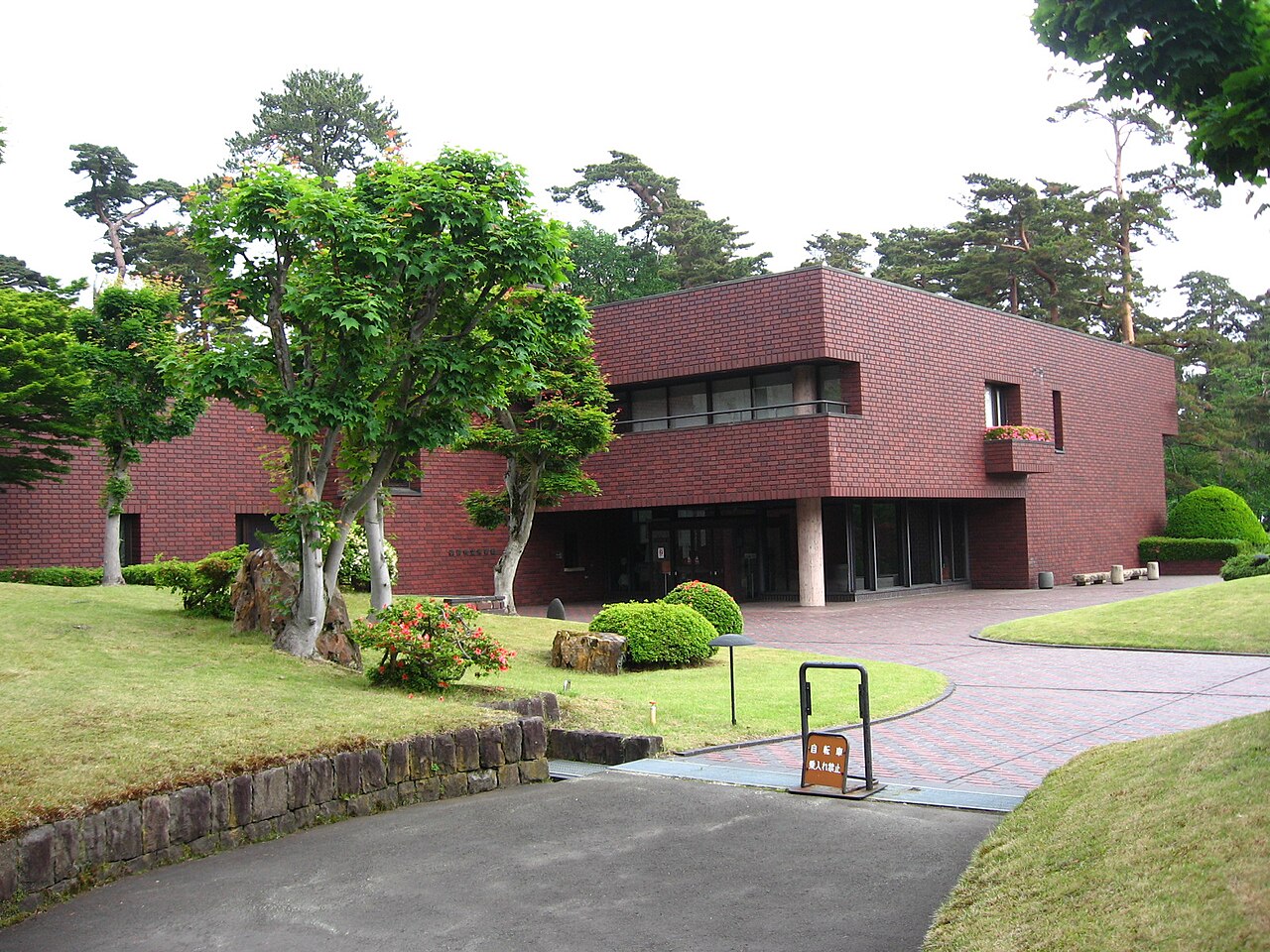
The museum stands in a corner of the third bailey of Hirosaki Castle, surrounded by the castle and old pines. Kunio Maekawa's firm handled its design and supervision. The floor area is 2,279.6 m², of which 678 m² are exhibition rooms. Maekawa is said to have designed it without felling trees, out of respect for the landscape of the castle's historic site.
The exterior walls are made of tiles placed in the formwork before the reinforcing bars were fixed and the concrete poured. This process, common in Maekawa's late period, is also found at the new annex of the city hall, the greenery consultation centre and the city's funeral facility.
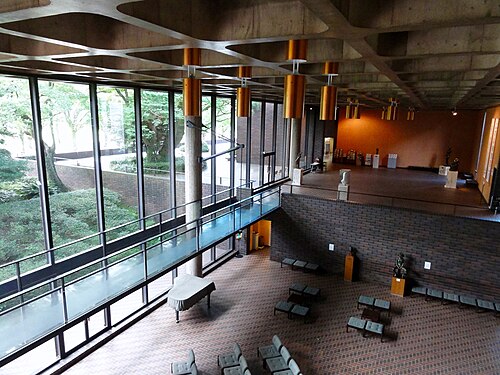
In the lobby, a concrete wall is chipped with a hammer: the work was done by hand by the craftsmen of the day, and the works of fiscal year 2013 uncovered their practice marks inside other walls. Round columns of bare concrete are poured in a wooden formwork assembled like a barrel, which imprints the wood grain and gives them a warmth close to wood. The volume that projects from the roof is the skylight of the lobby ceiling: after dark, when the museum is lit, the light shines out of it.
From the lobby one sees tall trees in the foreground, pines and castor aralias (kalopanax), Mount Iwaki on the left and, on the right, the south-west turret of the castle's second bailey, a nationally designated Important Cultural Property: a landscape where nature and history agree, which Maekawa wished to show.
Use today
The museum presents the history of the Hirosaki domain, with works of art and craft, along with the culture of Tsugaru nurtured by its climate and traditions, its precious surviving objects, its heritage and the achievements of local figures.
Visiting
The museum is open from 9:30 to 16:30. It closes on the third Monday of the month (the next day if that Monday is a public holiday), except during special exhibitions, and over the year-end holidays; it also closes temporarily while displays are being changed.
It stands in Hirosaki Park, about 2.8 km from JR Hirosaki Station.
Photos
40.61° N, 140.46° E
Greenhouses nearby
Architecture nearby
By the same architect
Sources (8)
- city.hirosaki.aomori.jp/hakubutsukan/2014-1203-gaiyou.html
- city.hirosaki.aomori.jp/hakubutsukan/2014-1203-gaiyou2.html
- city.hirosaki.aomori.jp/hakubutsukan/2014-1205-riyoannai-top.html
- city.hirosaki.aomori.jp/hakubutsukan/2014-1205-access.html
- maekawa-assoc.co.jp/page/founder.htm
- aomori-tourism.com/en/spot/detail_18.html
- openstreetmap.org/way/642365337
- wikidata.org/wiki/Q28154389
Affiliate links — booking through Verrière helps fund our research, at no extra cost to you.