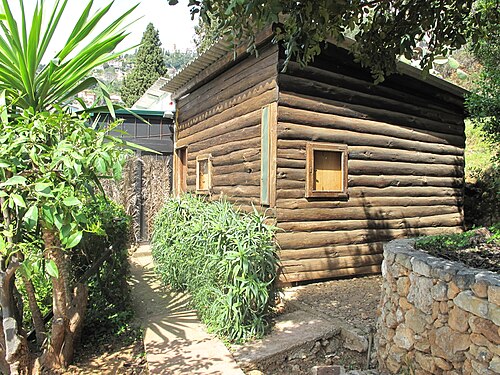
Lège Workers' Estate (Houses and Canteen)
Lège-Cap-Ferret, Gironde
Sources checked November 2026
- Year
- 1924-1925
- Architect
- Le Corbusier
- Type
- Workers' housing estate
- Access
- Visible from outside; the houses belong to a social landlord, the municipal canteen is inaccessible (Sites Le Corbusier and Fondation Le Corbusier, November 2026)
After reading Vers une architecture, the sugar industrialist Henry Frugès commissioned Le Corbusier to build houses for the workers of his sawmill at Lège. The programme brings together six houses of two types, a bachelors' house called the canteen, with a refectory, and a playing field fitted with a Basque pelota wall. Work ran from August 1924 to 1925; the houses and the canteen have been listed as historic monuments since 1990.
History
On 3 November 1923, after reading Vers une architecture, Henry Frugès, a sugar industrialist in Bordeaux, wrote to Le Corbusier: he was about to have a small workers' estate built around a sawmill he had just bought in the Landes near Arcachon. Shortly afterwards he commissioned him to build houses for the workers of that sawmill, at Lège; Le Corbusier built them with his cousin and partner Pierre Jeanneret.
Begun in August 1924, the work ended in 1925; the use of the "cement gun" and structural weaknesses caused many problems. During the crisis of the 1930s Frugès parted with his factory and went to North Africa; the Darbo family, foresters, bought the estate and the sawmill. The estate was then completely neglected and the houses were heavily altered: flat roofs gave way to gabled roofs, openings were blocked, interior layouts were altered and lean-tos were added.
The six houses, as well as the bachelors' house, known as the canteen, with its pelota wall, were listed as historic monuments in 1990. Gironde Habitat, a public development and construction office, has owned the houses since 1993 and launched a renovation campaign limited to the houses: from 1996 to 1997 the architect Jean-Luc Veyret restored their volumes and openings, notably the flat roof. In 2012 a further campaign, led by Pierre-Antoine Gatier, chief architect of historic monuments, dealt with thermal improvement and included replacing all the metal frames. The canteen belongs to the municipality of Lège-Cap-Ferret; in 2016 a preliminary study for its restoration was carried out with a view to opening it to the public.
Architecture
The programme includes six houses, three of type A and three of type B, plus a bachelors' house, also called the "canteen" and intended for seasonal workers, with its refectory, and a playing field equipped with a Basque pelota wall.
Visiting
The estate can be seen from the outside; the canteen is inaccessible.
44.80° N, 1.14° W
Architecture nearby
By the same architect