Conservatoire du Bégonia (Begonia Conservatory)
Rochefort, Nouvelle-Aquitaine
Entry updated on October 5, 2026
- Year
- 1987–1989
- Style
- Horticultural collection greenhouse (late 1980s)
- Dimensions
- 1,000 m² (650 m² originally, 350 m² extension in 1993)
- Status
- Open to the public, by guided tour only
Run by the town of Rochefort, this conservatory keeps under 1,000 m² of glass a begonia collection that the town presents as the most important in the world and that is recognised as France's national collection of the genus. It grew from the holdings of the horticulturist Vincent Millerioux, bought by the town after the harsh winters of 1985-86 in memory of Michel Bégon, intendant at Rochefort, to whom Charles Plumier dedicated these plants in 1690. Several hundred wild species and around a thousand hybrids can be seen on guided tours.
Affiliate links — booking through Verrière helps fund our research, at no extra cost to you.
History
1 min
Rochefort's tie to the begonia goes back to the late seventeenth century. On his voyages to the West Indies, the botanist Charles Plumier (1646-1704) came across these plants and in 1690 dedicated them to Michel Bégon (1638-1710), the king's intendant at Rochefort, who organised the expeditions sailing from the port. In the seventeenth and eighteenth centuries the town also made its name importing exotic plants, coffee in particular.
The present conservatory was born three centuries later from a private passion. Vincent Millerioux, a small grower from the Val-d'Oise, began collecting begonias in the 1960s after discovering Begonia rex; by 1985 his 250 or so plants made up the largest private collection in France. The harsh winters of 1985-86 led him to give up his business, and the town of Rochefort, bound to the genus by its history, acquired the collection.
A new greenhouse went up from 1987. Sources differ on the founding date: the tourist office gives 1987, Wikipedia 1988, while the magazine Hortus Focus places the public opening in June 1989. The original 650 m² was enlarged to 1,000 m² by a 350 m² extension in 1993. Over the following three decades the collection grew through exchanges with botanical gardens worldwide, through purchases and through expeditions to South America and Cameroon.
Architecture and engineering
1 min
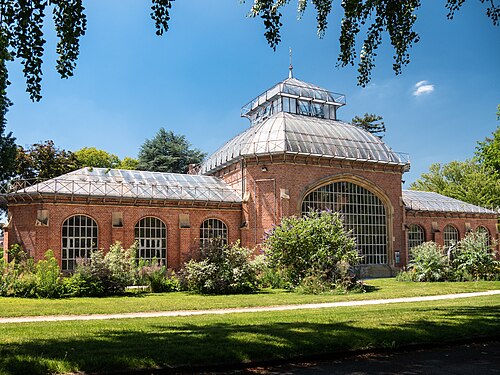
This is no nineteenth-century glass palace but a working greenhouse built in the late 1980s, whose designer is not named in any of the sources consulted. Its covered area, 650 m² at the outset, was brought to 1,000 m² in 1993 by a 350 m² extension.
Climate is the real challenge here. The begonias come from three continents, the Americas, South-East Asia and West and sub-Saharan Africa, and grow in the wild anywhere from sea level to 4,000 m. The greenhouse is therefore divided into zones with different conditions, and each plant is placed according to its needs: some are watered every three hours, others only every three days.
The most delicate miniature species are displayed in terrariums. Visits take place in small groups of no more than twenty-five, always led by a guide.
Plant collections
1 min
The conservatory describes its holdings as the largest begonia collection in the world, and it is recognised as the national collection of the genus Begonia in France. Figures vary between sources: about 500 botanical species and over 1,000 varieties, hybrids and cultivars according to Wikipedia and the Au jardin website, more than 1,500 species and hybrids according to the tourist office, and between 1,700 and 1,800 begonias according to Hortus Focus. The genus itself counts more than 2,000 described species.
All the main groups are represented: cane-stemmed bamboo-like begonias, climbing or trailing rhizomatous species, tuberous and miniature ones, as well as Begonia rex hybrids and other garden forms. Species singled out include Begonia luxurians, B. aconitifolia, B. prismatocarpa and B. sutherlandii, alongside the hybrid B. × erythrophylla. Some plants are in flower throughout the year, February and November included.
Visiting
1 min
The conservatory stands at 1 rue Charles-Plumier in Rochefort and can only be seen with a guide: tours are in French, last from 45 minutes to an hour and take groups of up to twenty-five people, with advance booking for parties. It closes in December and January, and also during orange or red heatwave alerts.
Since begonias flower in every season, the timing of a visit matters little, although the calendar is worth checking beforehand. The outing extends naturally into the town of Rochefort, the port from which Michel Bégon's expeditions once set sail.
45.92° N, 0.96° W
Greenhouses nearby
More greenhouses — France
Do you have a good photo of this greenhouse? Suggest it for this page →