ANDO MUSEUM
Naoshima, Kagawa
Sources checked October 2026
- Year
- 2013
- Architect
- Tadao Ando
- Type
- Architecture museum in a transformed traditional house (minka)
- Access
- Open to the public, closed on Mondays, tickets online or at the desk (official site, October 2026)
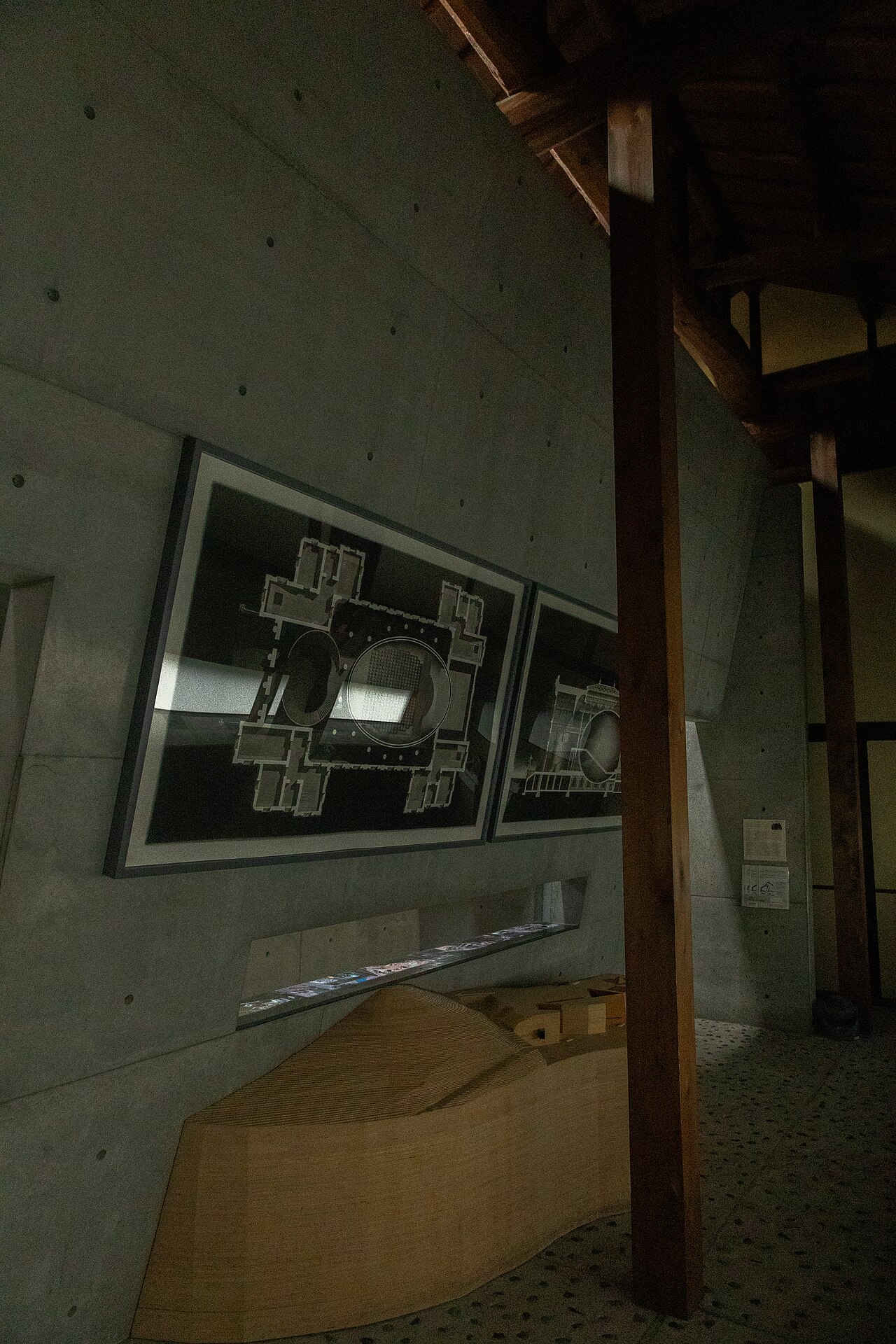
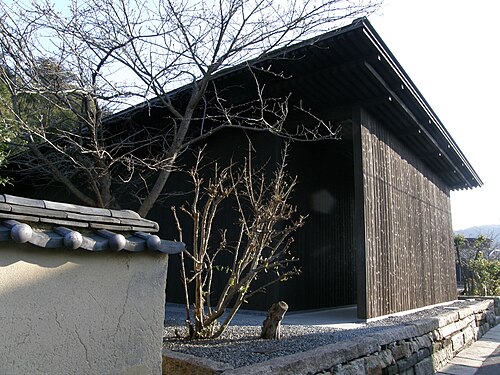
In the Honmura (本村) district of Naoshima (直島), Tadao Ando (安藤忠雄) nested a volume of bare concrete in 2013 inside a wooden house about a century old, whose exterior has been kept. Daylight comes down from the wooden roof; photographs, sketches and models present Ando's work and the island's history. It is his eighth work on Naoshima, less than 100 metres from Minamidera.
Affiliate links — booking through Verrière helps fund our research, at no extra cost to you.
History
ANDO MUSEUM opened on 12 March 2013 on Naoshima (直島), in Kagawa Prefecture (香川県). It is Tadao Ando's (安藤忠雄) eighth work on the island. It was conceived as the culmination of more than twenty years of Ando's work with Benesse Art Site Naoshima (ベネッセアートサイト直島), and Soichiro Fukutake (福武總一郎), chairman of the Fukutake Foundation (福武財団), also describes it as the culmination of the approach "use what exists to create what does not", the one behind the Art House Project (家プロジェクト).
The Honmura (本村) district was developed in the Middle Ages as a base for a war fleet (水軍, suigun), and several of its houses are over a hundred years old. The house chosen was tied to the Hachiman Shrine (八幡神社), the shrine of the whole island, whose great festival takes place in autumn: its family played the drum at the rituals and bore the house name (屋号, yagō) "Ichindon" (いちんどん), which means the first rank of the festival procession. The name plate now hangs in front of the gate. This history was one of the reasons the building was chosen.
When the house was taken apart to build the interior space, roof tiles from the late Edo period bearing a maker's inscription were found, reused several times; they were put back on the museum's roof. The original beams were put back once the interior had been built.
The design is by Ando's office (安藤忠雄建築研究所) and the construction by Kajima (鹿島建設). The built part was donated to the Fukutake Foundation by the Tadao Ando Culture Foundation (安藤忠雄文化財団) and others.
Architecture
Ando kept the shell of the house and nested a box of bare concrete (打ち放しコンクリート) inside it: outside it is still a wooden house about a century old, inside a double structure of concrete with a gently curved ceiling. The whole is small: a 114.43 m² footprint and 124.52 m² of floor area, with one level above ground and one below, in wood and reinforced concrete. The facade blends so well into the neighbouring houses that it is easy to miss; at the front, a transparent conical projection brings daylight down to the basement.
Ando describes one wall of the box as aligned with the main axis of the house and tilted towards the ridge, so that the space opens upward; light descends from the opening at the top of the wooden roof. His aim, he says, was to create a rich sense of depth in a tiny place, where past and present, wood and concrete, light and shadow clash as they overlap.
On entering the exhibition space, a reinforced-concrete wall tilted 12 degrees stands on the left, 4.3 m high and 180 mm thick. The design called for 250 mm; faced with a full-size mock-up on site, Ando judged the wall too thick, like a block of concrete, and had it slimmed. The tilt bounces natural light from the skylight off the wall and spreads it softly through the room. The curved ceiling, the tilted wall and the slits leave gaps through which the sun comes in.
The museum is lit by natural light alone: the skylight in the wooden roof and the windows in the walls, which the concrete reflects. In so thin and tilted a wall, the dense reinforcement hinders the flow of concrete and air escapes poorly, forming bubbles on the surface. The concrete was therefore poured in mid-December 2012, in a single pour: one worker poured it slowly along the formwork while the others struck the formwork from outside to drive out the air. The resulting wall is smooth and glossy, and above it one sees the beams and roof frame of the original house. Many of the workers had already built other Ando buildings on Naoshima, such as Benesse House (ベネッセハウス) or the Chichū Art Museum (地中美術館).
Use today
The museum presents Ando's work and the history of Naoshima through photographs, sketches and models, but people also come for the building itself: the renewed house is part of what one visits. A shop sells books about Ando and original goods, some of them bearing his signature or a drawing by his hand.
It stands in Honmura, where the Art House Project turns old houses into settings for contemporary art. Minamidera (南寺), which Ando built in 1999 for a work by James Turrell, is less than 100 metres away.
Visiting
The museum is open from 10:00 to 13:00 and from 14:00 to 16:30 (last entry 16:00) and closed on Mondays; if the Monday is a public holiday or a day off, it opens and closes the next day. Admission is charged, but free up to age 15. From March to November, the busy season, the number of visitors inside the museum may be limited. Address: 736-2 Naoshima-chō, Kagawa-gun, Kagawa (〒761-3110).
There are no toilets in the museum: visitors use the public toilets near Minamidera. Strollers are not allowed, and suitcases, umbrellas and tripods are left at reception (there are no coin lockers). Photography is permitted for personal use, but video and copying by drawing are not. As the building is old, some areas are not accessible to visitors with reduced mobility; the museum asks to be contacted before the visit.
The Naoshima town bus (直島町営バス) runs from Miyanoura port (宮浦港), where the ferries arrive, through Honmura on its way to Tsutsuji-sō (つつじ荘).
Photos
34.46° N, 134.00° E
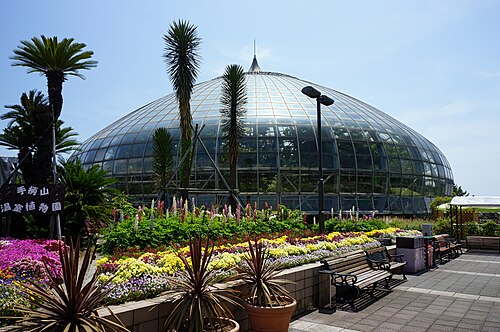
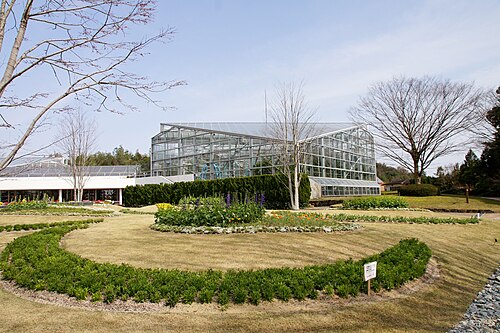
Greenhouses nearby
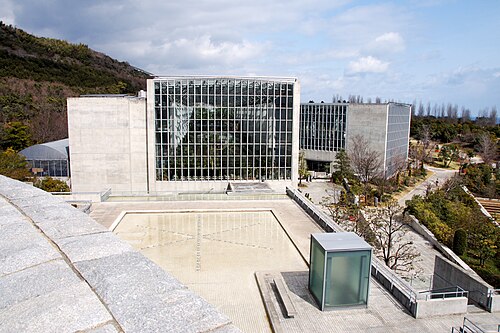
Architecture nearby
Sources (9)
- benesse-artsite.jp/art/ando-museum.html
- benesse-artsite.jp/en/art/ando-museum.html
- benesse-artsite.jp/story/20211119-2183.html
- benesse-artsite.jp/story/20231124-2775.html
- benesse-artsite.jp/access/naoshima/
- nikkei.com/article/DGXNASFK1800L_Y3A310C1000000/
- bijutsutecho.com/museums-galleries/764
- wikidata.org/wiki/Special:EntityData/Q135903981.json
- api.openstreetmap.org/api/0.6/node/2401898964.json
Affiliate links — booking through Verrière helps fund our research, at no extra cost to you.