Handayama Botanical Garden Greenhouses (岡山市半田山植物園 温室)
Okayama (Kita Ward), Okayama Prefecture
No freely licensed photo of this greenhouse yet. Do you have one? Suggest it for this page →
Sources checked October 2026
- Style
- Glasshouses on metal glazing bars, one a large barrel-vaulted volume
- Status
- Open to the public with the garden (closed Tuesdays, next day if a holiday)
On Handayama hill in Okayama, the municipal botanical garden, opened in May 1964, holds a group of greenhouses whose history the garden's Japanese timeline traces: a first unheated wooden house in 1957, desert and tropical plants from Kyoto University in 1958, all-aluminium rebuilds in 1974 and 1981, then a bromeliad room and a dome room in 2005. The official site's photograph shows a large barrel-vaulted glazed volume; the garden's 2026 flower map names a "Sunny Garden" greenhouse and a cactus greenhouse.
Affiliate links — booking through Verrière helps fund our research, at no extra cost to you.
History
Handayama Botanical Garden began in 1953 on the grounds of the city's water reservoir, then run by the Waterworks Bureau; it joined the Japanese Association of Botanical Gardens in 1954 and received a master plan from Kyoto University's landscape team in 1956. It officially opened in May 1964, free at first, with an entrance fee from November.
The greenhouses follow the timeline of the Japanese Wikipedia, whose page is flagged as insufficiently sourced: a first unheated wooden house in November 1957; in 1958 the arrival of desert and tropical plants from Kyoto University's garden, then a second house heated by a coal boiler; a third unheated wooden house in October 1967; the Sunny Garden completed in March 1972. In May 1974 the first house was rebuilt entirely in aluminium and opened as a desert plant house; in April 1981 the third was rebuilt in turn, in aluminium and unheated, with the same purpose. In March 2005 the houses were refitted with a bromeliad room and a dome room. In 2014 the garden was designated a museum-equivalent facility and celebrated its 50th anniversary.
Architecture and engineering
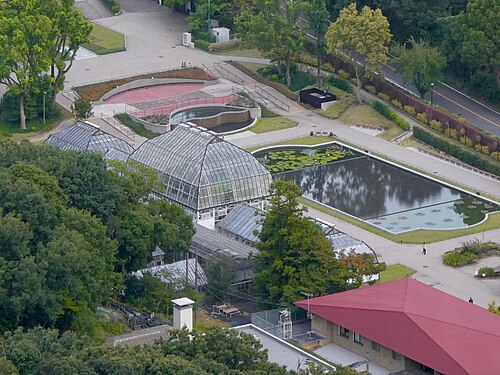
The Japanese timeline speaks of unheated wooden houses (1957, 1967), a coal-heated house (1958), then rebuilds "entirely in aluminium" (1974, 1981), the later one unheated. The official site's photograph shows a large barrel-vaulted glazed volume with a tall gable, its roof and walls made of rectangular panes on metal bars; a low house under dark shading flanks it on the left, and a glazed annexe serves as the entrance on the right.
A page from the Okayama Prefecture International Exchange Foundation (2023) says temperature and humidity stay constant all year in the greenhouses, so that visitors can see tropical plants up close. On the garden's official map, the greenhouse and the cactus greenhouse lie in the part of the garden near the rose garden and the water lily ponds.
Plant collections
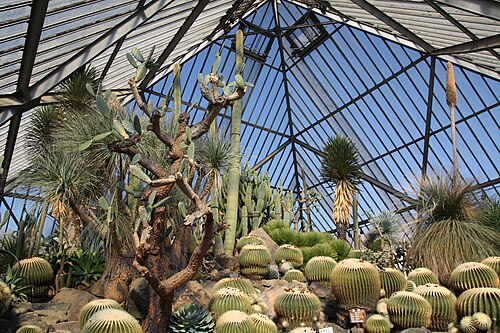
The Japanese timeline gives the greenhouses a desert and tropical purpose: desert and tropical plants from Kyoto University in 1958, then two rebuilds opened as desert plant houses in 1974 and 1981. The 2005 refit created a bromeliad room (アナナス室) and a dome room (ドーム室). The garden's flower map, dated 10 October 2026, also names a cactus greenhouse.
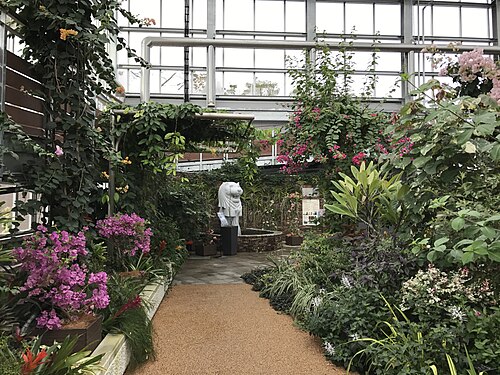
An article by the Okayama tourism association (June 2019) presents the Sunny Garden as a place to rest among brightly coloured plants such as ixora and bougainvillea, and to observe, with some caution, a carnivorous plant, the pitcher plant.
Outdoors, a pond holds a giant water lily, the "Paraguay onibasu" (パラグアイオニバス), whose leaves reach up to 1 m and whose flowers open at night during the summer Night Garden. The whole garden holds about 3,200 species and 150,000 plants.
Visiting
The greenhouses stand in Handayama Botanical Garden, 11 hectares on a hill overlooking central Okayama. The Ippon-matsu tumulus, a 65 m keyhole-shaped mound from the late fifth century, marks the high point; three circular reservoirs dating from 1905 and 1919, entered on the register of cultural properties in 2004, occupy the slope. According to the Japanese Wikipedia, the cherry blossom festival runs from late March to mid-April, with ten evenings of night opening; in summer the Night Garden shows the giant water lilies after dark.
The garden is about fifteen minutes' walk from Hōkaiin station on the Tsuyama line, or a bus on the Okaden network to the "Shokubutsuen-mae" stop, about a minute on foot.
34.69° N, 133.93° E
Greenhouses nearby
More greenhouses — Japan
Do you have a good photo of this greenhouse? Suggest it for this page →
Sources (6)
Affiliate links — booking through Verrière helps fund our research, at no extra cost to you.