Asahi Group Oyamazaki Villa Museum of Art
Ōyamazaki, Kyoto Prefecture
Sources checked October 2026
- Year
- 1995 (Ando annex), 2012 (Yamate-kan)
- Architect
- Tadao Ando
- Type
- Art museum in a villa of the 1910s-1930s, with two Ando annexes
- Access
- Open to the public, closed on Mondays (official site, October 2026)
On the southern slope of Mount Tennōzan in Ōyamazaki, the villa that the businessman Kaga Shōtarō (加賀正太郎) began building in 1912 became a museum in 1996. Tadao Ando (安藤忠雄) added the half-underground annex "Jewel Box in the Earth" (地中の宝石箱), whose cylindrical gallery permanently holds Claude Monet's Water Lilies, and in 2012 the Yamate-kan "Box of Dreams" (夢の箱), set under the trees. A garden of about 5,500 tsubo, its water-lily ponds and a terrace over the meeting of three rivers complete the visit.
Affiliate links — booking through Verrière helps fund our research, at no extra cost to you.
History
The villa was the work of a Kansai businessman, Kaga Shōtarō (加賀正太郎, 1888-1954), who took part himself in designing the buildings and the garden. As a young man he studied in Europe and kept the memory of the Thames seen from Windsor Castle: that memory led him to choose Ōyamazaki, where the Kizu, Uji and Katsura rivers meet, and he began building in 1912. The first phase was finished around 1917; it corresponds to the present entrance hall and is said to be inspired by a miner's house he had seen in England. From 1922 Kaga set about transforming the villa, and the present building dates from around 1932. He also grew orchids at Ōyamazaki and published a book of botanical plates, the Rankafu (蘭花譜). He took part in founding the whisky company Nikka and, late in life, entrusted his shares to his close friend Yamamoto Tamesaburo (山本爲三郎, 1893-1966), first president of the Asahi brewery: that link lies behind the present museum.
Kaga died in 1954; after his wife's death the villa left the family in 1967. After several resales the building deteriorated, and in 1989 a plan emerged to demolish it and build a large apartment block. A preservation movement, led mainly by local residents, grew; at the request of Kyoto Prefecture and Ōyamazaki town, Asahi Breweries restored the villa to its original appearance and opened it as a museum.
The museum opened in April 1996 (Heisei 8), bringing together three legacies: a precious piece of modern architecture, the heritage of an art movement at the forefront of its day, and the contemporary architecture of Tadao Ando. Ando's underground annex was completed in 1995 and the Yamate-kan in 2012, a hundred years after work on the villa began. In 2004 six buildings on the estate were registered as national tangible cultural properties: the villa itself (the Seikeirō, 霽景楼), the tea pavilion Saigetsu-an (彩月庵), the Tochinoki teahouse (橡の木茶屋), the Seikarō lookout tower (栖霞楼), the former garage and the garden entrance tunnel, Rōkandō (琅玕洞). The museum was called Asahi Beer Oyamazaki Villa Museum of Art; it took its present name in July 2023.
Architecture
The villa, whose design Kaga supervised, was first built of wood in the Taishō era and then greatly enlarged in the early Shōwa period. It follows the English Tudor Gothic style with exposed half-timbering, on a reinforced-concrete structure with a steel roof frame. On the second floor the terrace combines half-timbering with the memory of the Swiss chalets Kaga had seen in Europe; it is finished in Tatsuyama stone from near Kakogawa (Hyōgo) and overlooks the meeting of the three rivers. Inside, details abound: stained glass brought from Europe whose glass contains gold, cut-glass windows that scatter rainbow light across the floor on sunny afternoons, a real fishing net set into the plaster of one wall, bamboo shoots (a speciality of the Otokuni area) carved on the fireplace and ceiling, and Chinese funerary reliefs of the Later Han dynasty built in above the hearth. A bathroom with running hot water, a luxury then, was fitted upstairs.
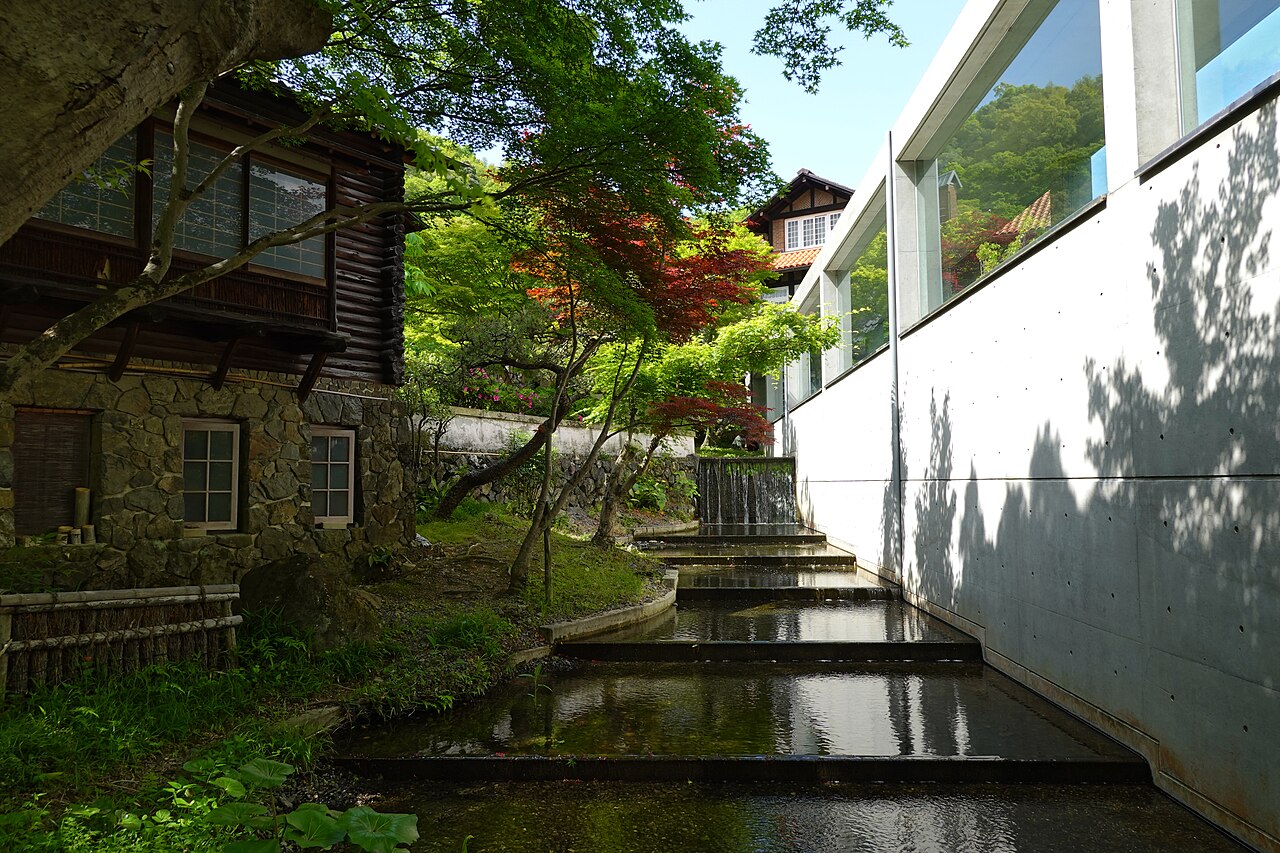
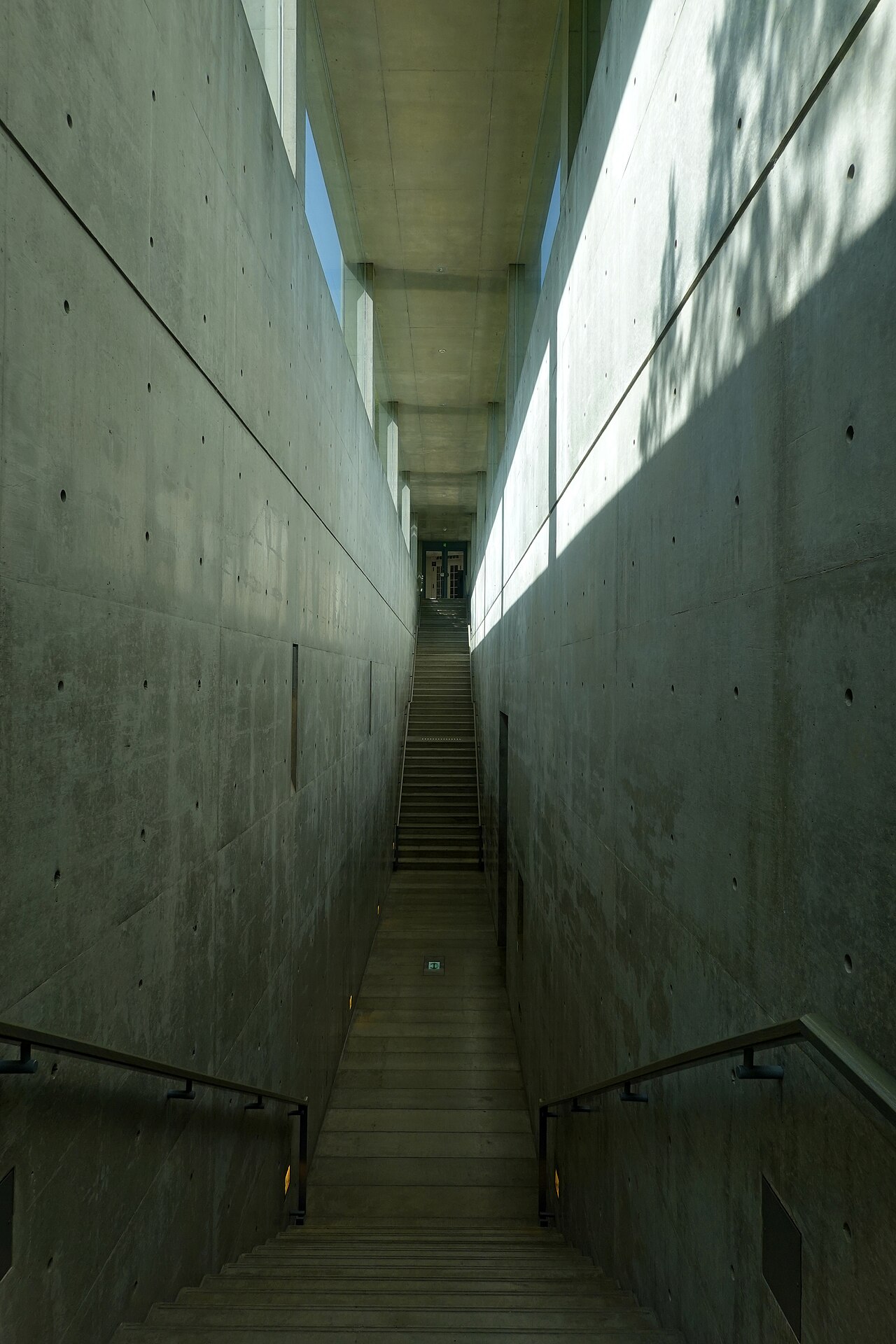
Tadao Ando's annex, which he named the "Jewel Box in the Earth" (地中の宝石箱, Chichūkan), is half-buried to harmonise with the landscape; its exhibition space is cylindrical and its top is planted. A passage in exposed concrete links it to the villa: one leaves the villa, goes down a stair between high walls, and the upper part of the passage is glazed on all four sides, so the green of the surrounding trees enters the space. At the foot of the stair, the slope of the ground brings the water of the outside pond to eye level. Near the stair a small water-lily pond spills in a cascade towards the large pond in the garden; the roof of the annex is planted.
The Yamate-kan (山手館), "Box of Dreams" (夢の箱), is a single-storey box-shaped building that contrasts with the cylinder of the underground annex. It is placed so as not to disturb the view of the Seikarō tower from the ground-floor terrace of the villa: it sinks among the trees and its roof is planted, so this straight-lined concrete blends into the nature of Tennōzan. It stands on the site of the villa's orchid greenhouse, and the glazed corridor linking it to the villa was the passage that led to that greenhouse.
Use today
The core of the collection is the Yamamoto Tamesaburo holding, donated when the museum opened: ceramics by Kawai Kanjirō (河井寬次郎), Hamada Shōji (濱田庄司), Bernard Leach and Tomimoto Kenkichi (富本憲吉), and fine pieces of old craftwork brought from East and West by Yanagi Sōetsu (柳宗悦) and his circle. They bear witness to the mingei ("folk art") movement, whose name was coined in 1925 by Yanagi, Kawai, Hamada and others, and which Yamamoto supported with fervour.
The cylindrical gallery of Ando's annex permanently shows Claude Monet's Water Lilies series. The Yamate-kan shows varied works according to the exhibition. From June to August the water lilies in the garden ponds answer those of Monet.
The villa's garden, of about 5,500 tsubo, is open for strolling: spring cherry trees, autumn maples and ginkgos, winter camellias. On the villa's second floor a tea room serves drinks and cakes, with seats on the terrace; the museum shop is on the ground floor. The former Tudor Gothic garage now serves as a free rest house.
Visiting
The museum is open from 10 am to 5 pm, last entry at 4:30 pm. It is closed on Mondays (on the following Tuesday when the Monday is a public holiday), on exceptional closure days and over the year-end holidays. The general admission fee varies with the exhibition; junior-high pupils and younger enter free. Address: 5-3 Zenihara, Ōyamazaki, Otokuni District, Kyoto (〒618-0071).
It is a walk of about 10 minutes from JR Yamazaki station (山崎) or Hankyū Ōyamazaki station (大山崎); there is no car park and no vehicle access, and a free 13-seat shuttle, with priority for older visitors, links both stations to the garden entrance. From that entrance (the Rōkandō tunnel) to the villa there are about 300 m of gentle uphill. The villa has small steps and passages 70 to 80 cm wide in places, and a lift serves the villa and Ando's annex; visitors who are unsure about walking are asked to tell the museum beforehand.
Visitors are asked to refrain from photography inside; it is allowed in the garden and on the terrace. Backpacks, umbrellas, tripods and items larger than 40 × 40 cm may not be brought in (free lockers in the former garage), strollers are left in front of the villa, only pencils may be used for notes, and pets are not allowed.
Photos
34.90° N, 135.68° E
Greenhouses nearby
Architecture nearby
Sources (12)
- asahigroup-oyamazaki.com/about/
- asahigroup-oyamazaki.com/about/history/
- asahigroup-oyamazaki.com/about/structure/
- asahigroup-oyamazaki.com/about/design/
- asahigroup-oyamazaki.com/about/garden/
- asahigroup-oyamazaki.com/about/yamamoto/
- asahigroup-oyamazaki.com/guide/
- asahigroup-oyamazaki.com/guide/floor/
- asahigroup-oyamazaki.com/guide/access/
- asahigroup-oyamazaki.com/guide/barrier-free-accessibility/
- museum.or.jp/museum/5104
- openstreetmap.org/way/477804152
Affiliate links — booking through Verrière helps fund our research, at no extra cost to you.