Greenhouse of Hattori Ryokuchi Urban Greening Botanical Garden (服部緑地都市緑化植物園 温室)
Toyonaka, Osaka Prefecture
No freely licensed photo of this greenhouse yet. Do you have one? Suggest it for this page →
Sources checked October 2026
- Year
- 1983
- Architect
- Mitsuo Taki (瀧光夫)
- Style
- Modern brick-and-steel building with large glass walls, glasshouse built into a slope
- Status
- Open to the public with the garden (closed Tuesdays and at year end)
In the Hattori Ryokuchi Urban Greening Botanical Garden, in Toyonaka, the display glasshouse is built into the "Flower and Green Consultation Center" building, dated 1983 and designed by Mitsuo Taki, which spans a level change of almost 5 metres. The route descends a slope under glass walls and a glass ceiling, among subtropical plants (about a hundred species according to a 2018 guide), old cacti, a water-lily pool and the Camellia Room, where cold-sensitive camellias are kept above 15 °C in winter. The garden opened in 1983, at the first National Urban Greening Fair.
Affiliate links — booking through Verrière helps fund our research, at no extra cost to you.
History
The Hattori Ryokuchi Urban Greening Botanical Garden opened in 1983, the year Hattori Ryokuchi Park hosted the first National Urban Greening Fair; according to the Tsubaki Fan blog, the crown prince of the day visited and a commemorative camellia was planted. The garden, of about 6 hectares, has kept its "camellia hill" (Tsubakiyama) since the beginning, planted at the opening with 700 varieties with the help of local nurseries.
The programme of the Living Architecture Museum Festival Osaka 2023 dates the "Flower and Green Consultation Center" building (花と緑の相談所), which houses the display glasshouse, to 1983 and credits its design to Mitsuo Taki. The building was published in the October 1984 issue of Shinkenchiku under the title "Osaka Prefectural Hattori Ryokuchi Urban Greenery Botanical Garden, Flower and Greenery Consultation Center". An architecture fan's Instagram post says 1977; 1983 coincides with the garden's opening.
Outdoors, the camellia hill has suffered the decline of many trees, blamed on a fungus, and a new planting began in January 2026, according to a March 2026 report.
Architecture and engineering
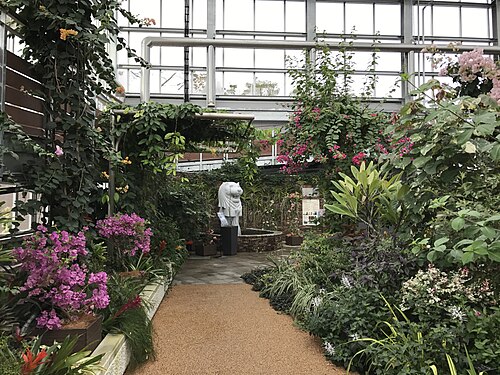
The 2023 programme describes a building that straddles a level change of almost 5 m and houses the glasshouse in it, with a modern staging of terrain, plants, water and park landscape. An architecture-minded blogger describes in 2025 a gentle climb between trees, then a modern building of brick and steel whose large glass panes reflect the greenery; inside, a glass ceiling diffuses light into a tall volume opened to the outside by glazed walls. Another review mentions a glasshouse covered with large sheets of glass, visible from outside, which is toured by descending a gentle ramp.
The building also serves as the garden's entrance and reception: visitors enter through a door whose handle bears a ginkgo leaf and the Camellia Room is on the lower floor. An indoor pool holds water lilies that reflect the green and the sky through the glass. On OpenStreetMap the building has two levels and covers about 950 m²; a 2018 guide mentions a baby rest room on the ground floor of the glasshouse.
Plant collections
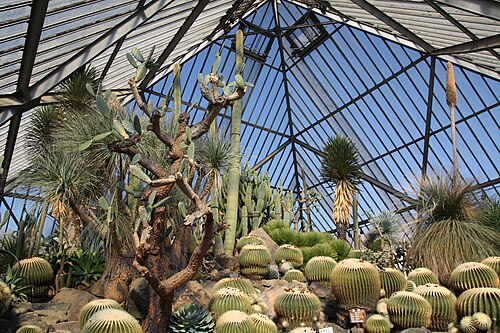
A 2018 guide counts about a hundred species of subtropical plants in the glasshouse; a camellia website notes fine cacti and other succulents, grown over decades. A 2025 visitor also cites a pale-blue-flowered plumbago (ルリマツリ), an Indian bodhi tree (インドボダイジュ), many cacti and a water-lily pool.
The Camellia Room gathers cold-sensitive camellias, kept above 15 °C according to the Sankei: about twenty camellias from the earliest to the latest, that newspaper says, and more than twenty Camellia according to Tsubaki Fan, among them the yellow camellia of southern China (金花茶) and Vietnam's Camellia amplexicaulis, as well as Western cultivars such as 'Coral Delight', 'Grand Slam', 'Dr Tinsley', 'Fire Dance' and 'Margaret Davis'. Blooms stay in good condition until early March. Outdoors, the camellia hill holds about 500 varieties and more than a thousand trees.
Visiting
From the garden's east gate, the reception building is straight ahead: visitors buy a ticket there, then the camellia hill lies to the right, while a staircase leads down to the glasshouse and the Camellia Room. Ryokuchi-koen station, on the Kita-Osaka Kyuko line, is about 10 minutes away on foot.
Camellias bloom from December to April, peaking in March and April; the Camellia Room protects them from bad weather and from birds. The garden also has a herb garden to see from May to July and volunteer guided tours on every open day at 10:30 and 13:30, starting from the camphor-tree deck. Neighbouring Hattori Ryokuchi Park holds, among other things, the open-air Japan Folk House Museum, opened in 1956.
34.77° N, 135.49° E
Greenhouses nearby
More greenhouses — Japan
Do you have a good photo of this greenhouse? Suggest it for this page →
Sources (10)
- hattori-ryokuchi.com/guide/arboretum/
- hattori-ryokuchi.com/guide/arboretum/guide_access/
- ikenchiku.jp/ikefes2023/153/
- data.shinkenchiku.online/projects/articles/SK_1984_10_230-0
- sankei.com/article/20250129-NWY5TBTNAVNZXJXPS7OO32OJK4/
- mediall.jp/landmark/134479
- tsubaki-fan.com/camellia-trip/hattoriryokuchisyokubutuen-tsubakiyama-camelliaroom/
- lovegreen.net/event/p161958/
- note.com/yasuisanchi/n/n83b5743b6612
- wills.co.jp/areainfo/toyonaka/spotG00126.html
Affiliate links — booking through Verrière helps fund our research, at no extra cost to you.