Benesse House Museum
Naoshima, Kagawa
Sources checked October 2026
- Year
- 1992
- Architect
- Tadao Ando
- Type
- Contemporary art museum and hotel
- Access
- Museum open year-round, 8:00 to 21:00; the Oval and guest rooms are for hotel guests only (official site, October 2026)
Benesse House Museum (ベネッセハウス ミュージアム), opened in 1992 on a height above the Seto Inland Sea, combines museum and hotel on the principle of the "coexistence of nature, art and architecture". Tadao Ando (安藤忠雄) opens the interior to the island through large apertures and completed the complex with the Oval (1995), the Park and the Beach (2006), all of his design. The site-specific works stand where their artists chose to put them.
Affiliate links — booking through Verrière helps fund our research, at no extra cost to you.
History
The story begins with a meeting in 1985. Tetsuhiko Fukutake (福武哲彦), founder of the company Fukutake Shoten (福武書店), wanted to create a place on an island in the Seto Inland Sea where children from around the world could gather; Chikatsugu Miyake (三宅親連), then mayor of Naoshima (直島), dreamed of turning the south of the island into a clean, educational cultural area. The two men agreed to develop the island.
In July 1989 the Naoshima International Camp (直島国際キャンプ場) opened under the supervision of Tadao Ando (安藤忠雄); Karel Appel's open-air sculpture Frog and Cat (かえると猫), installed then, was the first contemporary artwork permanently installed on the island. Benesse House (ベネッセハウス) opened in July 1992 as a single complex that is both museum and hotel. Art activity started at the same time under the name "Naoshima Contemporary Art Museum" (直島コンテンポラリーアートミュージアム), with many exhibitions from 1992 to 1995. In September 1994 the exhibition "OUT OF BOUNDS" showed works outside the museum, in the open air, an important step towards what followed; Yayoi Kusama's (草間彌生) Pumpkin was already in it. In July 1995 Ando completed the Oval (オーバル), a building reserved for accommodation.
In 1996 the policy changed: rather than buy works to display, artists were invited to make works "that exist only on Naoshima", shown permanently in and around Benesse House. The museum still holds Ando's drawings and a model for the project (1995, 1996 and around 1998).
The Park (パーク) and the Beach (ビーチ), two new accommodation buildings, opened in May 2006. In March 2022 the Valley Gallery (ヴァレーギャラリー) and the Hiroshi Sugimoto Gallery "Time Corridors" (杉本博司ギャラリー 時の回廊) opened. The Pumpkin was replaced the same year, in the same place, by a new version.
Architecture
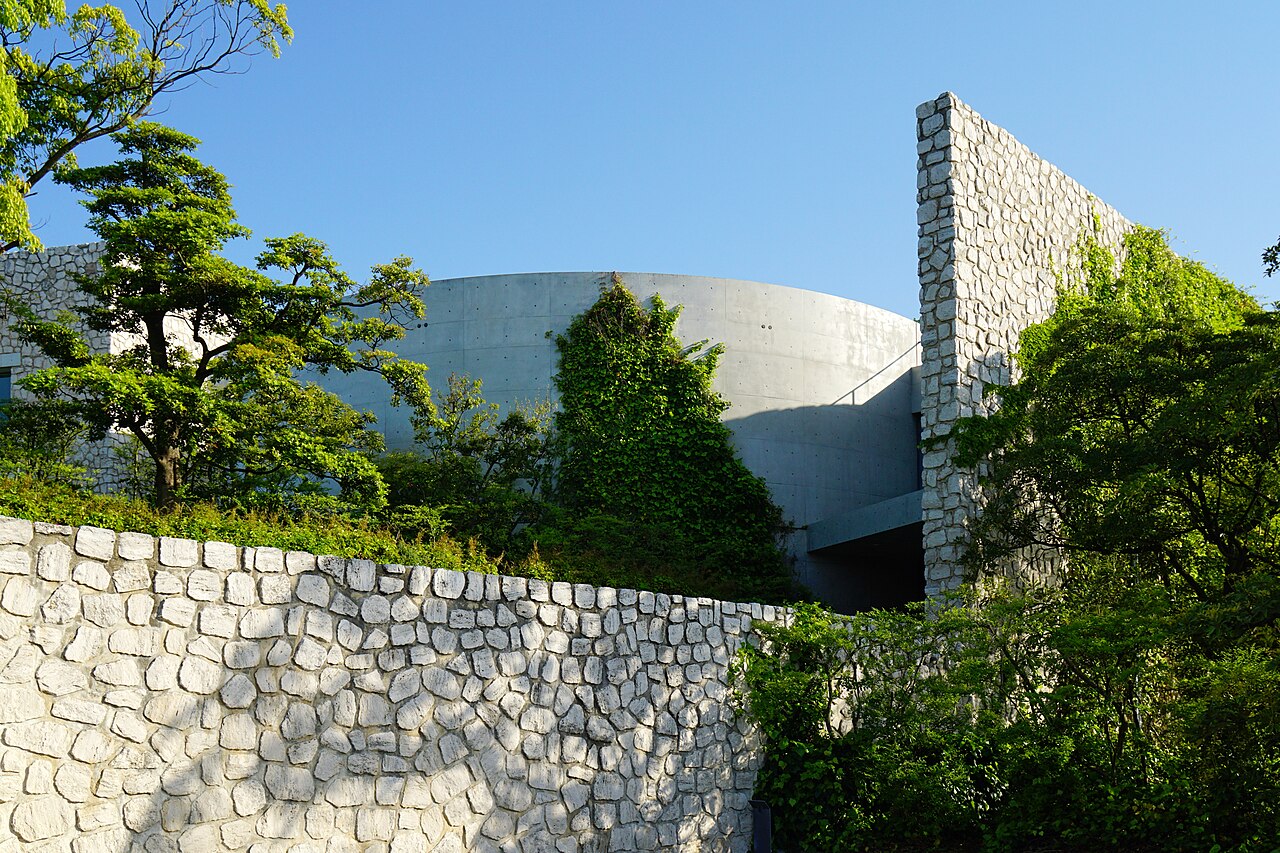
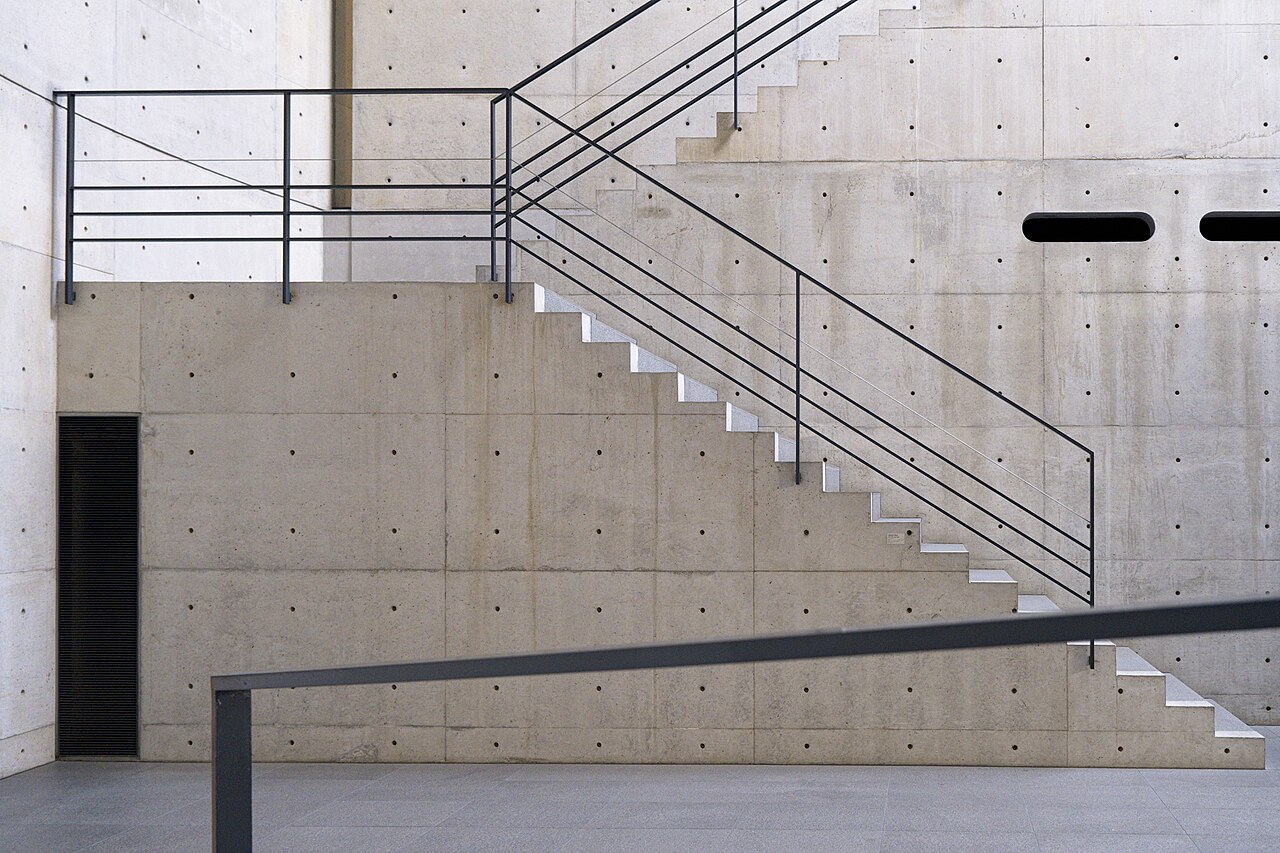
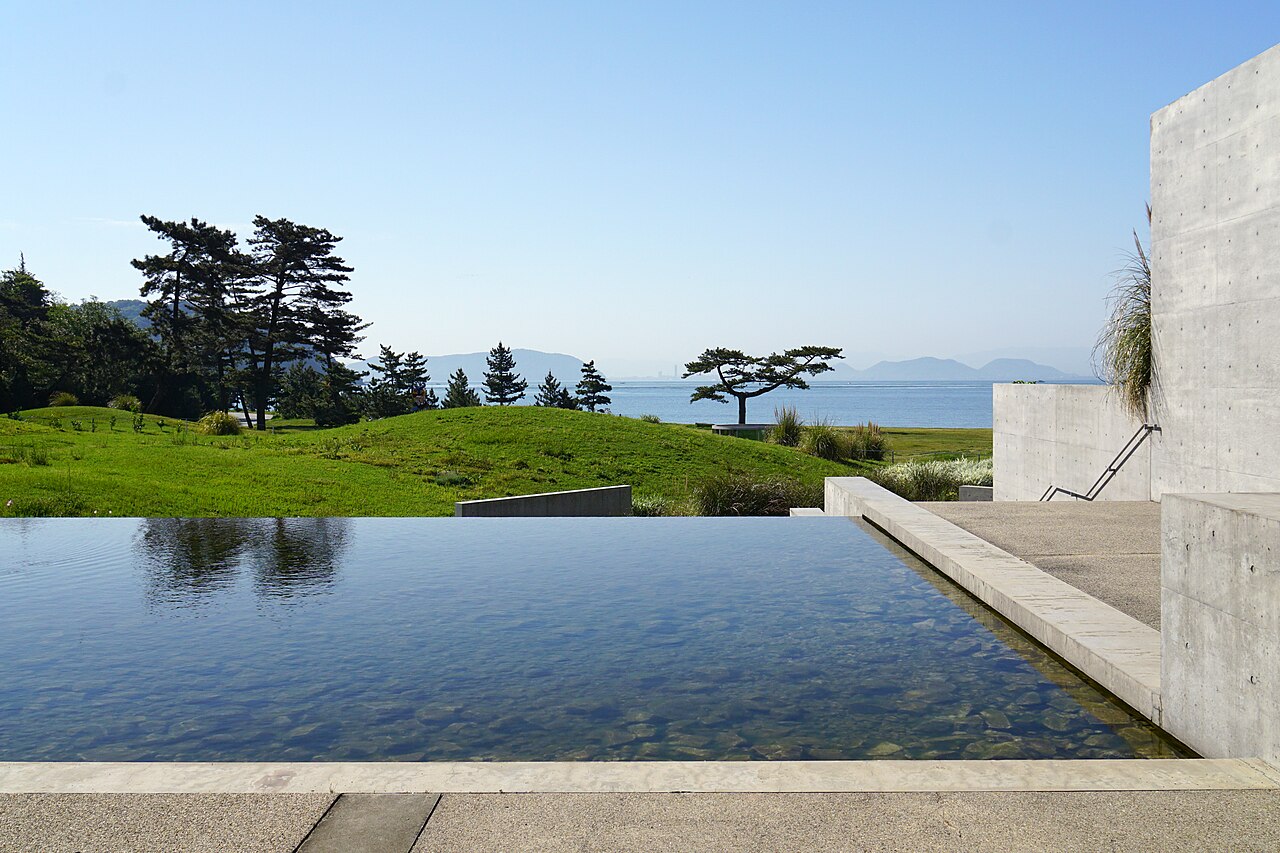
The museum stands on high ground overlooking the Seto Inland Sea, and large openings bring the island's nature into the interior. The whole complex (the Museum, the Oval, the Park and the Beach) is Ando's work, composed to blend over time into the Setonaikai National Park (瀬戸内海国立公園). Visitors move along long ramps, stairs and passages, and outside light enters through openings cut into the walls, so that contemporary art is felt with the whole body. In the museum, the basement restaurant, with its wide glazed opening, gives a view of the Inland Sea and contemporary art from every seat; the second-floor café opens to the south and west and takes in natural light.
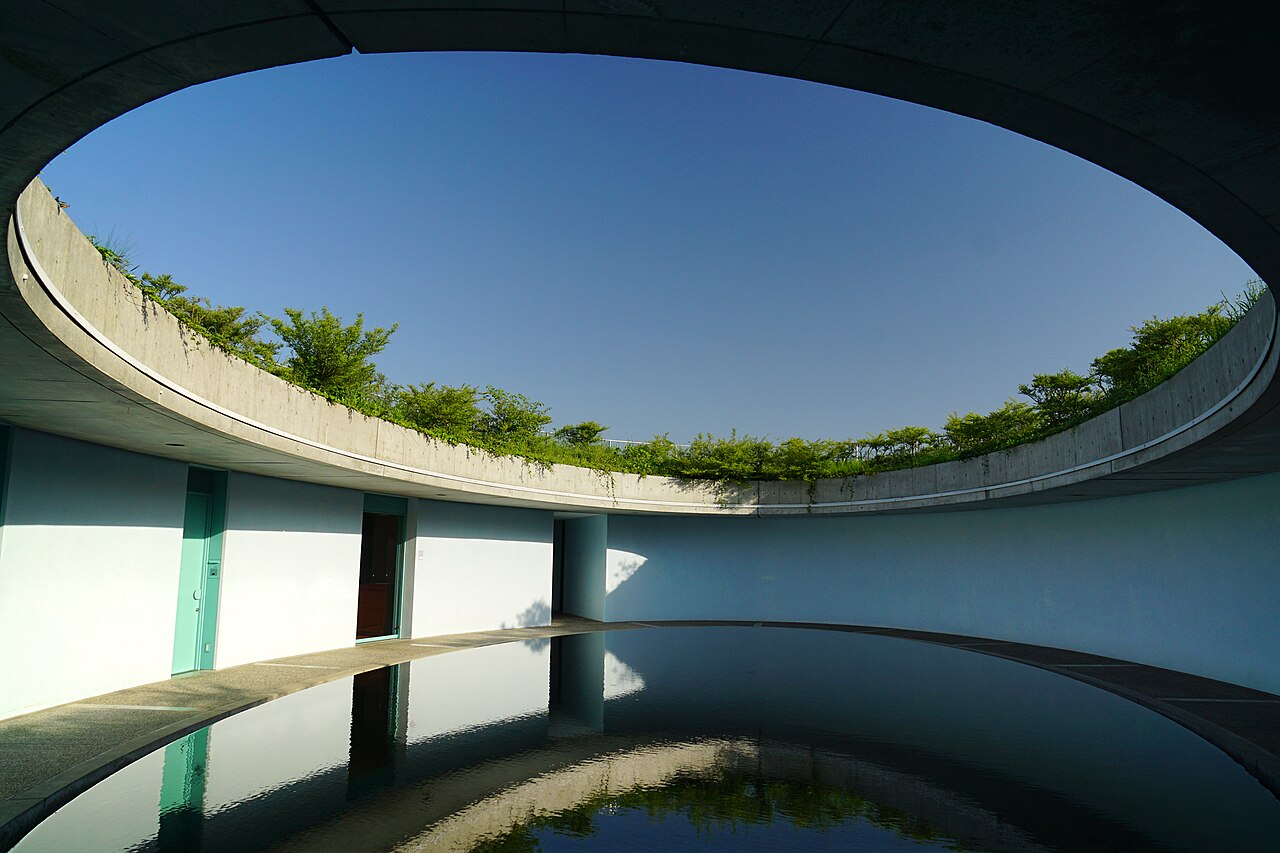
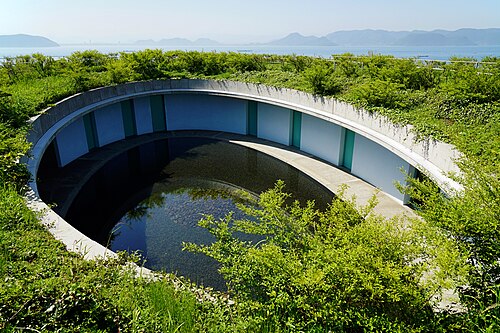
The Oval stands on a hill, reached from the museum by monorail. It has only six rooms, whose floor-to-ceiling openings look out over the Inland Sea; in some of them the artist drew directly on the wall. The Oval Twin rooms are the highest of the four buildings. Beyond the entrance lie an elliptical pool and a central void.
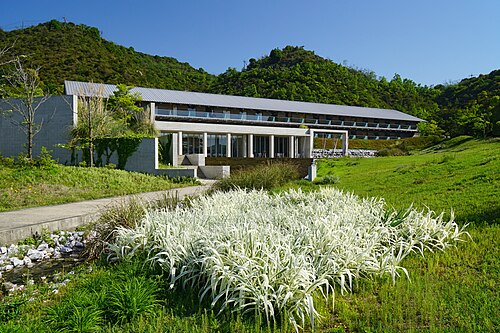
The Park is one of the rare wooden buildings designed by Ando. Room verandas look over the lawn and its open-air works, then the sea, with the mountains of Shikoku beyond. The Beach is the closest to the sea, a few steps from the water's edge: from inside, the eye is level with the water, as if one were in the sea.
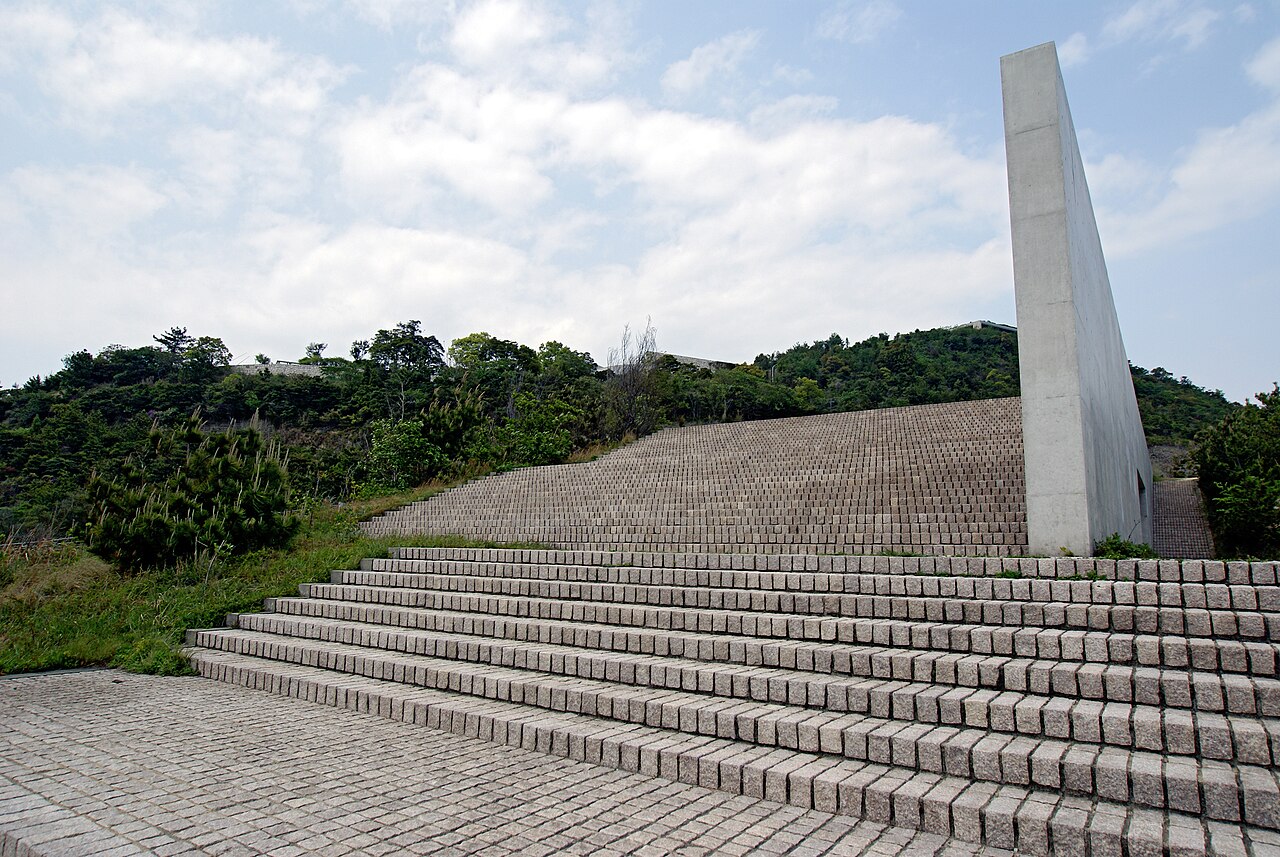
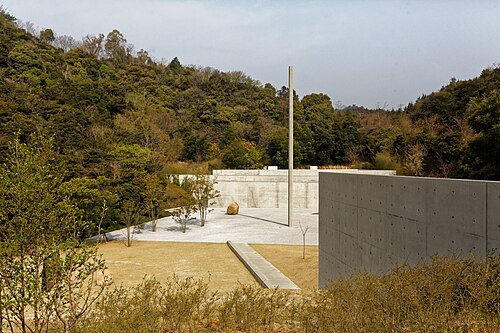
South of the museum, on a stepped plaza, the Seaside Gallery (シーサイドギャラリー) is an Ando gallery, long and narrow along a north-south axis following the terrain; a large east-facing opening lets light in. The Valley Gallery, opened in 2022, is a small shrine-like building along a valley regarded as a boundary or sanctuary; its double wall creates an introspective interior, while the opening to the semi-outdoors lets visitors feel light and wind directly.
Use today
The museum combines works from the collection with works made for the place, which the artists placed where they chose. They are not confined to the galleries: they are found throughout the building, along the shoreline and in the nearby forest.
Inside, the collection includes Alberto Giacometti, Cy Twombly, Jean-Michel Basquiat, Robert Rauschenberg, Frank Stella, David Hockney and Yves Klein. Site-specific works include Richard Long (1997) on the ground floor, Kan Yasuda (安田侃, 1996) and Jannis Kounellis (1996) in the basement, and, in the Seaside Gallery, Walter De Maria (2000). Outdoors, among others, is Yayoi Kusama's Pumpkin (2022). On the shore, Cai Guo-Qiang's (蔡國強, 1998) "Cultural Melting Bath" is reserved for hotel guests, by reservation. Each of Benesse House's 65 guest rooms displays a different artwork.
The museum building also holds a Japanese restaurant in the basement, and a café and shop on the first floor.
Visiting
The museum is open from 8:00 to 21:00 (last admission 20:00), all year round. Admission is charged, with one price online and another at the counter; it is free up to age 15 and for hotel guests. The Valley Gallery is included in this ticket (9:30 to 16:00, last admission 15:30). The Oval is an accommodation building: only its guests may enter, not ordinary visitors; some works in the Park are also reserved for hotel guests.
Photography is allowed, except for a few works, for personal use only (not for printed publication); video and sketching are not permitted. Large luggage, umbrellas and tripods must be left at the reception, pets are refused and drones are forbidden without prior permission. No eating or drinking in the museum except at the café. Some areas are not accessible to people with reduced mobility; the museum asks visitors to contact it before coming.
Address: 香川県香川郡直島町琴弾地 (761-3110), Naoshima, Kagawa. From Miyanoura port, the municipal bus runs to Tsutsuji-so (つつじ荘), then a free Benesse Art Site Naoshima shuttle links Tsutsuji-so with the museum, the Lee Ufan Museum and the Chichu Art Museum; walking is also possible. The area is private: cars and bicycles may not enter, except those of hotel guests.
Photos
34.45° N, 133.99° E
Greenhouses nearby
Architecture nearby
Sources (11)
- benesse-artsite.jp/art/benessehouse-museum.html
- benesse-artsite.jp/stay/benessehouse/
- benesse-artsite.jp/about/history.html
- benesse-artsite.jp/access/naoshima/
- benesse-artsite.jp/stay/benessehouse/oval.html
- benesse-artsite.jp/stay/benessehouse/park.html
- benesse-artsite.jp/stay/benessehouse/beach.html
- ana.co.jp/ja/ca/japan-travel-planner/travel-to-japanese-architecture/detail18/
- benesse-artsite.jp/en/art/benessehouse-museum.html
- wikidata.org/wiki/Special:EntityData/Q11337013.json
- openstreetmap.org/api/0.6/map.json?bbox=133.9885,34.4435,133.9935,34.4465
Affiliate links — booking through Verrière helps fund our research, at no extra cost to you.