Museum of Wood Culture (Kinodendo, 木の殿堂)
Kami, Hyōgo Prefecture
Sources checked October 2026
- Year
- 1994
- Architect
- Tadao Ando
- Type
- Museum of wood culture
- Access
- Open to the public, free admission, closed on Mondays (official website, October 2026)
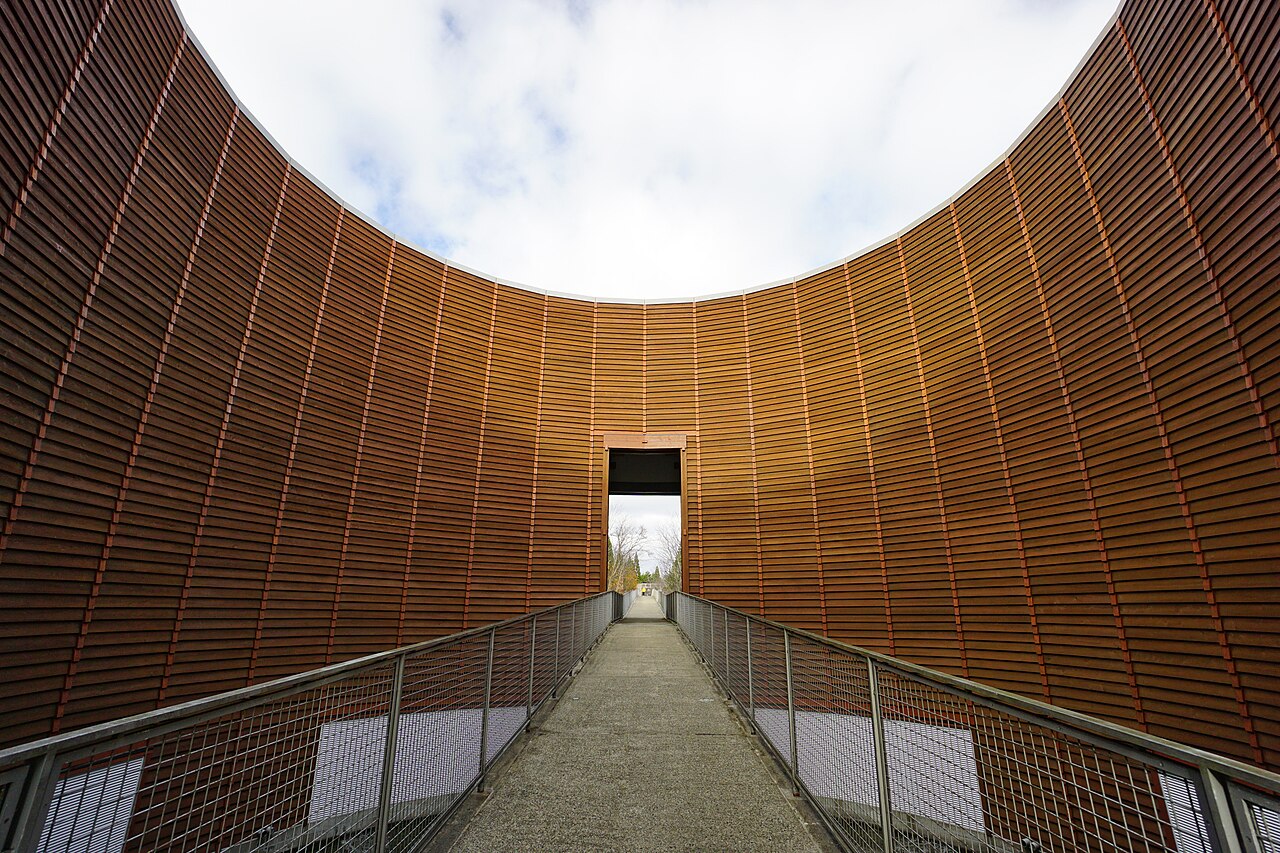
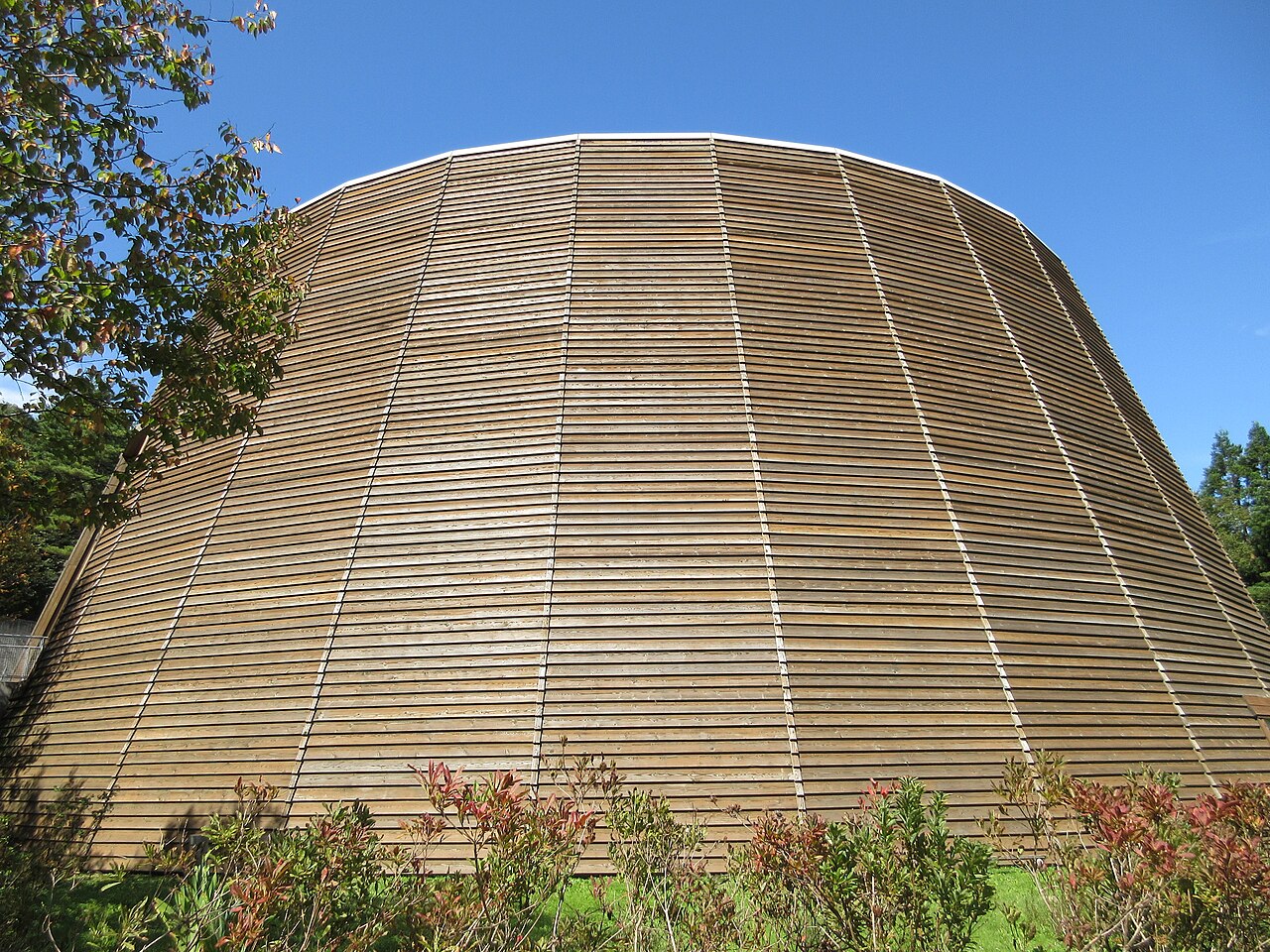
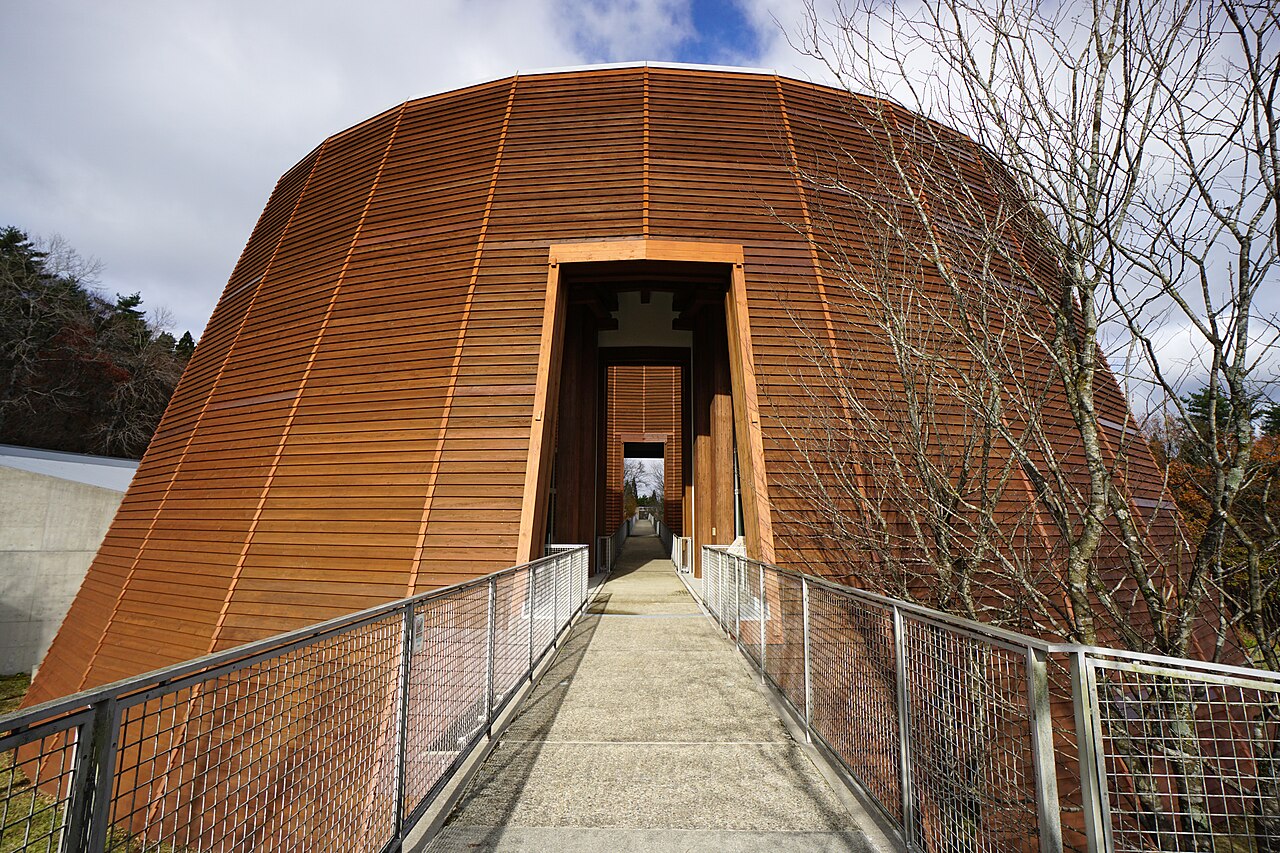
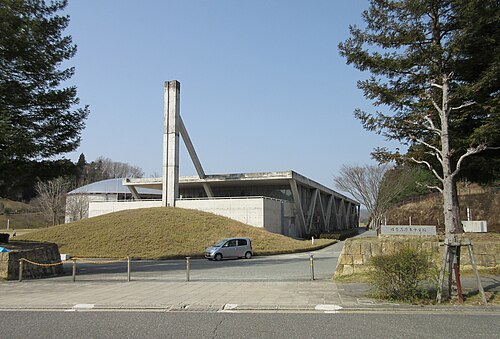
This Hyōgo Prefecture museum, designed by Tadao Ando, is a wooden ring 46 m across in the middle of the forest, its centre open to the sky above a pond. Its frame of posts and beams in laminated Hyōgo cedar forms a hall 16 m high where wood culture is shown through models of houses and tools from around the world. Completed in 1994 for the National Tree-Planting Festival, it is free to enter.
Affiliate links — booking through Verrière helps fund our research, at no extra cost to you.
History
Kinodendo (木の殿堂), officially Hyōgo-kenritsu Ki no Dendō (兵庫県立木の殿堂), is a museum of Hyōgo Prefecture (兵庫県) that opened in 1994 in the forest of Torogawadaira (瀞川平), in the town of Kami (香美町), in the north of the prefecture. It is an annex of the prefecture's outdoor education centre at Uwano-kōgen (兵庫県立兎和野高原野外教育センター). Its theme is "forest, sea and sun" (森と海と太陽), presented as symbols of Japan's nature and culture.
The building was put up for the National Tree-Planting Festival (全国植樹祭), held at Muraoka (村岡町, now part of Kami) on 22 May 1994. In it Tadao Ando built, this time permanently, the concept of the Japan Pavilion at the 1992 World Expo in Seville, which he had designed as one of the largest wooden pavilions in the world. Ando's office drew up the plans; the works went to a joint venture of Shimizu, Maeda Kensetsu Kōgyō and Meisei Kensetsu.
Architecture
The plan is a circular ring 46 m in diameter, with a 22 m circular void at its centre open to the sky; at the bottom of the void, water forms a pond. Water and sky meet there on the vertical, which states the theme of the place: forest, sea, sun. Ando speaks of a "nothing" (無) opened to the sky in the middle of the building.
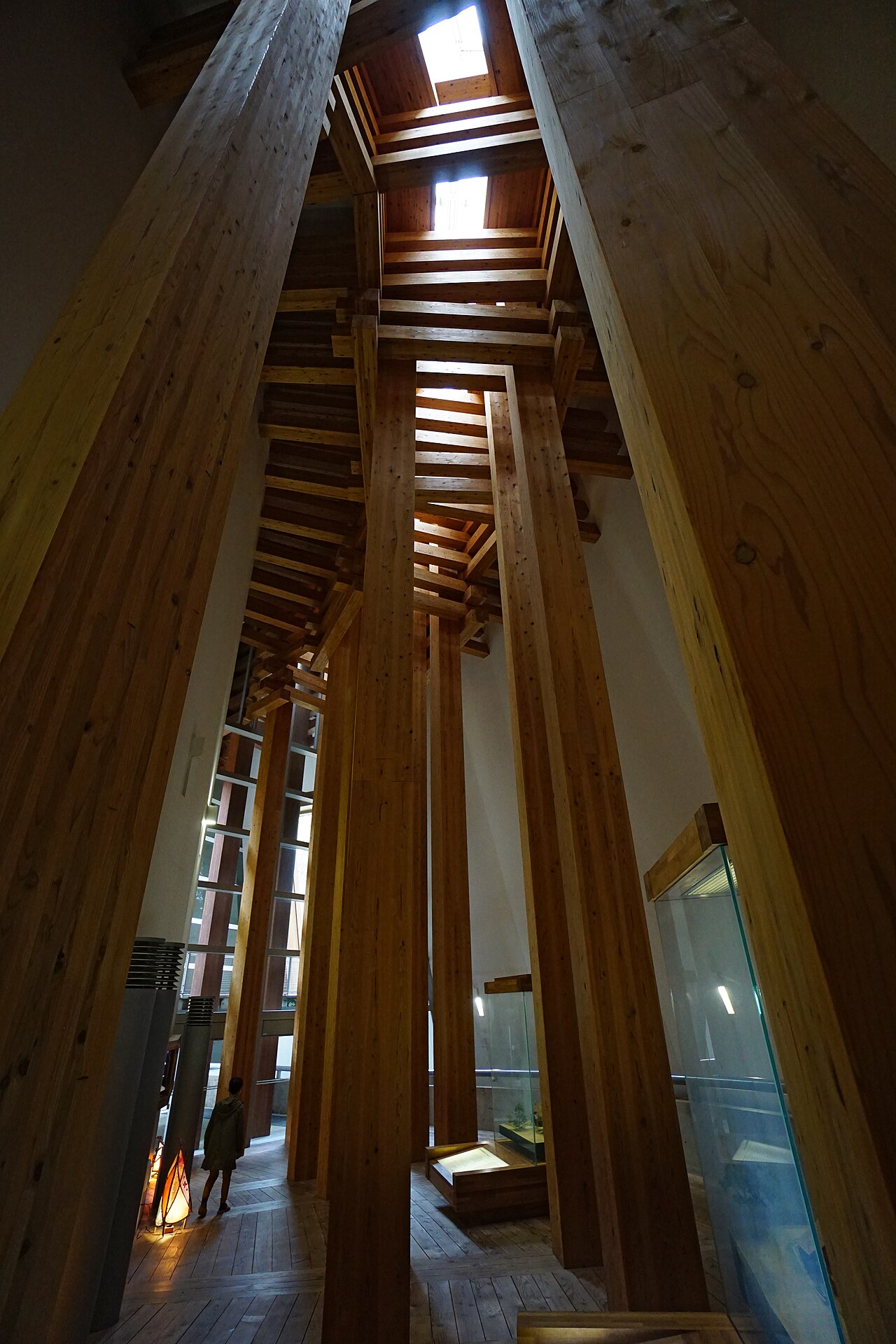
The ring, 16 m high under the ceiling, stands on a frame of posts and beams in glued laminated timber made from Hyōgo cedar (sugi). In the central void, these posts rising like a forest and their joined beams (木組み) are themselves the exhibit that best conveys the idea of the museum.
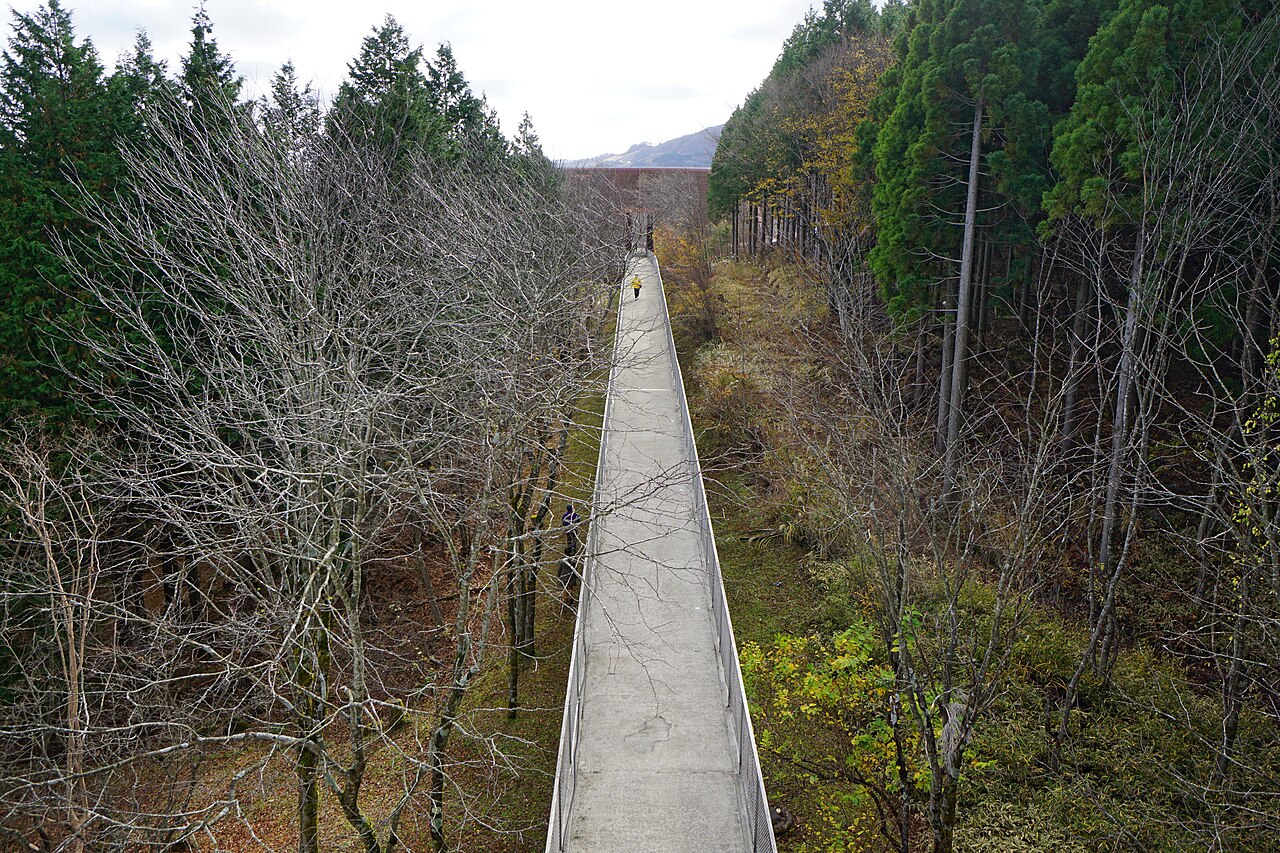
The route is written as an approach: one crosses the forest in a straight line, the ramp turns at a right angle at its end, then runs straight through the ring. Inside, a single ramp climbs, descends and winds along the exhibition rooms. On a site wrapped in dense forest, Ando wanted to bury the building in the landscape with a form as simple as possible; he stretched to the limit the passage that runs through the building to the forest behind. It leads to a lookout from which one sees the countryside all around, which he considers the climax of the visit. The annex stands about 200 m north of the main building, at the end of a gallery; its roof terrace is a lookout over the Tajima (但馬) mountains.
Use today
The exhibition presents wood culture around the world. It is organised around four forest zones: subarctic conifer forest, summer-green deciduous forest, evergreen laurel forest (照葉樹林) and tropical rainforest. Each shows its trees, its wooden houses and its tools. Among the house models are a 1880 house from Karelia (Russia), a 1781 house from Baden-Württemberg (Germany), a house from Guizhou (China) and a house from North Sumatra (Indonesia). The symbol piece is the Hakogi house (箱木家住宅, in Kobe), known as the "thousand-year house" and said to be the oldest traditional house (minka) in Japan.
There is also a library on forests and wood, whose books can be borrowed; a wood-joinery workshop (組み木, kumiki) where animals are made in wood, by reservation, three sessions a day; and a high-definition screening room of 100 seats with a 160-inch screen. In front of the building lies a large lawn with a giant swing.
Visiting
Admission is free. The museum is open from 10:00 to 16:30 from April to November and from 10:00 to 16:00 from December to March; it is closed on Mondays (the next weekday if the Monday is a public holiday) and from 31 December to 4 January. Animals are not allowed anywhere on the site, lawn included, except assistance dogs. Groups are asked to telephone the day before; the joinery workshop is by reservation.
By car from the Osaka and Kobe area, take the expressways to the Yōka-Hyōnosen exit (八鹿氷ノ山), then Route 9 to the Uwano-kōgen-guchi intersection and turn left; in winter, snow tyres or chains are required. Without a car: JR train to Yōka station (八鹿), about 2.5 hours from Osaka or Kobe, then a Zentan bus (全但バス) to the Hachikita-guchi stop (ハチ北口), about 40 minutes. From there it is 5.5 km, about an hour on foot, or about 10 minutes by taxi.
Photos
35.43° N, 134.58° E
Greenhouses nearby
Architecture nearby
Sources (14)
- kinodendo.jp/about/
- kinodendo.jp/annai/
- kinodendo.jp/about/facilities/
- kinodendo.jp/access/
- kinodendo.jp/
- kinodendo.jp/information/5057/
- kinodendo.jp/about-us/
- kobecco.hpg.co.jp/42719/
- meikenkogyo.com/works/442/
- rinya.maff.go.jp/j/ryokka/syokuju/pdf/syokujyusaikaisaiitirann.pdf
- ja.wikipedia.org/wiki/%E5%85%B5%E5%BA%AB%E7%9C%8C%E7%AB%8B%E6%9C%A8%E3%81%AE%E6%AE%BF%E5%A
- kami-tourism.com/feature/muraoka
- wikidata.org/wiki/Special:EntityData/Q11393028.json
- nominatim.openstreetmap.org/search?q=%E6%9C%A8%E3%81%AE%E6%AE%BF%E5%A0%82+%E9%A6%99%E7%BE%
Affiliate links — booking through Verrière helps fund our research, at no extra cost to you.