Nariwa Museum
Takahashi, Okayama
Sources checked October 2026
- Year
- 1994
- Architect
- Tadao Ando
- Type
- Municipal museum: paintings, antiquities, fossils
- Access
- Open to the public, closed on Mondays (official site, October 2026)
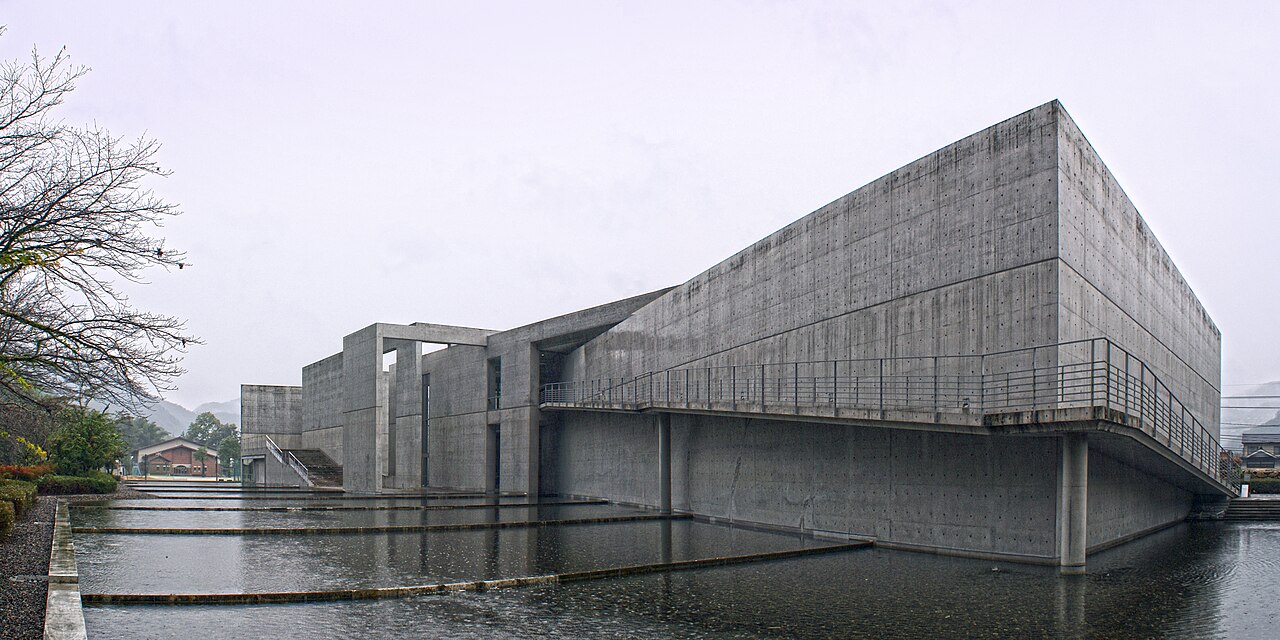
In the green town of Nariwa, in western Okayama Prefecture, Tadao Ando built in 1994 a bare-concrete museum between the stone walls of a former lord's residence and a hill, around a pond. Visitors climb a ramp with the view blocked by concrete walls, then, at the bend, water and mountain open up all at once. It holds the paintings of Kojima Torajirō, a native of the town, the Egyptian and Oriental antiquities he brought back, and plant fossils from the area.
Affiliate links — booking through Verrière helps fund our research, at no extra cost to you.
History
The museum began in 1953 as the Nariwa Town Museum (成羽町美術館, Nariwa-chō Bijutsukan), created to honour the Western-style painter Kojima Torajirō (児島虎次郎, 1881–1929), who was born in 下原, today part of Nariwa. It was the first town-run (町立) museum in Okayama Prefecture. The town had bought works by Kojima in 1951, for the fiftieth anniversary of its municipal status. In 1967 the artist's family entrusted the museum with his paintings and collections, and the museum was moved; in January 1993 the family gave it the 702 pieces it had deposited.
The present building, the third, is the work of Tadao Ando (安藤忠雄). Designed from December 1991 to March 1993 and built from March 1993 to October 1994 by the Ōbayashi company (大林組), it opened in November 1994 on the site of the Nariwa jin'ya (成羽陣屋跡), a historic site designated by the city of Takahashi. Ando said in November 1994 that he had designed it with this wish: to take in the rich natural surroundings, and to let the townspeople take part calmly and with pleasure in cultural life.
Since April 2009 the museum has carried its present name, 高梁市成羽美術館 (Takahashi-shi Nariwa Bijutsukan). A public-interest foundation, the Nariwa Art Promotion Foundation (成羽町美術振興財団), set up in 1993 and recognised as a public-interest foundation in 2012, runs it. Apart from a change of use for part of the premises, the building has not been greatly altered; its facade and equipment were renovated in the 2010s.
Architecture
The building, of reinforced concrete and steel-framed reinforced concrete, has one basement level and two storeys above ground, with a maximum height of 12 m. It stands on a 7,607.89 m² site, of which 1,601.98 m² is built, for 2,691.98 m² of floor area.
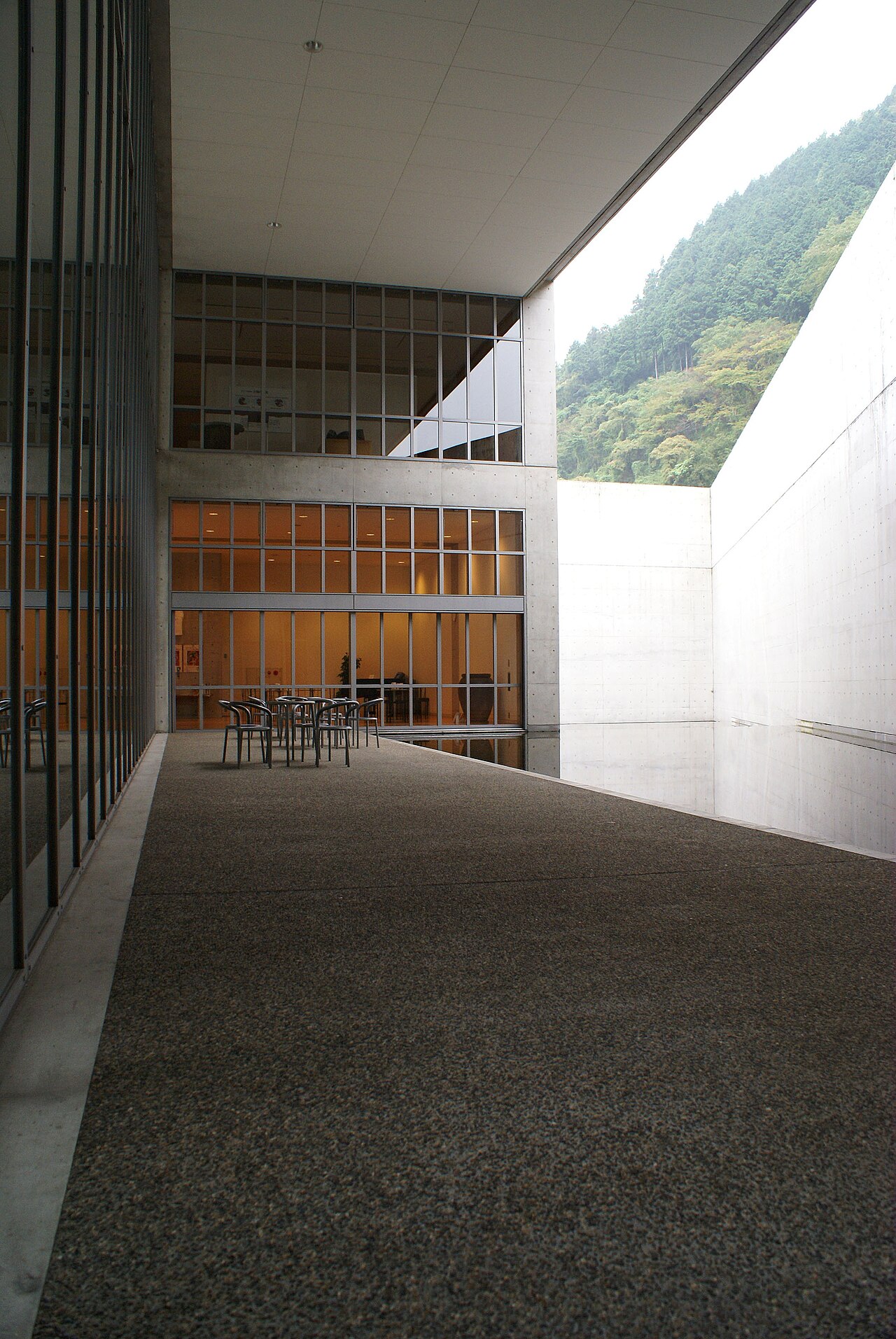
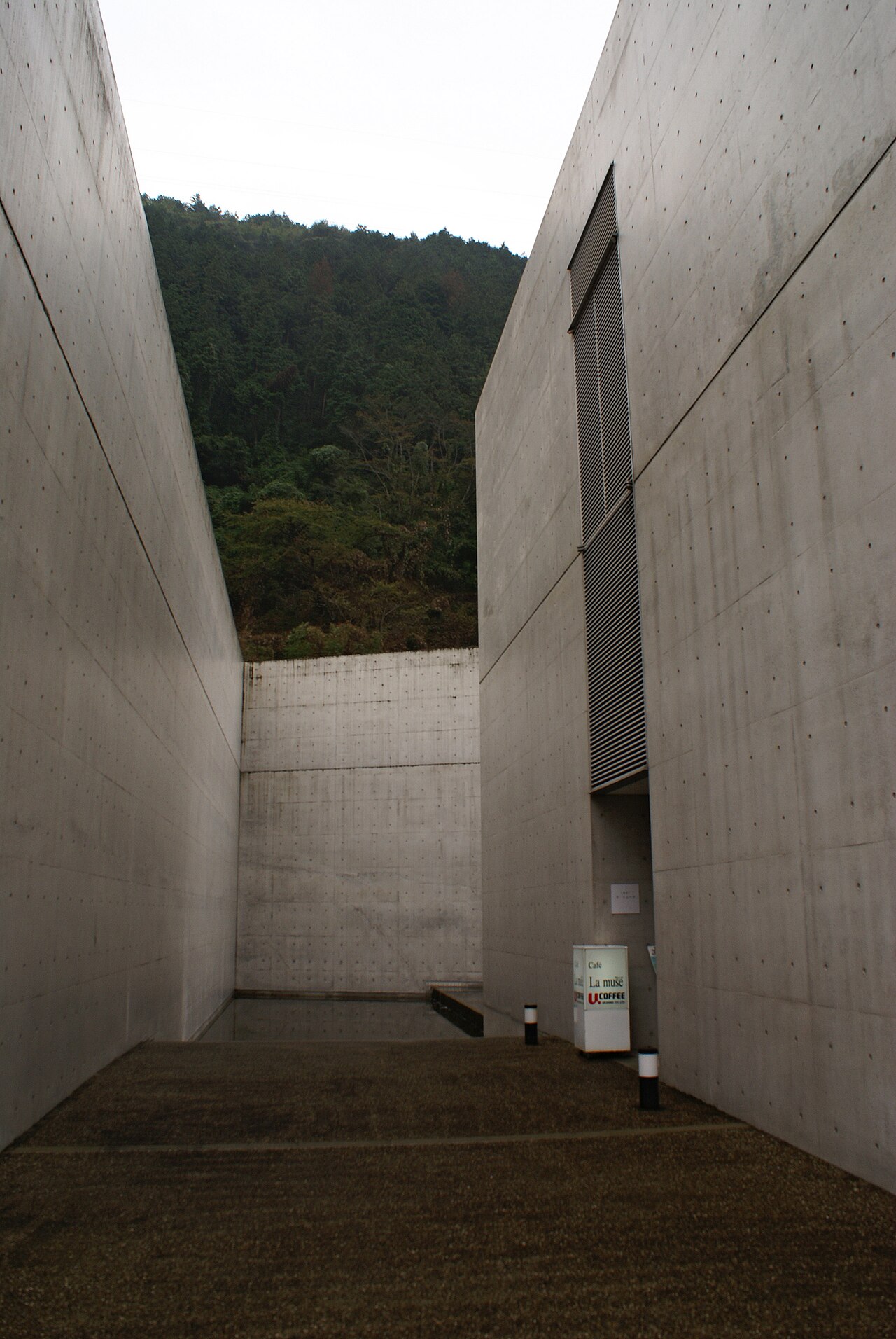
The site keeps, along its edge, the stone walls of the former lord's residence, and the building and its artificial pond occupy the space that these walls and the hill to the south enclose around them. The approach begins behind concrete walls that block the view. You climb a ramp, turn at a sharp angle, and all at once the pond and the mountain appear. Inside, exhibition rooms made of orthogonal walls interlock with ramps set at sharp angles, and inside and outside intertwine in a complex space. The concrete walls and the light the building lets in make shadow and brightness shift with the hours.
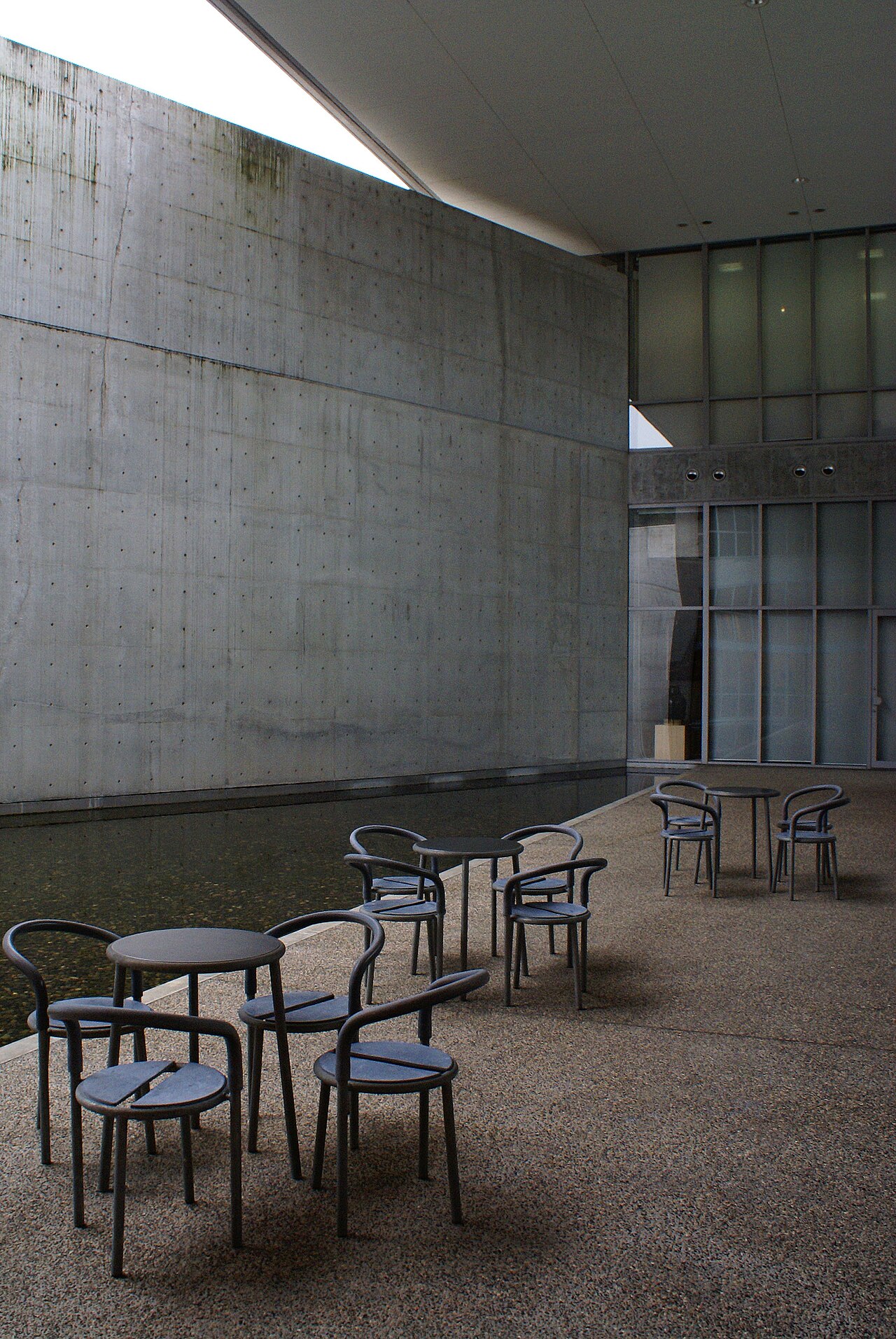
A rectangular volume, bare poured concrete, large steel-framed openings, circulation by ramps, water in the outdoor design, a long bent approach: the whole carries the features found across Ando's series of public museums. A water garden, the "Garden of Still Water" (静水の庭), is planted with water lilies divided from those of Monet's garden, echoing the episode that links Monet to Kojima. Upstairs is, among others, the fossil room; on the ground floor, the room devoted to the Orient.
Use today
It is a municipal museum. Its core is the work of Kojima Torajirō, a painter of colourful portraits and landscapes, presented as a leading figure of Impressionism in Japan, who also helped assemble the Western art collection — Monet, El Greco — that is the foundation of the Ōhara Museum of Art (大原美術館). The museum also holds some 500 pieces from China, Korea and the Orient that Kojima collected, including a group of ancient Egyptian objects assembled in the 1920s, rare in Japan for so early a date: funerary figurines (shabtis) and amulets, from the Predynastic to the Late Period.
It also keeps plant fossils from the Nariwa area. In the Late Triassic, around 230 million years ago, a great forest covered the region; its plants have been preserved as the oldest forest plant fossils in Japan. More than 110 species have been found there, about 40 of them new to science: this is the "Nariwa Flora" (成羽フローラ).
The museum also serves as a citizens' gallery, a place of artistic activity for local people, and holds temporary exhibitions. It has a café and a shop, which can be used without an admission ticket.
Visiting
The museum is open from 9:30 to 17:00, last entry 16:30. It is closed on Mondays (if the Monday is a public holiday or a substitute holiday, the museum opens that day and closes the next, Tuesday), from 25 December to 7 January (dates may change) and during exhibition changeover periods, set through the year: check the calendar before coming. Admission varies with the exhibition; it is free for pre-school children and, on showing proof, for holders of a disability certificate and one companion. Photography in the galleries depends on the exhibition. The café and the shop are open only on days the museum is open.
From Bitchū-Takahashi station (備中高梁) it is about twenty minutes by bus to the Nariwa (成羽) stop, next to Taikomaru Plaza (たいこまるプラザ); the free car park, of about 90 spaces, is shared with it. From the car park to the reception there are steps and long ramps: visitors in wheelchairs or with strollers are asked to park on the west side, by the service door, and to announce themselves on the intercom. Reception is upstairs, at the top of an outdoor ramp, and the exit is on the ground floor.
Photos
34.78° N, 133.54° E
Greenhouses nearby
Affiliate links — booking through Verrière helps fund our research, at no extra cost to you.