Center House, Matsue Vogel Park (松江フォーゲルパーク センターハウス)
Matsue, Shimane Prefecture

Entry updated on October 5, 2026
- Year
- 2001
- Architect
- Unknown
- Style
- Climate-controlled floral display glasshouse linked to walk-through aviary houses
- Dimensions
- About 8,000 m² (Center House); about 12,000 m² of linked glasshouses
- Status
- Open to the public
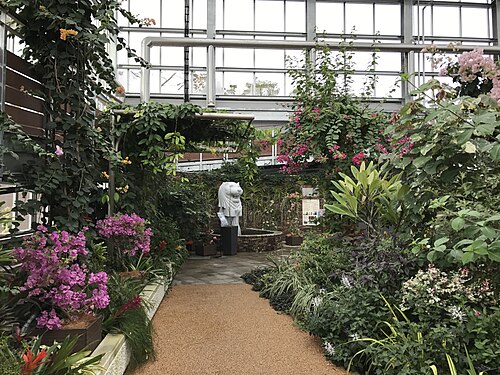
Opened on 23 July 2001 on the north shore of Lake Shinji, this flower-and-bird park is built around the Center House, a display glasshouse of about 8,000 m² that the official site describes as the largest floral greenhouse in Japan. Some 10,000 plants of around 1,500 varieties, mainly begonias and fuchsias, flower there all year at about 20 °C. Further glasshouses, joined by covered walkways, hold waterfowl and tropical birds. Bought by the city of Matsue in 2015, the park has since been run by the Ichibata railway group.
Affiliate links — booking through Verrière helps fund our research, at no extra cost to you.
History
1 min
The park grew out of a drive by the city of Matsue, in Shimane Prefecture, to attract private investment. The municipality put in about 5.8 billion yen and the company Kamo about 1.5 billion yen; the complex was built on hills on the edge of the city, above the north shore of Lake Shinji, and opened on 23 July 2001.
It was one of five theme parks run by the Kamo group. As results kept worsening, the company pulled out at the end of March 2015 and went bankrupt with debts of around 550 million yen. The city then bought the facilities for 75 million yen, a small fraction of the original outlay.
Since April 2015 the park has been operated under a management contract by a joint venture of the Ichibata Electric Railway and a newly founded subsidiary, Ichibata Park. The railway link goes back further: the park has its own station on the Kita-Matsue line, and in spring 2010 a Cape penguin named Haruka served there as honorary station master on three separate days. None of the sources consulted names the architect or the builder of the glasshouses.
Architecture and engineering
1 min
The Center House, the heart of the park, is a display glasshouse of about 8,000 m² kept at roughly 20 °C all year. The official site calls it the largest floral greenhouse in Japan, and the Japanese Wikipedia ranks it among the largest display greenhouses in the world. It also contains a restaurant and a shop selling potted plants, and can host weddings.
It belongs to a group of about 12,000 m² of glasshouses joined by covered walkways, designed so that the whole circuit stays under cover. From the Center House a 140-metre moving walkway, lined with bird enclosures, climbs to the Kunibiki lookout at an elevation of 53 metres. Two further halls are given over to birds: the Waterfall Aviary, where waterfowl fly free, and the jungle-themed Tropical Aviary.
Behind the scenes, a production greenhouse of 2,860 m² and 130 metres in depth, closed to visitors, grows the display plants. There, 170 air-conditioning units hold about 20 °C by day, 15 °C at night and 60 per cent humidity, while artificial lighting provides fourteen hours of daylight. Pots filled with peat moss imported from the Netherlands are watered from below by an ebb-and-flow system.
Plant collections
1 min
The Center House shows some 10,000 plants of about 1,500 varieties, led by begonias and fuchsias grown to be in flower in every season; fuchsias, which need cool conditions, bloom continuously thanks to the controlled climate. The park's website also describes South African pelargoniums, mostly double-flowered, coleus from its own breeding with leaves ranging from deep purple to yellow-green and red, African streptocarpus, and Brugmansia from tropical America, whose hanging flowers are fragrant in the evening.
The park keeps about 90 bird species. More than twenty species of owl, some sixty birds in all, live in the owl centre by the entrance, and flight demonstrations are held inside the Center House. The tropical aviary concentrates on toucans, hornbills and turacos, and the Shimane tourism board notes that the park's shoebill is the only one on view in the Chūgoku region.
Visiting
1 min
The park covers 32 hectares above the north shore of Lake Shinji. Matsue Vogel Park station, on Ichibata's Kita-Matsue line, serves it directly, and Matsue Castle is about twenty minutes away. Because the glasshouses are linked by covered passages, it works well on rainy days. An hour is enough for a quick circuit, but the prefectural tourism board suggests three to four hours to take in the flight demonstrations, the penguin walk and the feeding sessions. On clear days the Kunibiki lookout gives views as far as Mount Daisen. Izumo Taisha, about forty minutes away by car, makes a natural pairing.
35.48° N, 132.94° E
Greenhouses nearby
More greenhouses — Japan
Do you have a good photo of this greenhouse? Suggest it for this page →