Display Glasshouses of the Botanischer Volkspark Blankenfelde-Pankow (Palm Tower and Cactus Tower)
Berlin (Blankenfelde, Pankow district)
Entry updated on October 5, 2026
- Year
- 1928-1929
- Architect
- Albert Brodersen (design); built by Alexander Weiß
- Style
- Two tower-like glasshouses linked by a low glazed wing
- Dimensions
- Tall houses about 12 m high
- Status
- Closed to unaccompanied visits since 2024 (staff shortage); no reopening date
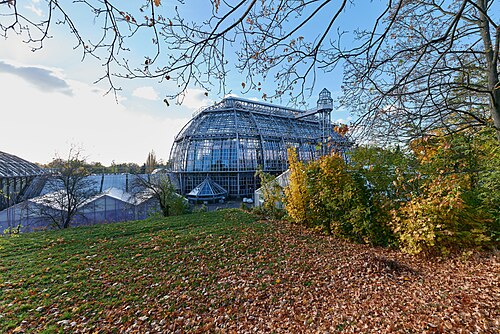
In the Botanischer Volkspark at Blankenfelde, laid out from 1909 by Berlin's garden director Albert Brodersen as the city's central school garden, two tall tower-like glasshouses, the Palm Tower and the Cactus Tower, joined by a low glazed wing, were built in 1928-1929. Listed as a monument since 1994 and restored from 2009 at a cost of 1.75 million euros, they hold tropical useful plants and the celebrated 'Königin der Nacht' cactus. Because of staff shortages they have been closed to unaccompanied visitors since 2024.
Affiliate links — booking through Verrière helps fund our research, at no extra cost to you.
History
1 min
The story of these glasshouses begins far from Blankenfelde, in the Humboldthain, where Gustav Meyer had laid out a Prussian school garden in 1874. Around 1909 the expansion of the AEG works forced it to move: Berlin's garden director Albert Brodersen (1857-1930) re-established it on former sewage fields at Blankenfelde, in the north of the city. Low glasshouses were put up there around 1910 by the building firm Otto Beyroth to plans drawn by the park administration, and a landscape garden devoted to the plant communities of Brandenburg was begun in 1911.
The two large glasshouses were built in 1928-1929 to Brodersen's design and executed by Alexander Weiß, when the site was completed as the 'Botanischer Hauptschulgarten'. Damaged in the war, they had been reglazed by 1950. The garden returned to teaching in 1952 with a central station for young naturalists, and the tall houses were remodelled in 1985-1986.
Listed as a monument in 1994, the park passed to Pankow district on 1 January 1995 and opened to the public, joining the Barnim Nature Park in 1998. For the centenary in 2009 a restoration of both towers and the central wing was launched at a cost of 1.75 million euros, backed by the Lotto foundation; Haas Architekten give 2013 as its completion date. Run by Grün Berlin from 2011 until the end of 2021, the glasshouses then reverted to the district. In September 2024 the Berlin press reported that they were closed to visitors for lack of staff, with no reopening date.
Architecture and engineering
1 min
The ensemble consists of two tower-like buildings, nicknamed the Palmenturm (Palm Tower) and the Kakteenturm (Cactus Tower), linked by a lower wing that is also fully glazed. A local guide puts their height at about twelve metres. The site also keeps flat glasshouses (Flachgewächshäuser) from around 1910, altered after 1970 and likewise protected.
The restoration led by the Berlin practice Haas Architekten, with the engineering offices Dittrich for building services, CRP for building physics and Professor Hilbers for structures, set out to reconcile heritage protection with energy efficiency: thermally insulating glazing, insulated profiles, automated ventilation in walls and roof, and rainwater collection for irrigation. According to the architects, energy consumption fell by 60 per cent as a result.
In 2020 and 2021 Grün Berlin had panes checked and replaced, the shading, vent motors and hinges serviced, and then the entire climate control renewed, with new sensors and a new climate computer. The two towers run different regimes: a constant temperature above 22 °C on the tropical side, 8 to 10 °C for the cacti.
Plant collections
1 min
The best-known plant here is the 'Königin der Nacht' (Queen of the Night), a snake cactus in the Cactus Tower whose large flowers open only once a year, at night, for about twelve hours, in late June or early July; the event drew crowds every year.
In 2017-2018 the planting of the tropical house was completely redesigned around tropical useful plants to support educational programmes, so that cacao, coffee, banana, oil palm, pomegranate, papaya and maracuja now grow side by side. This continues the original purpose of the glasshouses, which allowed Berlin schoolchildren to study tropical plants. The guided tours run by Pankow's environmental office focus on the tropical and subtropical plants of the ensemble, and the park as a whole holds some six thousand plants, perennials and other species, some of them rare.
Visiting
1 min
The glasshouses stand in the Botanischer Volkspark, a 34-hectare park at Blankenfelder Chaussee 5 in Blankenfelde, in the north of Berlin; the west entrance next to the tropical house is the meeting point for guided tours. Since 2024 the district has stated that they can only be seen with a guide, with no date for reopening to unaccompanied visits, so it is wise to check before travelling.
The park itself justifies the trip, with its landscape devoted to Brandenburg plant communities and its place within the Barnim Nature Park. Late June, when the 'Königin der Nacht' flowers, was traditionally the high point of the year.
52.60° N, 13.40° E
Greenhouses nearby
More greenhouses — Germany
Do you have a good photo of this greenhouse? Suggest it for this page →
Sources (7)
- berlin.de/ba-pankow/politik-und-verwaltung/aemter/strassen-und-gruenflaechenamt/gruenflaec
- de.wikipedia.org/wiki/Botanischer_Volkspark_Blankenfelde-Pankow
- gruen-berlin.de/pressemitteilung/hintergrund-botanischer-volkspark-blankenfelde-pankow
- haas-architekten.de/projekte/glashaeuser/schaugewaechshaeuser-im-volkspark-pankow
- berliner-kurier.de/berlin/botanischer-volkspark-in-pankow-immer-oeder-li.2251699
- panke.guide/botanischervolkspark.html
- pankow-weissensee-prenzlauerberg.berlin/de/botanische-fuehrungen-durch-die-schaugewaechsha