BOTANICA MUSEUM Greenhouse, former Chiba City Flower Museum (千葉市花の美術館)
Mihama-ku, Chiba, Chiba Prefecture
Entry updated on October 5, 2026
- Year
- 1995 (renovated 2022–2025)
- Architect
- Unknown; 2025 staging: Hikaru Seino
- Style
- Cylindrical glass greenhouse attached to a fair-faced concrete flower museum
- Dimensions
- 3,939 m² floor area (whole museum)
- Status
- Open to the public (as BOTANICA MUSEUM since 2025)
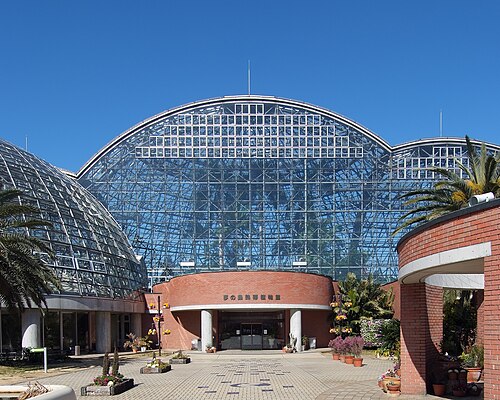
Built as a theme pavilion for the 1995 National Urban Greening Fair and opened year-round in April 1996 in Inage Seaside Park, Chiba's flower museum combines an atrium, a restaurant and a greenhouse shaped like a tall glass cylinder, arranged around an artificial waterfall. Closed in 2022 for a renovation costing about 500 million yen, it reopened on 29 March 2025 as BOTANICA MUSEUM, staged by the floral artist Hikaru Seino, while the tropical greenhouse kept its original layout.
Affiliate links — booking through Verrière helps fund our research, at no extra cost to you.
History
1 min
The building began life as a theme pavilion, called the 'flower museum', for the 12th National Urban Greening Fair, held in Chiba from 25 August to 22 October 1995. After the fair closed, the city reopened it on 2 April 1996 in Inage Seaside Park as the base for its work promoting plants in the city. The earthquake of 11 March 2011 damaged it, notably through soil liquefaction: after a temporary closure, the museum first reopened its rose garden and then reopened fully on 16 September 2011. In January 2013 the company Sanyo Media bought the naming rights for three years, and the venue was known as Sanyo Media Flower Museum until 1 April 2021.
Ageing facilities led to its closure on 1 April 2022. According to the Tokyo Shimbun, the city spent some 500 million yen on a major renovation, with the interior fit-out then handed to a private company. The works, completed in January 2023 for this package, included replacing the high, arched ceiling with aluminium louvres imported from the Netherlands and redoing the leaking roof's waterproofing. The project forms part of the renewal of Inage Seaside Park entrusted to a consortium led by the company World Park.
The museum reopened on 29 March 2025 as BOTANICA MUSEUM, staged throughout by the floral artist Hikaru Seino, who founded the GANON FLORIST studio in 2013. After a further closure from 16 March to 2 April 2026, it made its full opening on 3 April 2026, adding the upper floor, night illumination of the gardens and evening sessions on every opening day.
Architecture and engineering
1 min
The museum consists of three buildings: an atrium used as an exhibition hall, a greenhouse and a rest building housing the restaurant, with a total floor area of 3,939.42 m². Before the renovation, a visitor's account described a fair-faced concrete building announced from afar by the greenhouse, a tall glass cylinder; on winter evenings, light escaping through the glass made the building stand out. The sources consulted do not name the 1995 architect or give the greenhouse's own dimensions.
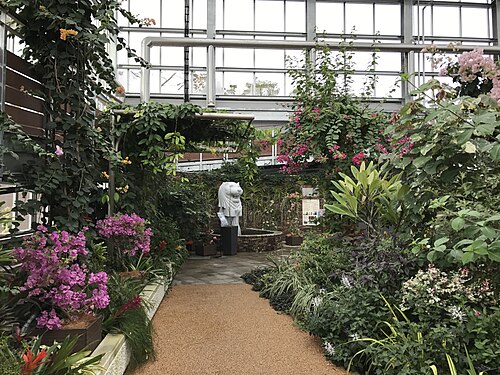
Under a very high ceiling, the interior of the greenhouse rises on several levels around a large artificial waterfall, crossed by a walkway in the manner of a suspension bridge, and an upper floor looks down on the planting. This original layout was deliberately kept in the 2025 makeover. The neighbouring atrium, glazed and lofty, takes in plenty of daylight, and the restaurant, also glazed, looks onto the inner courtyard.
The renovation focused above all on presentation: the spaces were designed to engage all five senses, from music played in the galleries to artworks built around scent. Digital lighting made evening opening possible for the first time, and it was considerably strengthened in 2026 for both the artworks and the greenhouse. Four open-air gardens surround the complex.
Plant collections
1 min
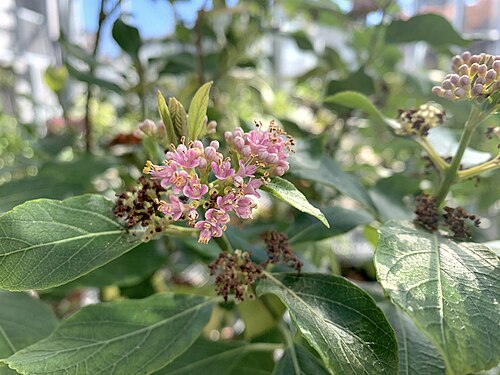
According to Japanese Wikipedia, some 1,600 species and 48,000 plants are grown indoors and in the gardens. The greenhouse, renamed the Botanicarium, is given over to tropical and subtropical plants and cultivated orchids; hibiscus and オーガスタ are among the plants on show, and an account from before the renovation recorded blooms such as ヒスイカズラ and オオベニゴウカン.
Since 2025 the atrium has shown five installations by Hikaru Seino: giant flowers ('MICRO KIDS'), a tree made of more than 10,000 fresh flowers dried on site ('MIRACLE TREE'), five creatures evoking the world's major climates ('BOTANICALIEN'), a moss wall about 6 m high ('MOSS MOSS') and a mirrored room filled with sound ('BOTA Hz'); new works were added in 2026. Outside, the symmetrical front garden, with its beds and fountain, was planted in 2025 with tulips in spring, celosia in autumn and violas in winter, and a long side garden leads to the rose garden at the back.
Visiting
1 min
The museum stands in Inage Seaside Park, in Mihama ward; a bus links it with JR Inage Station in about a quarter of an hour, and Inage-Kaigan Station is some twenty-five minutes away on foot. The front, side and rear gardens are free to explore, while the atrium and greenhouse require a ticket. Evening openings show the greenhouse and the artworks in a completely different light from the daytime. The museum also holds seasonal events, such as a festival inspired by Mexico's Day of the Dead, with beds of marigolds, in late October and early November 2026, and offers gardening advice on several afternoons a week. Inage beach, close by, rounds off an outing.
35.62° N, 140.06° E
Greenhouses nearby
More greenhouses — Japan
Do you have a good photo of this greenhouse? Suggest it for this page →
Sources (8)
- sunsetbeachpark.jp/activity/botanicamuseum/
- city.chiba.jp/toshi/koenryokuchi/ryokusei/hananobijyutukan.html
- ja.wikipedia.org/wiki/%E5%8D%83%E8%91%89%E5%B8%82%E8%8A%B1%E3%81%AE%E7%BE%8E%E8%A1%93%E9%A
- tokyo-np.co.jp/article/396019
- shuken.jp/works/service/4354/
- rurubu.jp/andmore/article/23503
- garden-vision.net/garden_visit/visit_t-hana-m.html
- prtimes.jp/main/html/rd/p/000000039.000056344.html