Koishikawa Botanical Garden Public Glasshouse (小石川植物園 公開温室)
Bunkyō, Tokyo
Entry updated on October 5, 2026
- Year
- 2019
- Architect
- Kume Sekkei (久米設計)
- Style
- Contemporary glass box on triangular steel trusses
- Dimensions
- 1,547 m² of floor space
- Status
- Open to the public
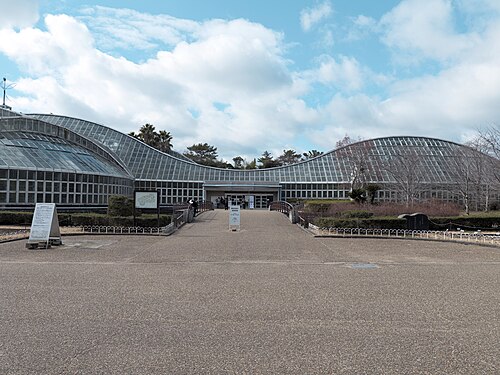
The University of Tokyo's botanical garden at Koishikawa, which grew out of a Tokugawa shogunate medicinal herb garden founded in 1684, opened a new public glasshouse in November 2019, designed by the firm Kume Sekkei. The 1,547 m² steel-and-glass building replaces a greenhouse destroyed in 1945 and rebuilt in 1952 and 1964, whose brick foundations it preserves. Its six rooms display some 2,000 tropical and subtropical species, including threatened plants from the Ogasawara Islands and orchids, while a neighbouring cool house holds about 400 more, alpine or from cooler climates.
Affiliate links — booking through Verrière helps fund our research, at no extra cost to you.
History
1 min
Koishikawa Botanical Garden has more than three centuries of history. In 1684 the Tokugawa shogunate moved its medicinal herb garden from Azabu to the northern part of the Hakusan estate in Edo, creating the Koishikawa herb garden; in 1722 a charity clinic for the poor, the Koishikawa Yōjōsho, opened within its grounds. When the University of Tokyo was founded in 1877 the garden was attached to it and became a place of research. It was here, in 1896, that Hirase Sakugorō observed the spermatozoids of the ginkgo, and Ikeno Seiichirō those of the cycad.
According to the horticultural magazine Plantia, published by Hyponex, a first wooden greenhouse in the Western style was completed in 1900. The garden's official chronology records that in 1945 the greenhouse burned down completely during the war, along with several other buildings. It was rebuilt in timber in 1952 and reconstructed on a steel frame in 1964; Plantia states that this greenhouse went out of use in 2014.
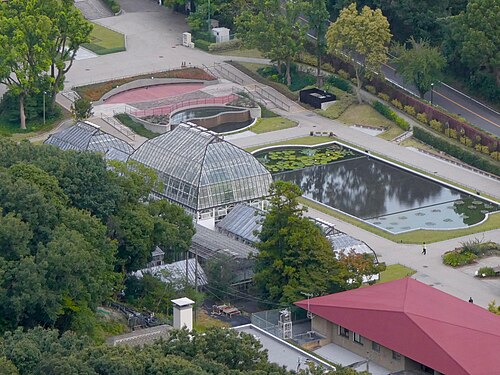
The new public glasshouse and a cool house were completed in 2019 to designs by the firm Kume Sekkei. Opened to visitors on 19 November 2019, the public glasshouse is four times larger than its predecessor, according to the Japanese Wikipedia. The project kept traces of the past in view: the brick foundations of the old greenhouse, the remains of a boiler room and an arched furnace and, in front of the building, a fountain pond dating from the Meiji era.
Architecture and engineering
1 min
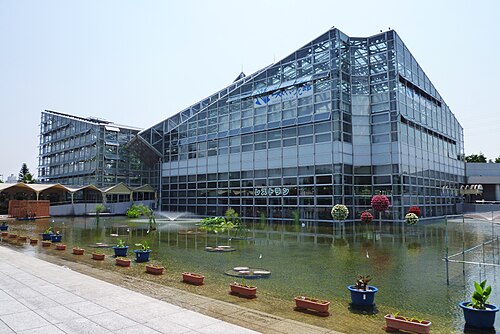
Designed by Kume Sekkei, the public glasshouse is a two-storey steel building with a total floor area of 1,547 m². The architects present it as a transparent glass box in which structure and envelope become one: a sequence of three-hinged triangular trusses creates a single, generous volume while giving the plants the sunlight and ventilation they need. Plantia notes that large sliding openings run across the whole roof to let out the summer heat, and that the paths were widened to ease circulation.
The design works with a historic site. The brick foundations of the previous greenhouse were incorporated into the new building, old masonry and the remains of an arched furnace are displayed to visitors, and the existing pond was kept. Inside, six rooms are arranged by region of origin and growing conditions. Next door, the cool house (冷温室) is fitted with substantial cooling equipment that reproduces the freshness of mountain habitats, so that species which the Tokyo summer had made hard to grow can now be shown.
Plant collections
1 min
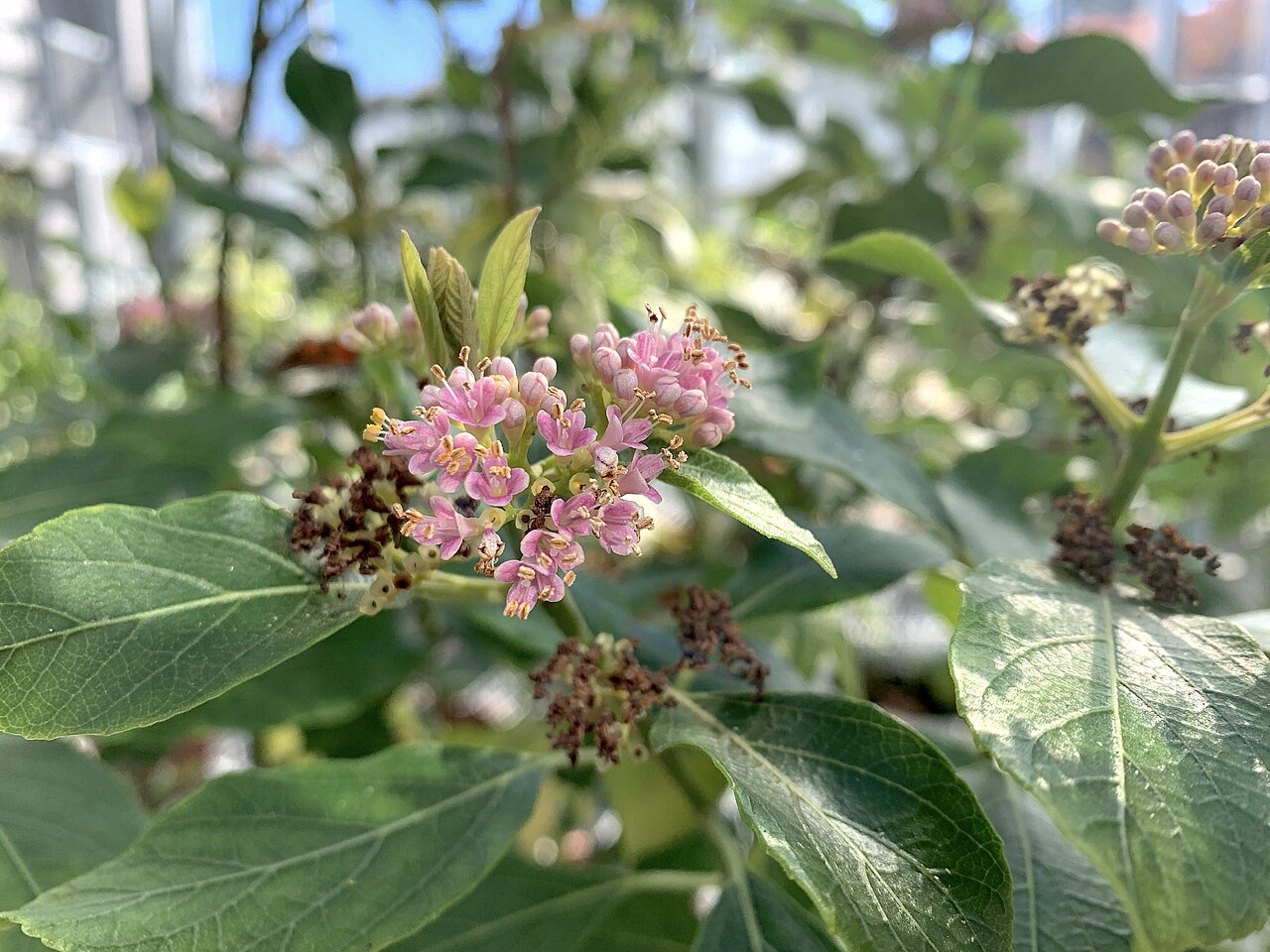
The public glasshouse holds about 2,000 tropical and subtropical species in six rooms: plants of arid zones, useful plants from around the world, 'symbol trees', East Asian flora from the Ryukyu Islands and Taiwan, plants of the Ogasawara Islands and, finally, orchids. The second room grows, among others, the titan arum (Amorphophallus titanum).
The fifth room is devoted to the Ogasawara (Bonin) archipelago, which has about 140 endemic species, around 90 of them reportedly threatened with extinction. Plantia mentions munin-nobotan, a member of the melastome family, munin-yatsude, ogasawara-azami, a thistle, as well as uchidashi-kuroki, yuzuriha-wadan and shima-murasaki. The cool house gathers some 400 alpine and cool-climate species; chinguruma and miyama-kinbai, two plants of the Japanese high mountains, grow there in open beds.
Visiting
1 min
The garden covers more than 16 hectares in the Hakusan district of Bunkyō ward. An hour is enough for the two glasshouses, but the whole garden deserves half a day. The glasshouse keeps shorter hours than the garden, and some plants may be withdrawn from display for cultivation reasons.
The walk leads on to the medicinal herb garden that recalls the origins of the site, the ginkgo of the spermatozoid discovery, the so-called 'Newton's apple tree', 'Mendel's vine' and the former main building of the Tokyo Medical School, built in 1876 and re-erected in the garden in 1969.
35.72° N, 139.75° E
Greenhouses nearby
More greenhouses — Japan
Do you have a good photo of this greenhouse? Suggest it for this page →