Large Greenhouse, Adachi Park of Living Things (足立区生物園 大温室)
Adachi, Tokyo
Entry updated on October 5, 2026
- Year
- 1993
- Architect
- Unknown
- Style
- Two-level indoor tropical greenhouse under a glazed roof
- Status
- Open to the public
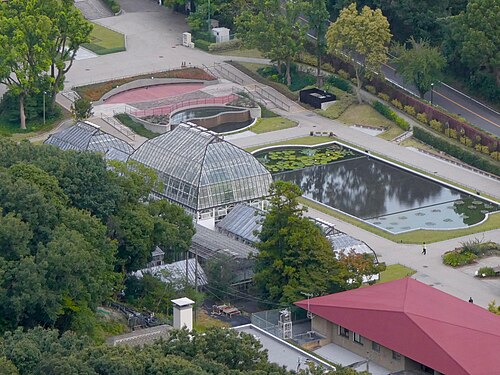
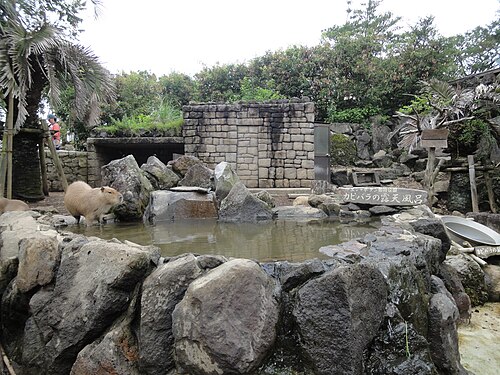
Opened in October 1993 in Motofuchie Park, the Adachi Park of Living Things (Adachi-ku Seibutsuen) is owned by Tokyo's Adachi ward and run by a joint venture of two companies. Its large greenhouse, a single volume over two floors, recreates tropical and subtropical habitats: an introductory zone on the Ryukyu Islands, then a jungle-like hall with a tank of giant Amazonian fish and butterflies flying all year round. Closed for works in 2013 and reopened in April 2014, the park also breeds an endangered butterfly from Tsushima island for the Ministry of the Environment.
Affiliate links — booking through Verrière helps fund our research, at no extra cost to you.
History
1 min
The Adachi Park of Living Things grew out of smaller activities in Motofuchie Park: firefly-viewing evenings and small displays of aquatic animals came before a permanent facility opened in October 1993 (on 1 October, according to Japanese Wikipedia). The large greenhouse is part of that building; none of the sources consulted names its designer or gives it a separate date.
Attendance fell at first: the park's report for fiscal 2025 says it dropped to about 60,000 visitors in fiscal 1999. From 2003 the organisation that now leads the operating consortium took over interpretation and went on to rework the education programmes and displays. The park closed in 2013 for renovation and reopened in April 2014; fiscal 2014 brought 197,134 visitors, the highest figure since opening. It is owned by Adachi ward and managed by a consortium of Shizen Kyoiku Kenkyu Center and Tobu Ryokuchi.
Since 2014, at the request of the Ministry of the Environment, the park has kept an ex-situ population of the Tsushima ura-boshi-shijimi, a small butterfly found in Japan only in the north of Tsushima island. The species was listed as a nationally rare protected species in January 2017, and since 2017 the breeding work has formed part of the official protection and propagation programme. Fiscal 2025 set a new attendance record of 261,497 visitors.
Architecture and engineering
1 min
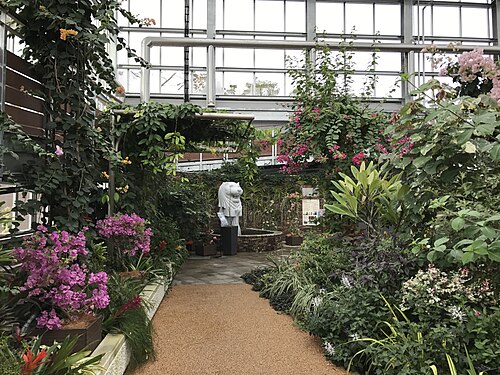
The large greenhouse is not a free-standing pavilion: it sits inside the park building as a single volume open through two floors, from the ground floor to the upper level, beneath a glazed roof. In the layout presented at the 2014 reopening, the route begins with an introductory zone on Japan's subtropical regions and leads into a larger, jungle-like hall where a big acrylic-fronted tank shows Amazonian fish, including pirarucu. A raised planted bed overlooks the tank.
On the upper level an artificial hill is reached by steep steps and a walkway, and an automatic door opens at that level. In fiscal 2025 the operator fitted handrails, dug out and relaid the floor of the hill and repaired the walkway, noting that the humidity of a greenhouse wears equipment out unusually fast even indoors. The house has fan convectors and watering taps, and three roof panes were replaced in March 2026 after scaffolding was put up. The sources give neither the floor area nor the height of the greenhouse; the whole facility is given as 7,200 m².
Plant collections
1 min
The greenhouse is planted with tropical and subtropical species dense enough to need pruning every month (eleven sessions in fiscal 2025), and a planting list drawn up the previous year is extended as more plants are identified. The planting also serves the animals: a large-leaved plant sold in Japan as 'Augusta' was set above the pirarucu tank to shade it and keep algae off the glass, and potted 'Benjamin' placed on the hill gives the tsumamurasaki-madara butterfly somewhere to lay its eggs.
Butterflies are the main attraction: 65 species and 9,368 adults were released in fiscal 2025, mostly in the large greenhouse, with a peak of 1,075 in April. In 2014 the most numerous were the kuroten-shirocho (781 individuals) and the kabatateha (589). Three times a year, surplus Tsushima ura-boshi-shijimi from the breeding programme (822 adults emerged in 2025) are shown to the public here.
Visiting
1 min
The greenhouse is inside the Adachi Park of Living Things, in Motofuchie Park (Hokima district). From Takenotsuka station it is about a twenty-minute walk, or a bus ride. Butterflies fly here all year; in fiscal 2025 the special showings of the Tsushima ura-boshi-shijimi took place in late April to early May, in July and in September. During winter evening openings the park has run a 'night tour of the tropical world' inside the greenhouse. A visit can continue with the Australia Dome, opened in 2010, the open-air insect dome and Motofuchie Park itself, whose firefly evenings marked their fortieth anniversary in 2025.
35.79° N, 139.81° E
Greenhouses nearby
More greenhouses — Japan
Do you have a good photo of this greenhouse? Suggest it for this page →