Greenhouses of the Ichikawa Ornamental Botanical Garden (市川市観賞植物園 大温室・サボテン温室)
Ichikawa (Ōmachi Park), Chiba Prefecture

Sources checked October 2026
- Year
- 1993
- Style
- Two glazed, metal-framed greenhouses combined in one building, facing a courtyard
- Dimensions
- Garden of 6,769 m²
- Status
- Open to the public, free admission
Opened on 11 October 1993 in Ōmachi Park, some 600 m from the municipal zoo, the Ichikawa ornamental garden is built around two glazed greenhouses in a single building: one for cacti and succulents, the other a large tropical house whose emblem tree is a traveller's palm, surrounded by coffee shrubs and jade vines. City statistics count about 180 tropical and 150 cactus species, 3,400 plants in all. A courtyard with a small pond and a 6,769 m² site complete the ensemble, which is free to enter, unlike the neighbouring zoo.
Affiliate links — booking through Verrière helps fund our research, at no extra cost to you.
History
The ornamental garden (観賞植物園) belongs to Ōmachi Park, in the north-east of Ichikawa, which the city set aside as a recreation zone of about 150 hectares: the council in charge of the zone dates from March 1987, and the zoo, its main hub, opened on 21 August of that year. The ornamental garden came later: the city's chronology places it in 1993, and its statistics give the date of 11 October 1993. The official footprint of the garden is 6,769 m².
The garden has remained free to enter, while the zoo charges admission. Municipal statistics count 34,477 entries for fiscal 2025, against 19,733 for fiscal 2020, the year of Covid-19 closures; the garden's own diary notes that in 2020 the jade vine was flowering while the park was shut to the public. The same diary says, in a 2022 entry, that Arabica coffee has been planted since the opening and that three varieties introduced from Okinawa two years earlier had flowered for the first time that year.
Architecture and engineering
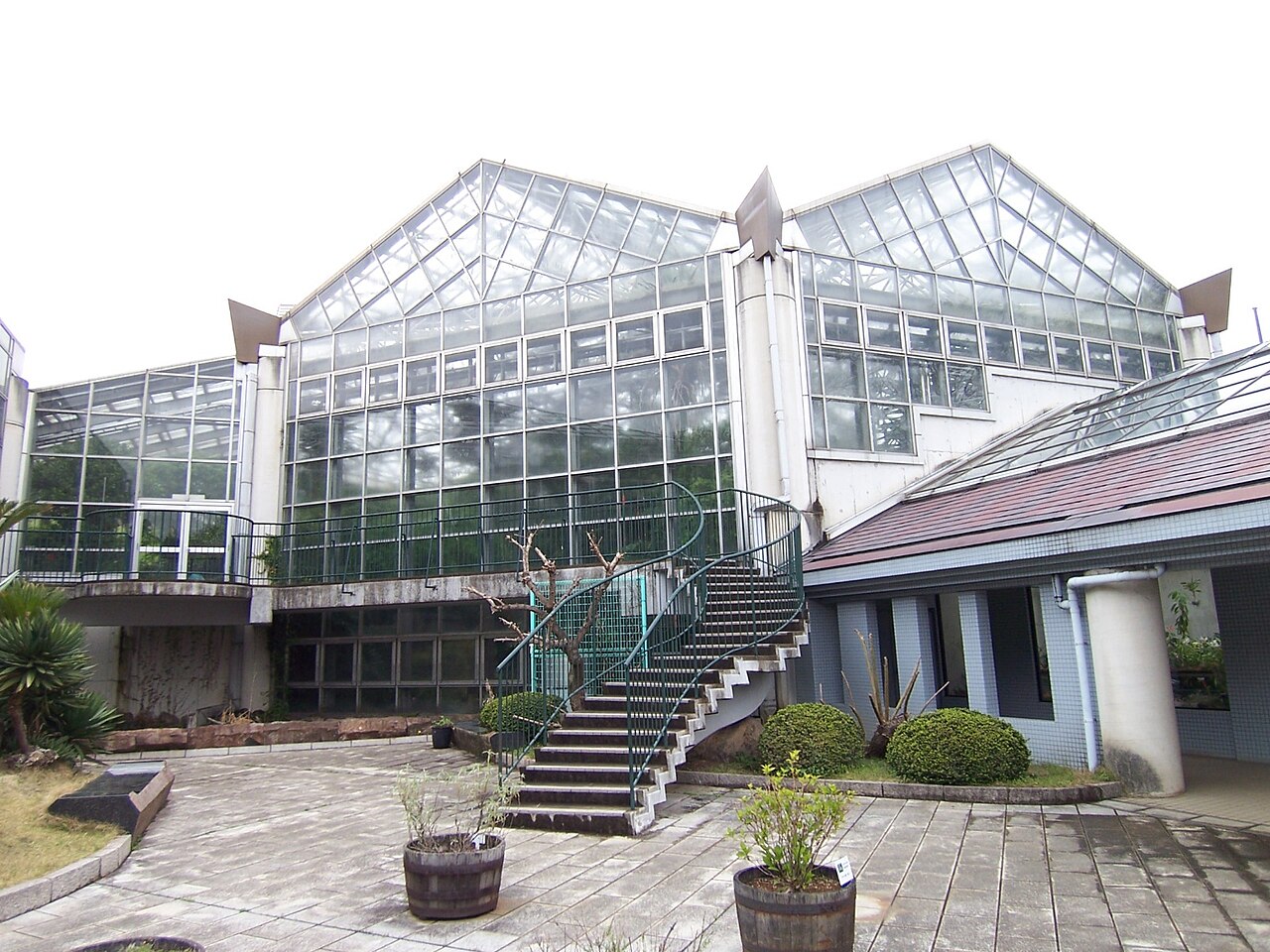
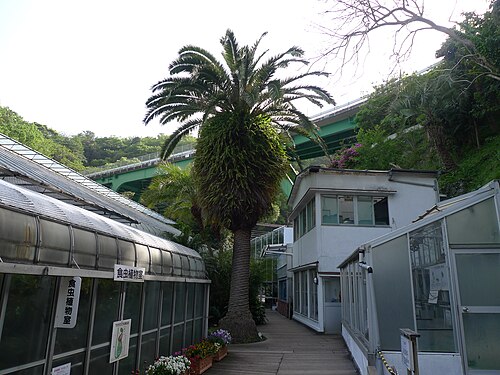
The two greenhouses share a single building: in the photograph published on Wikimedia Commons in 2025, the cactus house stands on the left and the large house on the right, facing a paved courtyard planted with agaves. The façades are fully glazed, in large panes on a metal frame, with ventilation flaps near the top; on the large-house side, the roof is a run of glazed gables of different heights. According to Wikipedia, an inner courtyard leads to a small pond with turtles and small fish.
According to a November 2024 article on a local news portal, the large house is heated by hot-water pipes and its humidity is regulated by ceiling sprinklers, whereas the cactus house relies on the natural greenhouse effect and ventilation. The same article mentions one house used for cultivation trials and another where ailing plants are nursed.
Plant collections
The 2026 municipal statistics count 180 tropical species (2,400 plants) and 150 species of cacti and succulents (1,000 plants); the city's own presentations and Wikipedia speak of about 350 species; an older online guide gave 240 tropical species and 170 cacti.
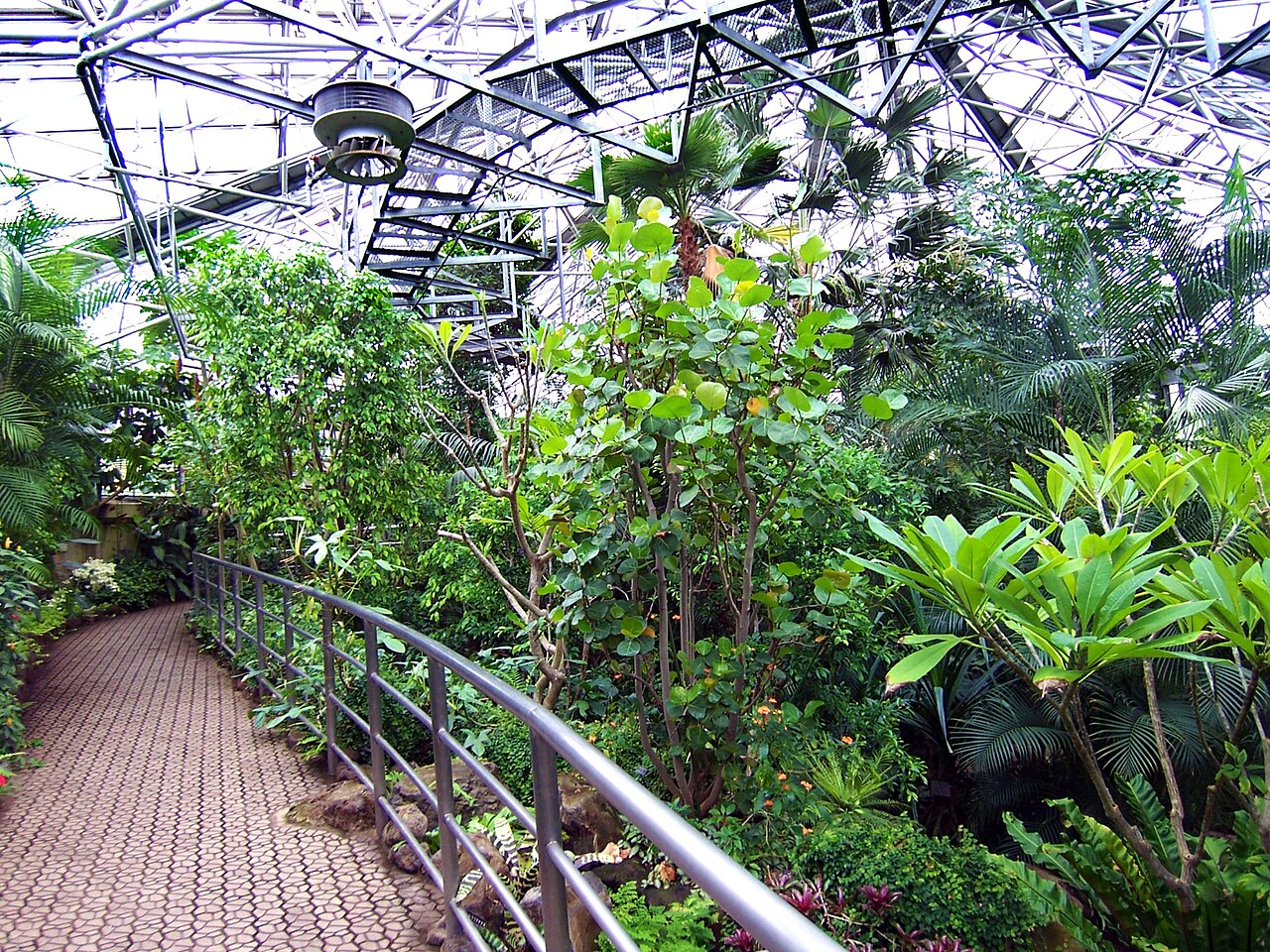
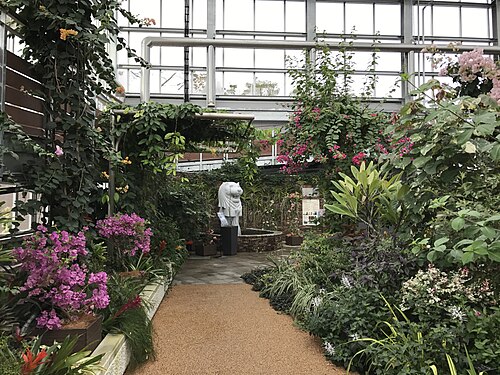
The large house has a traveller's palm (タビビトノキ) as its emblem tree, surrounded by coffee shrubs and jade vines (ヒスイカズラ), whose flowering runs, according to the garden's diary, until around Golden Week. Visitors can see tropical fruit trees laden with fruit at close range (pineapple, banana, papaya, coffee) and a corner of carnivorous plants; the local portal adds cacao trees, hibiscus, papyrus, staghorn ferns and orchids, including moth orchids. The 2020 diary also notes a mizurenbu, an evergreen tree of the myrtle family native to India, the Malay Peninsula and Borneo, whose red fruit is to be looked at, not picked.
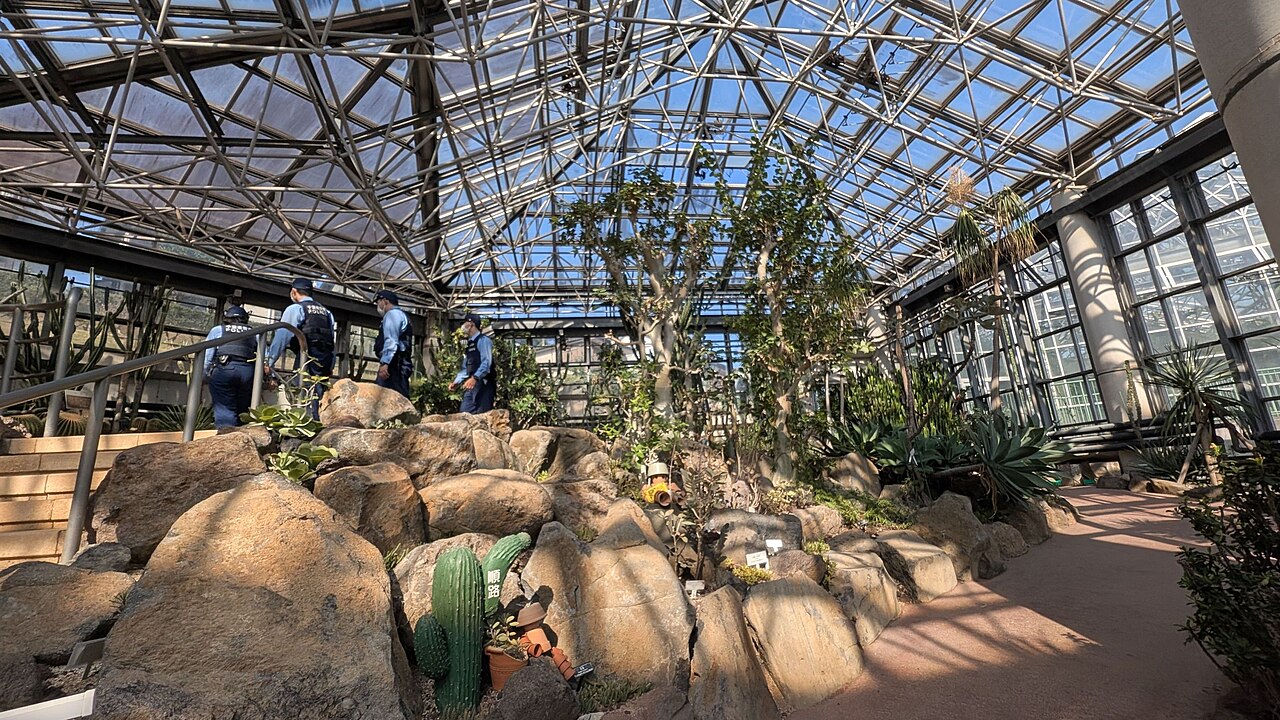
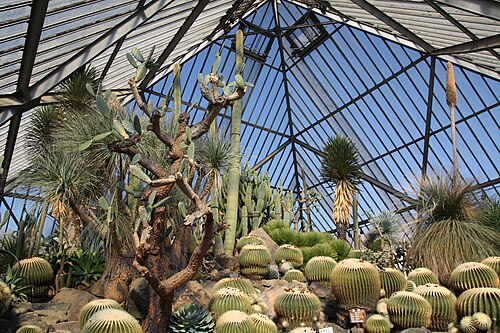
The neighbouring house holds cacti, succulents and air plants (エアープランツ); the diary remarks that most of the cacti come from Mexico, and the local portal lists aloes, dasylirions and an agave (アオノリュウゼツラン) that flowered there in 2012, a very rare event.
Visiting
The garden stands in Ōmachi Park, about 600 m from the zoo, roughly ten minutes on foot according to guides (the city gives a quarter of an hour from the zoo entrance), near the nature observation area. The approach from the Ōmachi gate involves steps and a steep slope, the municipality points out. One to two hours is usually enough, following the usual route: the cactus house first, then the large house.
The jade vine flowers in spring: the city's bulletins follow it from late March to early May in 2025. Concerts are held in the lobby a few times a year, and one-off events enliven the garden. Nearby, the nature observation area, home to fireflies (the city runs an observation period in July), and the rose garden (110 varieties, about 1,000 plants) are also free to enter; the zoo and the Ichikawa natural history museum lie in the same park. The whole can easily be combined into half a day.
35.77° N, 139.97° E
Greenhouses nearby
More greenhouses — Japan
Do you have a good photo of this greenhouse? Suggest it for this page →
Sources (8)
- city.ichikawa.lg.jp/site/zoo/6813.html
- city.ichikawa.lg.jp/site/zoo/6709.html
- city.ichikawa.lg.jp/uploaded/attachment/56805.pdf
- ja.wikipedia.org/wiki/%E5%B8%82%E5%B7%9D%E5%B8%82%E5%8B%95%E6%A4%8D%E7%89%A9%E5%9C%92
- commons.wikimedia.org/wiki/File:%E5%B7%A6%E3%81%8C%E3%82%B5%E3%83%9C%E3%83%86%E3%83%B3%E6%
- ichikawa-chiba.mypl.net/article/motoyawata-bot_ichikawa/90703
- city.ichikawa.lg.jp/site/zoo/7539.html
- city.ichikawa.lg.jp/site/zoo/7540.html
Affiliate links — booking through Verrière helps fund our research, at no extra cost to you.