Oliwa Park Palm House (Palmiarnia Parku Oliwskiego)
Gdańsk (Oliwa), Pomerania
Entry updated on September 30, 2026
- Year
- Eighteenth-century orangery; rotunda opened 2022
- Architect
- RYSY Architekci (rotunda and refurbishment, design 2016-2019)
- Style
- Restored baroque orangery with a contemporary glass rotunda
- Dimensions
- Rotunda 24 m high and 17 m in diameter (204 m²); orangery 705 m²
- Status
- Open to the public since 19 March 2022
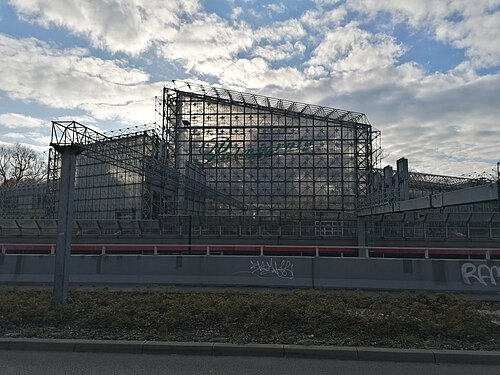
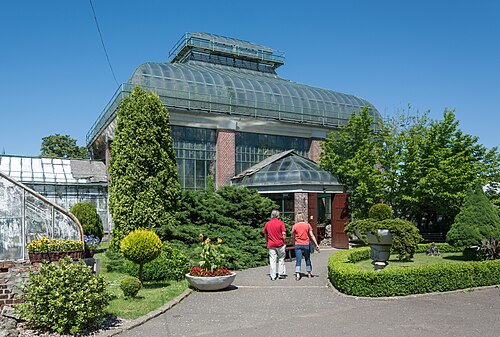
In Oliwa Park, once the garden of a Cistercian abbey, an eighteenth-century orangery was turned over the centuries into a palm house. When a date palm of nearly 180 years pierced its roof, the project by RYSY Architekci added a glazed rotunda 24 metres high while the orangery itself was restored. Begun in 2017, the works ended with the reopening of 19 March 2022, at a cost of about 24 million zlotys. Around 1,000 plants are on show; the date palm itself withered during the building work.
Affiliate links — booking through Verrière helps fund our research, at no extra cost to you.
History
1 min
Oliwa Park, of 11.3 hectares, is the garden of the former Cistercian abbey. Its baroque part was laid out in 1754-1756 by Abbot Jacek Rybiński, who entrusted the work to Kazimierz Dębiński, a gardener from Wilanów. The City of Gdańsk says an orangery already stood around 1734 on the park's eastern edge; another source ties it to the abbot's renovations of the 1750s, which leaves the date of origin uncertain. The park became public in 1926 and was entered in the register of monuments in 1946.
The building was extended twice in the nineteenth century. Between 1899 and 1929 the orangery was converted into a greenhouse with a small palm house, near an alpinarium. After a plant acclimatisation station was set up in 1946 and a botanic garden in 1952-1956, the modern facility opened in 1956 and was upgraded several times, notably in 1984.
A date palm planted in the ground, with the structure built around it, reached nearly 17 metres in 2013 and broke ceiling panes. The transformation project, designed in 2016-2019, called for a new rotunda and the restoration of the orangery; work began in 2017, the contractor changed in July 2019, and the palm house reopened on 19 March 2022 at a total cost of about 24 million zlotys. The palm, removed in December 2021, did not survive the length of the works.
Architecture and engineering
1 min
The complex brings together four buildings: a rotunda, the restored orangery, a technical and social building (114 m², delivered in July 2019) and a glasshouse. The rotunda, a slightly twisted glass cylinder, rises above 24 metres for 17 metres in diameter, with 204 m² and 4,280 m³; its height was raised from 19 to over 24 metres during the design to house the palm, within a 25-metre zoning limit. It consists of 420 panes of varying sizes, the largest about 2.6 m², held at 1,400 bespoke suspension points. Reflective glazing mirrors the tree canopies, and the dome has automatic vents and climate control. Gdańsk University of Technology carried out the wind-load study.
The restored orangery, of 705 m² and 3,190 m³, dates in its southern part from the mid-eighteenth century and has a mansard roof; its renovation, by the contractor Kamaro for 7.8 million zlotys, removed roof openings, added windows and a lift, and reopened original passages. The architects sought to join the vertical form, a house for a single tree, with the horizontal form of the orangery.
Plant collections
1 min
At reopening the palm house presented about a thousand exotic plants, two hundred from the former collection and eight hundred newly acquired. Visitors see palms, banana plants, araucarias, philodendrons, cacti, aloes, agaves, figs, cycads and orchids, together with tree ferns and an Abyssinian banana. The araucaria, from Australian forests, is the largest plant on site. A water-and-rock landscape displays the orchids; the interior and plant display were designed by Michał Kaczmarczyk and Joanna Bogdanowicz.
The date palm of nearly 180 years, described as the oldest cultivated specimen of its species in Europe, was removed in December 2021 after declining. Young palms of the same species were introduced after the reopening.
Visiting
1 min
The palm house lies within Oliwa Park, between Opata Jacka Rybińskiego Street and Grunwaldzka Avenue; entry is through a neighbouring café. About an hour covers the rotunda and the orangery, more if the park is explored, its baroque part of 1754-1756 adjoining an English-Chinese section added at the end of the eighteenth century.
Oliwa Cathedral is about 200 metres away and the Hevelianum about 2 kilometres. The park, open to the public since 1926 and counting more than two thousand trees, lends itself to a longer walk between the gardens and the abbey quarter.
54.41° N, 18.56° E
Greenhouses nearby
More greenhouses — Poland
Do you have a good photo of this greenhouse? Suggest it for this page →
Sources (8)
- architektura.muratorplus.pl/konkursy/zycie-w-architekturze-2025-palmiarnia-w-gdansku-oliwi
- architektura.muratorplus.pl/realizacje/szklany-dom-dla-jednego-drzewa-palma-przebila-dach-
- gdansk.pl/wiadomosci/Nietypowa-24-metrowa-rotunda-w-Parku-Oliwskim-Remont-palmiarni-dobieg
- gdansk.pl/wiadomosci/Palmiarnia-w-Parku-Oliwskim-Czas-na-rewitalizacje-zabytkowego-budynku
- zawszepomorze.pl/artykul/2276,tysiac-roslin-z-roznych-zakatkow-swiata-czyli-oliwska-palmia
- trojmiasto.pl/Palmiarnia-w-Parku-Oliwskim-o51211.html
- trojmiasto.pl/wiadomosci/Oliwska-palma-przerosla-swoja-oranzerie-i-uszkodzila-jej-dach-n65
- e-turysta.pl/atrakcje/muzea/palmiarnia-parku-oliwskiego.html