Butterfly Greenhouse, Itami City Museum of Insects (伊丹市昆虫館 チョウ温室)
Itami, Hyōgo Prefecture
Entry updated on October 5, 2026
- Year
- 1990
- Style
- Hemispherical glass greenhouse attached to a reinforced-concrete museum
- Dimensions
- ≈600 m² floor area, 15 m high
- Status
- Open to the public
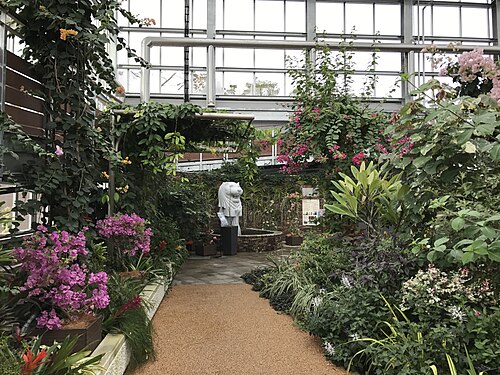
Opened on 10 November 1990 to mark the fiftieth anniversary of Itami's city status, the Museum of Insects occupies a four-storey building in Konyaike Park. Its centrepiece is a hemispherical glass greenhouse of about 600 m² and 15 metres in height, which the museum ranks among the largest in the Kansai region. Around 1,000 butterflies of some fourteen species, both local and from Okinawa, fly freely there all year, supplied by an in-house breeding stock of more than 500 caterpillars and pupae. Specimen rooms and enlarged dioramas complete the visit.
Affiliate links — booking through Verrière helps fund our research, at no extra cost to you.
History
1 min
The Itami City Museum of Insects (伊丹市昆虫館) opened on 10 November 1990. It was created as part of the celebrations for the fiftieth anniversary of Itami becoming a city, and was built in Konyaike Park (昆陽池公園) in Hyōgo Prefecture. From the start it combined galleries devoted to insects with a large greenhouse in which butterflies fly freely.
The museum is owned by the City of Itami. Since 1 April 2019 it has been run by a public-interest foundation, the Itami Culture and Sports Foundation (いたみ文化・スポーツ財団). It is recognised under Japan's Museum Act and belongs to both the Japanese Association of Museums and the Hyōgo museums association.
Beyond its displays, the museum has taken on wider work. Since 2006 it has taken part in "Naku mushi to gōchō" (鳴く虫と郷町), an event devoted to singing insects. After the 2011 tsunami it helped restore damaged insect collections belonging to the Rikuzentakata museum. It also runs ex situ conservation programmes, which covered eight species in 2026.
Architecture and engineering
1 min
The museum building is of reinforced concrete, partly with a steel frame. It rises four storeys above ground over one basement level, with a total floor area of 2,986.83 m², and covers 1,605.09 m² of a 1,800 m² plot.
Its most distinctive element is the butterfly greenhouse (チョウ温室): a hemispherical glass house with a floor area of about 600 m² and a height of 15 metres, which the museum describes as one of the largest in the Kansai region. Under this dome the butterflies move freely around visitors. A separate growing greenhouse produces the food plants for the caterpillars bred on site.
The rest of the building houses an ecology room, a special exhibition room, a first gallery of dioramas and a film hall that also serves for events and talks.
Plant collections
1 min
Throughout the year, around 1,000 butterflies belonging to some fourteen species are released into the greenhouse. According to the Japanese Wikipedia article, they include both species found locally and species from Okinawa.
This population depends on continuous breeding: the museum keeps more than 500 caterpillars and pupae under constant care, fed on plants grown in its own greenhouse. It also takes part in the ex situ conservation of eight species.
The adjoining rooms extend the greenhouse. The ecology room lines up display cases for about twenty insect species, among them foreign beetles, local species and aquatic insects. The special exhibition room holds specimens collected around the world, while the first gallery shows small insects and their habitats in dioramas enlarged ten times.
Visiting
1 min
The museum stands in Konyaike Park in Itami, Hyōgo Prefecture. Because butterflies fly in every season, the greenhouse is as rewarding in winter as in summer, and it makes a good choice for a rainy day.
A full visit takes in the greenhouse, the ecology room, the enlarged dioramas and the specimen room, and can be extended with a walk in the park that surrounds the museum. Some slopes along the indoor route are fairly steep; staff will help on request.
34.79° N, 135.39° E
Greenhouses nearby
More greenhouses — Japan
Do you have a good photo of this greenhouse? Suggest it for this page →