Lotus Hall Atrium Greenhouse, Mizunomori Water Botanical Garden (草津市立水生植物公園みずの森 ロータス館)
Kusatsu, Shiga Prefecture
Entry updated on October 5, 2026
- Year
- 1996
- Architect
- Unknown
- Style
- Heated greenhouse atrium at the centre of a hall devoted to aquatic plants
- Status
- Open to the public
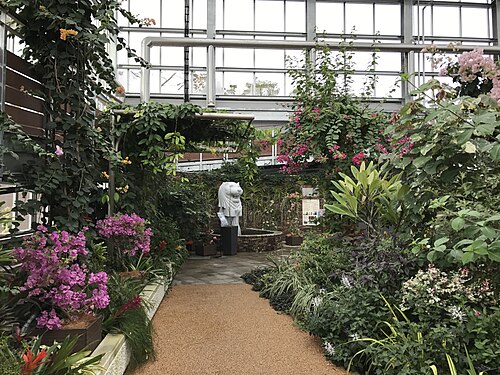
Opened by Kusatsu City on 13 July 1996 on the Karasuma Peninsula on the shore of Lake Biwa, close to what was then a lotus colony of about 13 hectares, the Mizunomori water-plant park is built around the Lotus Hall. At the centre of this pavilion, a heated greenhouse atrium keeps tropical water lilies in flower all year; it also holds the three sacred trees of Buddhism, including a true sal tree that the park says it alone in Japan has brought into flower, and, since 2020, a cactus area.
Affiliate links — booking through Verrière helps fund our research, at no extra cost to you.
History
1 min
Kusatsu City opened the Mizunomori water-plant park on 13 July 1996 on the Karasuma Peninsula, which juts out into Lake Biwa. Two aims were set out: to create a centre for flowers and greenery, and to give residents a place to relax, all under the theme of encounters between plants, water and people. Its specialism reflects the site: the park was built near a lotus colony of about 13 hectares, one of the largest in Japan, which is why the Lotus Hall, with its lotuses and water lilies, takes centre stage. The professional journal 公園緑地 published an article on it as early as 1997.
The lotus colony disappeared in 2016. In 2017 the park launched a 'lots of lotus' project (ハスいっぱいプロジェクト), in which around a hundred potted lotuses lined up in one of its ponds recall the lost landscape. The Lotus Hall greenhouse has kept growing too, with a cactus area added in 2020.
The city still owns the park, whose management has been delegated since fiscal 2013 to a consortium, the Ōmi Tetsudō Yū Group, led by the landscaping firm Seibu Landscape (Seibu Zōen) with the Ōmi Railway company and a community development association from northern Kusatsu. Its fourth five-year term runs from 1 April 2024 to 31 March 2029.
Architecture and engineering
1 min
The Lotus Hall (ロータス館) is the park's main building, a themed facility devoted to the aquatic plants grouped under the general name of 'lotus', above all lotuses and water lilies. The greenhouse sits at its centre: this is the atrium, called the ロータス・クスタス ボタニカルミュージアム, around which the other spaces are arranged. It is heated, so tropical water lilies flower there even in winter, and it is designed to offer blooms in every season.
Around it, the building contains an entrance hall, a temporary exhibition room, a permanent exhibition room, an aquarium for watching aquatic plants under water, a gardening and greening advice corner, a 105-seat screening hall with a 200-inch high-definition screen showing films on lotuses and water lilies, a shop, a restaurant and a café. Around the hall, the park lays out its water gardens: the water-lily pond, the lotus pond and the 花影の池 pool.
The sources consulted give neither the architect nor the builder, the dimensions or the structure of the atrium; the only known date is the opening of the park in 1996.
Plant collections
1 min
The atrium brings together aquatic plants from Japan and around the world, led by tropical water lilies (熱帯スイレン), which flower there all year. The park displays more than 150 water-lily varieties, a number described as the highest in Japan.
The greenhouse also holds the three sacred trees of Buddhism. The park states that it is the only place in Japan to have brought a true sal tree (サラノキ) into flower: this tropical species cannot cope with the Japanese climate, so Japanese temples plant another species, ナツツバキ, under the name of sal instead.
The cactus area opened in 2020 displays a kinshachi (金鯱) weighing about 100 kg, grown over more than fifty years, and a フルクラエア・フォエチダ・メディオピクタ, which flowers only once in several decades. The aquarium shows submerged plants from Japan and Asia, including ネジレモ, found only in Lake Biwa. Outside, the ponds, the garden of the seven autumn herbs, the wetland garden and the hilltop flower garden extend the collection.
Visiting
1 min
The park covers about 3.7 hectares on the Karasuma Peninsula and is reached by bus from JR Kusatsu Station, on the line serving the Lake Biwa Museum. The Lotus Hall is the natural starting point: its heated atrium keeps water lilies in flower in every season, which makes a visit worthwhile even in winter. Films in the screening hall and the aquarium round out the introduction to aquatic plants, and the advice corner answers gardeners' questions. For autumn 2026 the park has announced an orchid show and a bonsai exhibition. Outside, the lotus season is the time to see the rows of pots in the project that recalls the vanished colony.
35.07° N, 135.94° E
Greenhouses nearby
More greenhouses — Japan
Do you have a good photo of this greenhouse? Suggest it for this page →