Greenhouse, Botanical Garden of Amagasaki City, Kamisakabe-Nishi Park (上坂部西公園 温室)
Amagasaki, Hyōgo Prefecture
Entry updated on October 5, 2026
- Architect
- Unknown
- Style
- Four-section display greenhouse
- Dimensions
- About 600 m²
- Status
- Open to the public
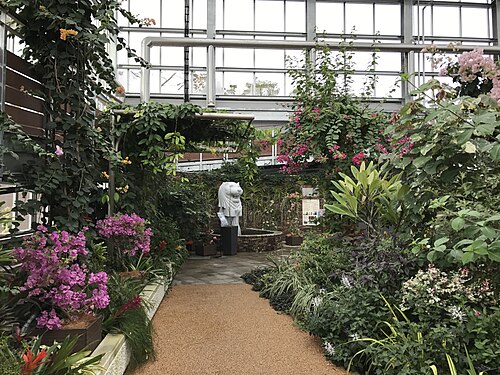
Kamisakabe-Nishi Park, Amagasaki's urban greening botanical garden since 1984, occupies a former factory site close to Tsukaguchi Station. Its greenhouse of about 600 m², in the north-west of the park, is divided into a succulent room, two rooms of tropical flowering trees and shrubs, and an exhibition room, and holds around 800 kinds of plants, among them a large banyan, hibiscus, Strelitzia, mango and papaya trees and cacti. Seasonal shows are staged there, including a display of potted flowering plants in winter.
Affiliate links — booking through Verrière helps fund our research, at no extra cost to you.
History
1 min
Kamisakabe-Nishi Park stands on land freed up when factories moved away. Amagasaki City began acquiring plots in 1970, and the urban park plan was formally adopted in 1972. In May 1971, however, a company linked to the owner of a corporate baseball ground filed plans for a bowling alley on the site. Residents and the parents' association of the neighbouring primary school objected, and a petition with 4,300 signatures went to the city council. The project was dropped in exchange for an alternative site found by the city, whose purchase of the land led to the park and to the neighbouring Piccolo Theater.
The ground, full of concrete rubble, was covered with about a metre of good soil from road works at Nose. The site first served as a nursery, Kamisakabe Midori-en, set up as an unemployment relief scheme, which at its peak raised 160,000 flower seedlings a year for planting around the city. It opened to the public in 1975, gained the forerunner of the green consultation centre in a prefabricated hut in 1977, became a full botanical garden in 1981 and was established as the Amagasaki City Urban Greening Botanical Garden on 1 April 1984.
The sources consulted do not date the greenhouse itself. With facilities now more than thirty years old, the city plans to rebuild the green consultation centre.
Architecture and engineering
1 min
The greenhouse stands in the north-west of the park, with the rose garden laid out in front of it. The association that runs the park gives it an area of about 600 m², divided into four spaces: a succulent room, two rooms for tropical flowering trees and shrubs, and an exhibition room for temporary displays. Published photographs show glazed rooms with a light frame and cactus beds edged in stone. Neither the designer nor the construction year is recorded.
In front of the greenhouse, a bed of about ten Australian species, including Grevillea and Banksia, is used to raise awareness of the urban heat-island effect. The park's architectural landmark, however, is not the greenhouse but the neighbouring green consultation centre, a round, dome-like building with an open central void designed by Osamu Ishii, known as the "green architect". A new timber exhibition pavilion was built in fiscal 2018.
Plant collections
1 min
According to the managing association, the greenhouse displays around 800 kinds of plants. The permanent collections include tropical trees, among them a large banyan (gajumaru), tropical flowers such as hibiscus and Strelitzia, fruit trees such as mango and papaya, and cacti and succulents including kinshachi and gekka bijin. The park's general description also mentions the coffee plant, and photographs show kaenboku and jaboticaba.
Temporary displays follow the seasons, featuring for example passion flowers or cyclamen; from 5 to 25 December 2026 the greenhouse hosts a show of flowering pot plants.
The botanical garden also conserves some 80 threatened species from Japan and abroad (2020 figure), including the denjisō fern found in the city in 2018 and listed as endangered in Hyōgo Prefecture, himebaramomi, the "Jurassic tree" and cacti. Since January 2020 it has also looked after the ogasawara-guwa, a tree endemic to the Ogasawara Islands and nationally listed as threatened, under a foster-parent programme of the national forest research institute.
Visiting
1 min
The park is a few minutes' walk from JR Tsukaguchi Station, and the Piccolo Theater bus stop is at its entrance. The greenhouse, closed two days a week, pairs naturally with the rose garden in front of it, with some 250 roses of 50 varieties, including "Rose Amagasaki 2016", chosen by a residents' vote for the city's centenary.
The green consultation centre, seasonal flower beds, water plaza and central lawn round off the walk. The park is also a stopover for migrating birds, and winter, once the leaves have fallen, is the best season for birdwatching. In December an orchid show and the greenhouse's display of potted plants bring extra life to the garden.
34.75° N, 135.42° E
Greenhouses nearby
More greenhouses — Japan
Do you have a good photo of this greenhouse? Suggest it for this page →