Longwood Gardens Conservatory
Kennett Square, Pennsylvania

Sources checked September 2026
- Year
- 1921
- Style
- Neoclassical, glass-and-steel structure
- Dimensions
- More than 1.6 hectares under glass, one of the largest conservatory complexes in the United States
- Status
- Open to the public; the "Longwood Reimagined" expansion opened in November 2024
Magnate Pierre S. du Pont had the grand conservatory built opened in 1921 on his Longwood estate in Pennsylvania. The complex, expanded over the decades with rooms such as the ballroom fitted with an Aeolian organ of more than 10,000 pipes completed in 1929, today covers about 1.6 hectares under glass. Since 2021, the site has been undergoing "Longwood Reimagined," the largest transformation in its century-long history.
Affiliate links — booking through Verrière helps fund our research, at no extra cost to you.
Practical info
- Tickets
- Timed ticket required. Adult (16-64): $35 from 26 Oct to 15 Nov; during A Longwood Christmas, $45 on non-peak days (Mon-Thu from 23 Nov to 17 Dec; every day from 4 to 10 Jan) and $52 on peak days (Fri-Sun from 20 Nov to 3 Jan; every day from 18 Dec to 3 Jan). Youth (5-15): $20, then $25 and $32; free for ages 4 and under.
- Opening hours
- 2-15 Nov 2026: Wednesday to Monday 10am-5pm, closed Tuesday. 16-19 Nov: closed Monday and Tuesday; on Wednesday and Thursday the conservatories are closed all day and the outdoor gardens are open 10am-5pm (last entry 4pm). A Longwood Christmas, 20 Nov-10 Jan 2027: daily 10am-11pm. Closed 11-12 Jan 2027.
- Getting there
- 1001 Longwood Road, Kennett Square, Pennsylvania, on US Route 1, about 3 miles north-east of Kennett Square. Free parking in all car parks. The OurBus coach from New York and Philadelphia drops off at the entrance (admission extra).
Frequently asked questions
Do I need to book?
Yes: timed admission tickets are required during the Gardens' opening hours. Members may also need to reserve, depending on the period.
Are there closing days?
Yes: the site is closed on Tuesdays until 15 November 2026, on 16 and 17 November, then on 11 and 12 January 2027. The conservatories are closed all day on 18 and 19 November 2026; the outdoor gardens stay open from 10am to 5pm.
Can I visit without a car?
The OurBus coach links New York and Philadelphia to the entrance; rideshare operates, but few drivers are available.
When did the main conservatory open?
The conservatory planned by Pierre S. du Pont opened in 1921, according to the garden's own history page.
History
Longwood's glasshouse history begins in 1914, when the industrialist Pierre S. du Pont (1870–1954) added an L-shaped conservatory to the old Peirce farmhouse, doubling its size. By 1916 he was contemplating indoor facilities on a far grander scale. Work on the great conservatory began in 1919, the year the Camellia House was also built, and it opened to the public in 1921.
In the winter of 1920, on a trip to Santa Barbara, du Pont bought mature citrus trees, tangerines, grapefruit and oranges, to plant the Orangery. A Music Room followed in 1923. In 1928 the architect E. William Martin designed an addition first known as the Azalea House, and in 1929 the Ballroom built to house an Aeolian organ of 10,010 pipes, described as the largest ever installed in a private residence. The organist Firmin Swinnen played there most Sunday afternoons until 1956. The organ was restored between 2004 and January 2011.
Later decades brought a string of additions: the Palm House (1966), Isabelle Greene's Silver Garden (1989), Roberto Burle Marx's Cascade Garden (1992), the Mediterranean Garden (1993), the restoration of the East Conservatory under Sir Peter Shepheard (2005–2006), the Children's Garden (2007) and Kim Wilkie's Green Wall (2010). Launched in 2021, Longwood Reimagined, the most ambitious transformation of the conservatory in a century, opened in November 2024.
Architecture and engineering
The historic conservatory unfolds as a series of rooms. In the Orangery, citrus trees stand between columns clad in creeping fig (Ficus pumila) that still grows there. The Exhibition Hall has a sunken marble floor that can be flooded with a few inches of water to create a mirror. The East Conservatory covers half an acre (about 2,700 m²) under a vast ridge-and-furrow roof echoing the Orangery's, with a central stream, a 16-foot-wide waterfall and three heated, black-dyed pools.
The West Conservatory, designed by WEISS/MANFREDI with landscape architects Reed Hilderbrand, covers 32,000 square feet (about 3,000 m²). Its asymmetrical peaked roof reinterprets historic Lord & Burnham glasshouses, and its arching steel columns and beams evoke branches. It has 1,958 engineered glass panels with reflective dots for bird safety, earth-duct ventilation, computer-controlled vents and shades, and underground tanks collecting rainwater from more than an acre of roofs. Longwood describes the whole as a four-acre conservatory.
Plant collections
The conservatory holds more than 13,500 plant taxa, including over 4,500 orchids of 2,500 taxa, displayed on custom trellises in the Orchid House. The main conservatory combines mature trees, meticulously grown hanging baskets and bird-of-paradise, with displays that change with the seasons; the Exhibition Hall still has bougainvillea planted in the 1920s.
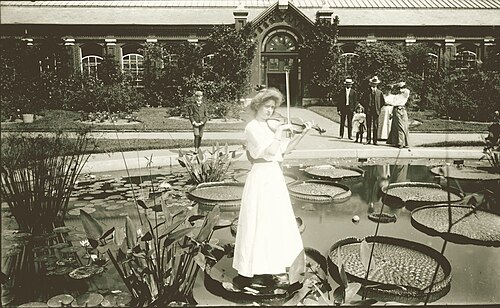
The East Conservatory features Mediterranean and subtropical flora: citrus, camellias blooming from October to March, azaleas, hanging ferns and palms. The West Conservatory gathers more than 60 permanent species from Mediterranean climates (acacias, bay laurels, cypress, Leucospermum, Leucadendron). The Cascade Garden, Burle Marx's only design in North America, now occupies its own 3,800-square-foot glasshouse, and the Waterlily Court shows tropical waterlilies and Victoria water-platters.
Visiting
The conservatory forms the heart of the Conservatory District on the 1,077-acre estate at Kennett Square. Allow at least two hours to take in the historic rooms, the East and West Conservatories, the Orchid House and the Children's Garden. The historic rooms host the Chrysanthemum Festival each autumn, and the displays change with the seasons. The visit can be combined with the Bonsai Courtyard, the Waterlily Court and the estate's outdoor gardens.
39.87° N, 75.67° W
Greenhouses nearby
Architecture nearby
More greenhouses — United States
Do you have a good photo of this greenhouse? Suggest it for this page →
Sources (6)
- longwoodgardens.org/gardens/conservatory-district/historic-main-conservatory
- longwoodgardens.org/gardens/conservatory-district/west-conservatory
- longwoodgardens.org/gardens/conservatory-district/east-conservatory
- longwoodgardens.org/view-all-gardens
- longwoodgardens.org/history
- en.wikipedia.org/wiki/Longwood_Gardens
Affiliate links — booking through Verrière helps fund our research, at no extra cost to you.