Glasshouses of the University of Regensburg Botanical Garden (Botanischer Garten der Universität Regensburg)
Regensburg, Bavaria
No freely licensed photo of this greenhouse yet. Do you have one? Suggest it for this page →
Sources checked October 2026
- Year
- 1972
- Style
- Four display glasshouses arranged by climate
- Dimensions
- About 800 m² of glasshouses, about 550 m² of them open to the public
- Status
- Open to the public, free admission; glasshouses open on weekdays
The botanical garden of the University of Regensburg, laid out from 1977 on 4.5 hectares, has glasshouses of which the first date from 1972. Four houses, with about 550 m² open to visitors, are arranged by climate: ferns, bromeliads and orchids; carnivorous plants and useful plants of temperate zones; tropical rainforest and tropical useful plants; cacti and other succulents. The glasshouses open on weekdays all year round and make up most of what can be visited in winter.
Affiliate links — booking through Verrière helps fund our research, at no extra cost to you.
History
Regensburg long sought a lasting botanical garden. Around 1600, according to the university, the physician Johann Oberndorffer laid out a medicinal plant garden, the city's first documented botanical installation; the city adds that it lasted only seventeen years. The Regensburg Botanical Society, founded in 1790 by David Heinrich Hoppe, then maintained several collections; a garden created in 1803, which at times held more than 4,000 species, was destroyed in 1809 in the fighting (its site: the former Protestant hospital according to the city, the former St. Emmeram monastery according to the university). A new garden opened in 1817 near the Max and Osten gates was abandoned in the mid-19th century for financial reasons, and its last remains disappeared in 1954 to make way for the indoor swimming pool.
The present garden grew out of the expansion of the university's science faculties. The first glasshouses went up as early as 1972, but 1977 is counted as the garden's birth year, when extensive construction began on 4.5 hectares. Further sections followed: threatened Bavarian plants in 2004, biological groups in 2005, a rock garden in 2013-2014.
The glasshouses have undergone an energy refurbishment: façade, external shading and heating were renewed and an energy screen added, according to a greenhouse manufacturer.
Architecture and engineering
The glasshouses stand in the lower part of the garden, east of the systematic section. The university gives about 800 m² of glasshouses in all, of which about 550 m² are open to the public, divided into four houses.
The houses are arranged by climate. According to the city, the orchids, the cocoa tree and a climbing plant from Java need at least 22 °C; house 2 is cooler, and the coolest house holds the cacti. The refurbishment by a greenhouse manufacturer covered the façade, external shading, heating and, inside, the cultivation benches, with an energy-saving screen added. A photograph from that manufacturer shows glass walls and a translucent roof. On the open map OpenStreetMap the main complex is drawn as a single building with a complex outline, with a Kalthaus some forty metres to the east. The garden's toilets are near the glasshouses.
Plant collections
According to the university's page, house 1 is devoted chiefly to ferns, bromeliads and orchids; house 2 combines carnivorous plants with useful plants of temperate zones; house 3 shelters tropical rainforest plants and many tropical useful plants. A city text (2023), which does not number the houses, adds detail: the warmest, at 22 °C or more, shows orchids, cocoa and a climbing plant from Java called Kletterschraubenpalme, pollinated by bats; the cooler house with carnivorous plants (sundews, butterworts, pitcher plants) also holds the "plant of immortality" from South-East Asia; the neighbouring house gathers strawberry guava, coffee, peanut, papaya, lemongrass and pepper.
In house 4, cacti, succulents and euphorbias from Africa and America occupy the rear, while the front shows carnivorous plants of cooler regions and plants of the Southern Hemisphere.
Visiting
The glasshouses are open on weekdays only, all year round: Monday to Friday, with shorter hours on Friday, never at weekends or on public holidays. Between 15 October and 31 March they provide the garden's regular opening, the open-air grounds opening only as the gardeners work. Admission is free. The garden lies at the south of the campus: it is about 2.7 km on foot from the main station, and is served by buses and by car, with free parking. The main paths are passable by wheelchair. The visit continues through the open-air sections, from the riverine woodland to the rock garden, as the seasons allow.
48.99° N, 12.09° E
Greenhouses nearby
More greenhouses — Germany
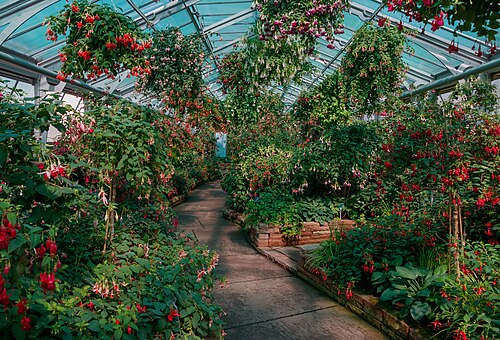
Do you have a good photo of this greenhouse? Suggest it for this page →
Sources (9)
- uni-regensburg.de/biologie-vorklinische-medizin/forschen/arbeitsgruppen/ag-pflanzenoekolog
- uni-regensburg.de/biologie-vorklinische-medizin/forschen/arbeitsgruppen/ag-pflanzenoekolog
- uni-regensburg.de/biologie-vorklinische-medizin/forschen/arbeitsgruppen/ag-pflanzenoekolog
- regensburg.de/regensburg-507/sehenswert/der-botanische-garten-der-universitaet
- de.wikipedia.org/wiki/Botanischer_Garten_der_Universit%C3%A4t_Regensburg
- en.wikipedia.org/wiki/Botanischer_Garten_der_Universit%C3%A4t_Regensburg
- grust.eu/botanischer-garten-regensburg
- botanische-gaerten.de/botanischer-garten-der-universitaet-regensburg.html
- openstreetmap.org/way/1527825379
Affiliate links — booking through Verrière helps fund our research, at no extra cost to you.