Glasshouses of the Erlangen Botanical Garden (Botanischer Garten Erlangen)
Erlangen, Bavaria

Entry updated on October 5, 2026
- Year
- 1964
- Architect
- Unknown
- Style
- Group of 1960s display glasshouses
- Dimensions
- About 1,510 m² according to Wikipedia, about 1,700 m² in other sources
- Status
- Open to the public
The botanical garden of the University of Erlangen-Nuremberg has occupied the north side of the Schlossgarten since 1826. Its 19th-century glasshouses, some of them heated by thermosiphon, were completely replaced in the early 1960s by the present complex, opened in 1964 and covering about a tenth of the garden. Around a large central house devoted to lowland rainforest are a montane rainforest house, three small houses for mangroves, useful plants and epiphytes, succulent houses, an alpine house and a Canary Islands house.
Affiliate links — booking through Verrière helps fund our research, at no extra cost to you.
History
1 min
Erlangen's botanical garden claims a long lineage, reaching back to the medical garden of the University of Nuremberg founded at Altdorf in 1626. In Erlangen itself, a first botanical garden was laid out in 1747 outside the Nuremberg Gate, shortly after the university was founded in 1743; it lasted until 1825. The present garden was created in 1826 on the north side of the Schlossgarten, the palace garden.
By the middle of the 19th century, according to German Wikipedia, the garden already had five free-standing glasshouses, some of them fitted with thermosiphon heating. In 1892 a building for the botanical institute went up in the middle of the garden; since 1993 it has been used by the virology institute.
The old glasshouses were completely rebuilt in the early 1960s: Wikipedia dates the work to 1961-1963 and says it brought the glasshouses' ground area to 1,510 m², while the garden's own website gives 1964 as the opening date of the present complex. Further additions followed, including a 90 m² house for Canary Islands plants built in 1998. The garden today belongs to Friedrich-Alexander University Erlangen-Nuremberg.
Architecture and engineering
1 min
The garden covers about two hectares, roughly a tenth of which is taken up by the glasshouses. Wikipedia gives their area as 1,510 m² and other descriptions as about 1,700 m²; the difference may reflect additions made after the 1960s, such as the 1998 Canary Islands house. No architect is named in the sources consulted.
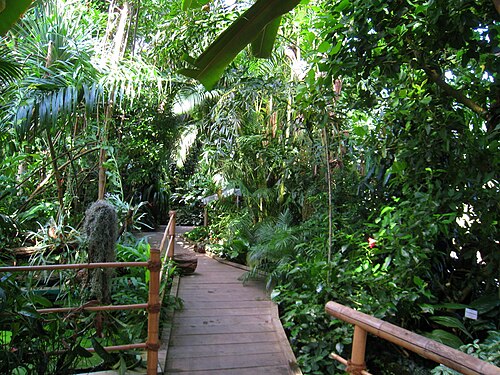
The tropical complex is arranged around its largest room, in the centre, devoted to lowland rainforest. To the north, a house kept cooler and more humid reproduces the conditions of montane rainforest. To the south, three smaller houses each take a single theme: mangroves, tropical useful plants and epiphytes. Further houses shelter succulents, high-mountain plants from the Mediterranean ranges (the Alpinenhaus), the flora of the Canary Islands and a fern forest. Pools of tropical water lilies complete the ensemble.
Plant collections
1 min
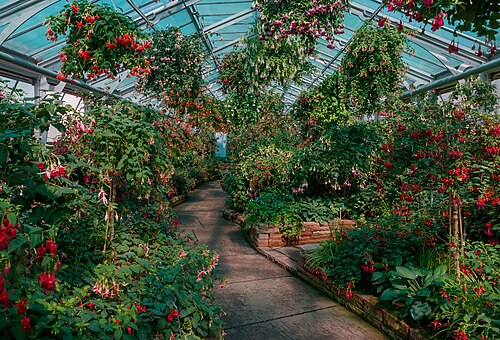
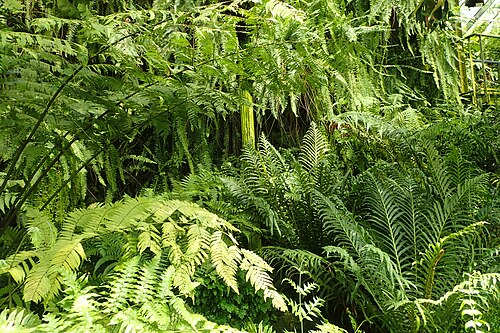
Erlangen's glasshouses present plants of tropical lowland and montane rainforests, tropical useful plants, epiphytes and typical members of mangrove vegetation. In the montane rainforest house, ferns, tree ferns and cycads benefit from a cooler, damp climate, and a fern-forest house develops the same theme. The tropical pools show off water lilies from warm regions.
The succulent houses gather plants of deserts and semi-deserts, including many cacti. The Kanarenhaus displays plants of Mediterranean-climate regions and the Macaronesian islands, and the Alpinenhaus high-mountain plants of the Mediterranean ranges. Orchids also feature in the tropical houses.
Visiting
1 min
The garden lies on Loschgestraße, on the north side of the Schlossgarten in the centre of Erlangen. From March to November it offers guided tours, some free and open to all, along with programmes for school classes. An hour is enough for the glasshouses, which make a pleasant detour in winter, when the warm tropical rooms contrast with the bare beds outside. The walk continues into the Schlossgarten, home to the baroque Orangerie of 1705-1706, whose central hall is framed by two quarter-circle wings.
49.60° N, 11.01° E
Greenhouses nearby
More greenhouses — Germany
Do you have a good photo of this greenhouse? Suggest it for this page →