Victorian glasshouse range, Tregrehan Garden
Tregrehan, near Par, Cornwall

Sources checked October 2026
- Year
- 1845
- Style
- Pine-framed, boiler-heated glasshouse range against the north wall of a walled garden
- Dimensions
- About 60 m long (about 50 m according to the garden's history page)
- Status
- Open in season (Wednesday afternoons until 28 October 2026)
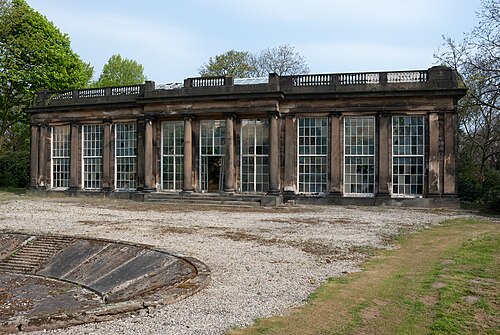
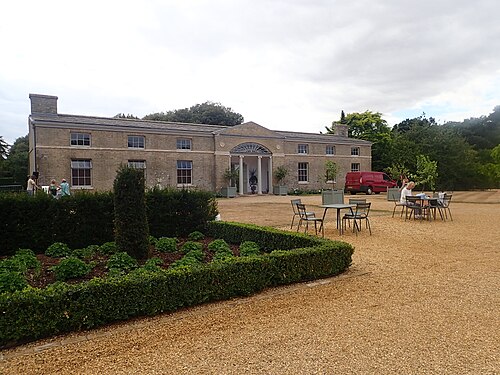
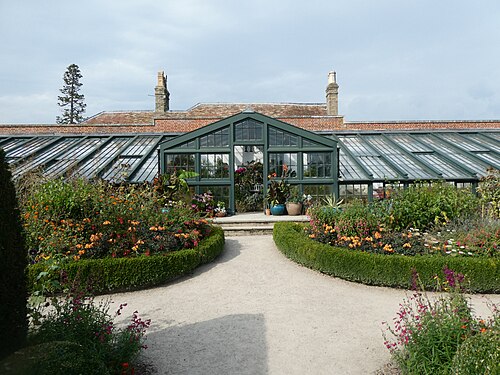
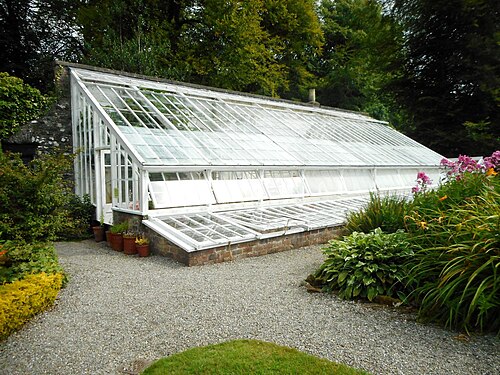
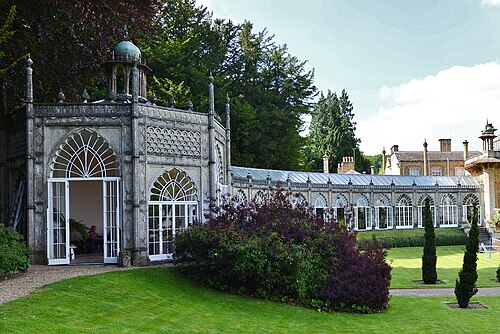
Set against the north wall of the walled garden rebuilt in the 1840s by the Carlyon family, the Tregrehan glasshouse runs for some sixty metres. Its frame is of close-grained pine, with sliding sashes for ventilation and a "wet system" of heating fed by twin boilers. Originally used as a heated show house for vines, orchids and camellias, it was restored in the early 1990s, with much of the glass, the roof included, replaced. It now holds shrubs, fruits and climbers that need only protection from frost.
Affiliate links — booking through Verrière helps fund our research, at no extra cost to you.
History
The Carlyon family has lived at Tregrehan since 1565. The present house was begun in 1680 and, remodelled in classical style to designs by George Wightwick, was completed in 1842 according to the garden's history page. The walled garden and its glasshouse belong to the same campaign of change, led by Edward Carlyon. The history page places the rebuilding of the walled garden and the erection of a large greenhouse range of about 50 m in 1844; the page devoted to the glasshouse gives 1845 and about 60 m; the summary of the park and garden register reproduced by Parks & Gardens UK dates the walls to 1844, a dated stone bearing this out, and the glasshouse range to 1846. The same register adds that the kitchen garden replaced a smaller walled garden shown on the 1839 tithe map and may have formed part of William Nesfield's scheme of the 1840s.
The glasshouse was first a heated show house for vines, orchids and camellias. The pleasure grounds suffered during the Second World War, and the register says clearance and reclamation did not begin until the mid-1970s. From 1987 a cousin of Gillian Carlyon, returning from New Zealand, set about restoring the estate. The glasshouse range, described as ailing and some 150 years old, was repaired in the early 1990s: the glazed roof was reinstated and many timber sashes were remade, while the main beams and internal dividing sections had remained in good order.
Architecture and engineering
The park and garden register describes an approximately square walled garden enclosed by stone-coped brick walls about 3 m high, some 50 m north-east of the house. Cruciform gravel walks meet around a circular pool and a mid-19th-century fountain of entwined dolphins, attributed to Nesfield.
Against the inner face of the north wall stands the timber-framed glasshouse range, of ornamental design. At the centre, a vinery shelters a circular bed planted with a tree fern; on either side, open loggias carry climbers, followed by lean-to glasshouses for temperate plants. According to the garden, the whole range is around 60 metres long and dominates the walled garden from every side; it is built of close-grained pine, with sliding sashes for ventilation and a twin-boiler "wet system" for heating. The garden regards it as one of the very few structures of this age and size still standing in the United Kingdom. North of the wall, further glasshouses and bothies are now used for nursery propagation.
Plant collections
Originally used as a heated show house for vines, orchids and camellias, the range now holds shrubs, fruits and climbers that need some protection from frost, without heat from the old boilers. The register mentions a tree fern under the central vinery and climbers in the flanking loggias.
The rest of the garden forms a living botanical collection, whose groupings the garden's pages list: Araliaceae, camellias, magnolias, rhododendrons, New Zealand and Southern Hemisphere plants, and trees. More than 150 trees have reached UK champion status according to Historic Houses, and over 8,000 accessions are recorded in the garden's database. From 1960 to 1987 Gillian Carlyon ran a camellia-breeding programme there: more than twenty hybrids were registered with the RHS. In September 2026 the garden's nursery was showing Brassaiopsis and Schefflera raised from plants in the garden.
Visiting
The glasshouse stands in the walled garden, north-east of the house according to the register; the garden says it is wheelchair-accessible, like the walled garden and the upper half of the grounds, by graded paths. Elsewhere the ground has uneven banks and steep drops: stout footwear is advised and dogs are not admitted to the garden.
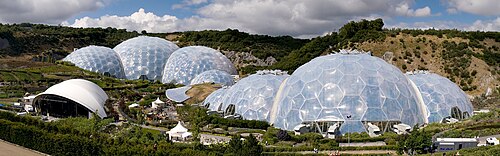
In 2026 the garden is open four days a week from 15 March to 31 May, then on Wednesday afternoons until 28 October; other dates are possible by appointment, and no 2027 calendar is published. The Eden Project lies about 1.4 km away as the crow flies and the Lost Gardens of Heligan about 9 km, both in the catalogue.
50.35° N, 4.74° W
Greenhouses nearby
More greenhouses — United Kingdom
Do you have a good photo of this greenhouse? Suggest it for this page →
Affiliate links — booking through Verrière helps fund our research, at no extra cost to you.