Gewächshäuser of the Botanical Gardens of the University of Bonn
Bonn, North Rhine-Westphalia
Entry updated on September 30, 2026
- Year
- 1979–1984
- Architect
- Not stated in the sources
- Style
- Modern glasshouse complex rebuilt on the original foundations
- Dimensions
- ≈2,500 m², seven houses shown, ≈3,800 species
- Status
- Open to the public
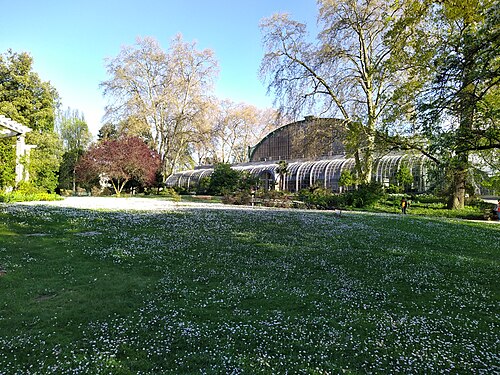
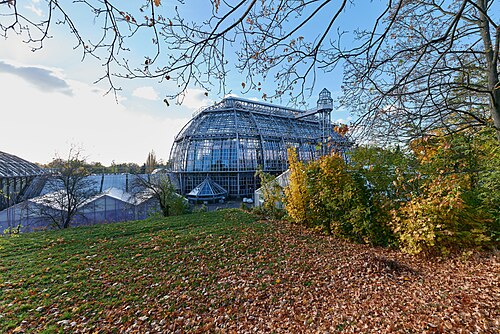
Beneath Poppelsdorf Palace, the glasshouses of the University of Bonn Botanical Gardens form a complex of about 2,500 m² with some 3,800 tropical and subtropical species. The nineteenth-century houses, including a palm house of 1875 and a Victoria house of 1878, are gone; after the destruction of the Second World War the present complex was erected between 1979 and 1984 on the original foundations. It includes a humid rainforest house, a fern house, a Victoria house, a desert house and a Mediterranean house. The titan arum, the garden's emblem, flowers there from time to time.
Affiliate links — booking through Verrière helps fund our research, at no extra cost to you.
History
1 min
The garden occupies the grounds of Poppelsdorf Palace, a residence of the electors of Cologne developed in the eighteenth century. When the university was founded in 1818, the grounds were converted into a botanical garden under Christian Gottfried Daniel Nees von Esenbeck. A first glasshouse with temperature zones was built in 1819; in 1849 an iron glasshouse replaced the earlier one. Between 1872 and 1878 the garden was extended and received a palm house (1875) and then a house for Victoria regia (1878). By 1900, according to the online encyclopedia, it ranked second in Germany after Berlin's.
The old glasshouses were demolished between 1922 and 1925 and a new complex was built between 1923 and 1926. The bombing of 1944-1945 struck the garden hard, and it was destroyed in the Second World War. Reconstruction of the grounds and buildings took twenty years, from 1949 to 1969; the present glasshouses were raised from 1979 to 1984 on the original foundations.
The garden, the palace and the neighbouring avenue were listed as heritage monuments in the mid-2000s (2004 or 2006 depending on the source). The collections have been recorded in an electronic database since 1990.
Architecture and engineering
1 min
The present complex covers about 2,500 m² and brings together seven houses presented to the public: rainforest, ferns, monsoon, Victoria, desert, Mediterranean and the Strasburger house, which is not open to visitors but can be seen through the glass. The online encyclopedia, for its part, mentions eleven modern houses in all, so the figure differs between sources.
Each house is set to a precise climate. The rainforest house is visited on a circuit; the monsoon house reproduces savannahs and seasonal tropical forests; the desert house separates the cacti and agaves of the Americas on one side from the aloes and euphorbias of Africa and Asia on the other. The Mediterranean house serves to overwinter frost-sensitive subtropical plants, which are moved outdoors in the warm season. The Victoria house holds a large basin for giant water lilies.
Plant collections
1 min
The houses cultivate about 3,800 tropical and subtropical species. The rainforest house shows bamboos, bananas, epiphytes and the tree-like pipevine Aristolochia arborea, whose flowers mimic mushrooms to attract fungus gnats as pollinators. The fern house gathers orchids, balsams, tree ferns from mountain forests and the Chilean bellflower (Lapageria rosea); the monsoon house holds cycads, gingers and gesneriads.
In the Victoria house grow the giant water lily Victoria and the titan arum, Amorphophallus titanum, which serves as the garden's logo. One specimen flowered for the twenty-eighth time in May 2020, at 187 cm tall; the tubers had been imported from Indonesia about thirty years earlier. The Mediterranean house includes the king protea, Protea cynaroides.
Visiting
1 min
The glasshouses lie within a garden of about twelve hectares at Meckenheimer Allee 171, in the Poppelsdorf district. An hour to an hour and a half is enough for the seven houses, more if the open-air grounds are included.
The titan arum is known for flowering irregularly, so its bloom is worth watching for on the garden's website. The visit continues naturally in the garden itself, with its medieval moat, parterre and Jardin Secret, and at Poppelsdorf Palace.
50.72° N, 7.09° E
Greenhouses nearby
More greenhouses — Germany
Do you have a good photo of this greenhouse? Suggest it for this page →