Morton H. Meyerson Symphony Center
Dallas, Texas
Sources checked October 2026
- Year
- 1989
- Architect
- I. M. Pei
- Type
- Concert hall
- Access
- Open to the public for Dallas Symphony Orchestra concerts, ticketed; free public tours, schedule available by phone (Visit Dallas and the orchestra's website, October 2026)
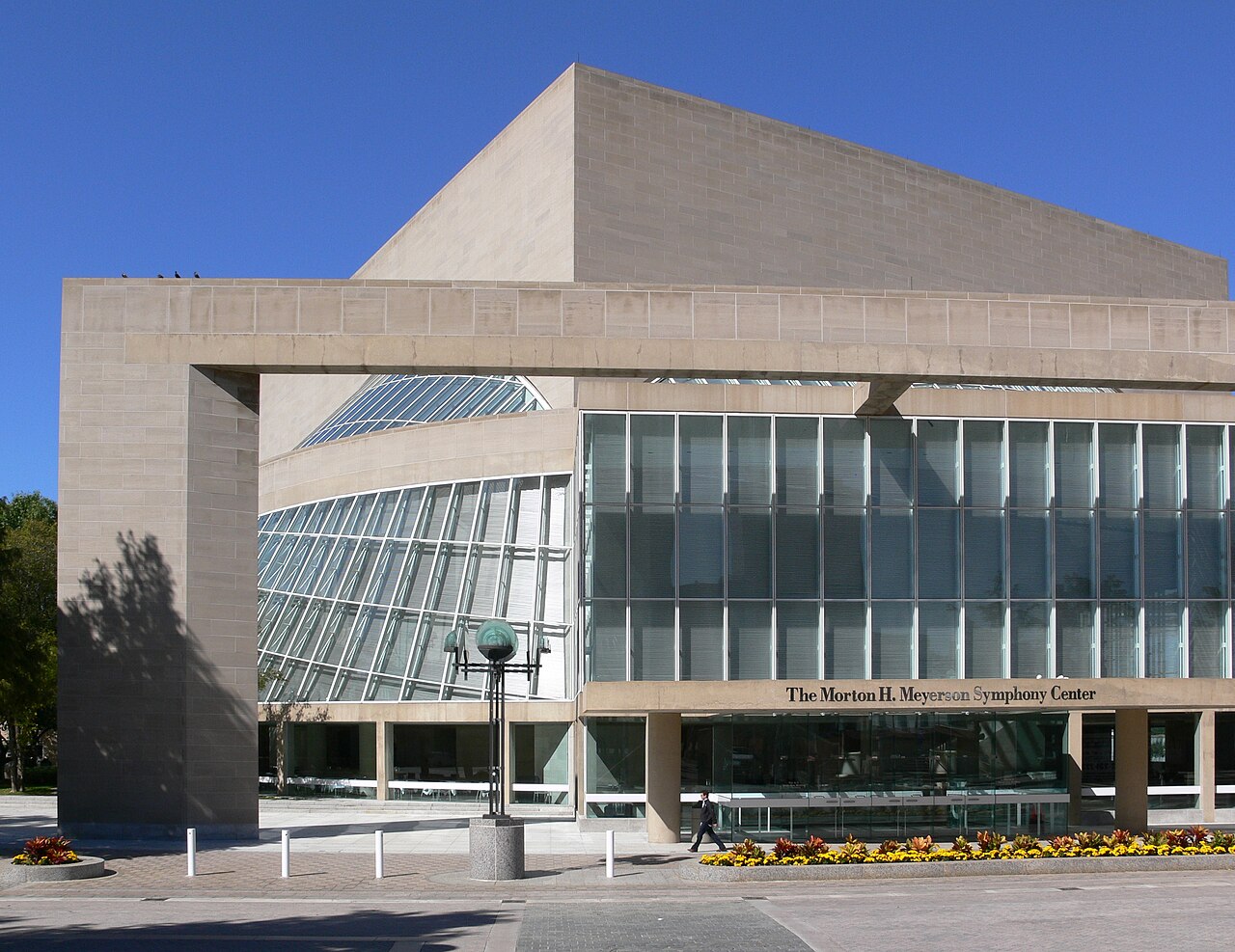
Designed by I. M. Pei with the acoustician Russell Johnson of Artec Consultants, this centre is the Dallas Symphony Orchestra's permanent home and opened in September 1989. Its Eugene McDermott Concert Hall, a shoebox in shape, is wrapped in a limestone cube inset with large curved windows, and in a circular lobby of glass on metal supports. The City of Dallas owns it, and the Dallas Symphony Association manages it.
Affiliate links — booking through Verrière helps fund our research, at no extra cost to you.
History
The partnership between the City of Dallas and private enterprise that produced the hall was first proposed in 1978; ground was broken in 1983, and construction proper did not begin until two and a half years later. The collapse of the oil market threatened the project several times, and its cost rose from an estimated $49.5 million to more than $86 million.
The centre is named for Morton Meyerson, who led the Dallas Symphony Association's ten-year effort to give the Dallas Symphony Orchestra a home. The naming in his honour dates from 1986; Ross Perot, who gave $10 million to the building fund in exchange for the name, had requested it. The concert hall itself, the Eugene McDermott Concert Hall, is named for another $10 million donation.
Pei, who also designed Dallas City Hall, was given the building together with the acoustician Russell Johnson of Artec Consultants. Their mandate was to build a hall sounding like the finest of the Concertgebouw in Amsterdam and the Musikverein in Vienna, two of Europe's most venerated halls. The shoebox shape had already been decided by the trustees and the acoustic team before Pei arrived; it was his first theatre, and potentially serious disagreements broke out between him and Johnson. The centre opened in September 1989.
The organ came later. Charles Fisk, who had dreamed of building a monumental concert organ, died in 1983 without seeing it; the instrument was built in 1991 and first performed in September 1992.
Architecture
The hall is wrapped in a freer envelope than its interior. With the shoebox already imposed, Pei chose to sculpt the exterior: he felt, he said, a need to be free, and so he turned to curvilinear forms to wrap "another form around the shoebox." He was unwilling to impose modern styles on the interior, since the music played there would mostly be from the eighteenth and nineteenth centuries. In 2000 he called the structure of the hall's interior "very conservative", for reasons, he said, that he no longer accepted; he added that it did not fully represent what he would have liked to do and that it was his first.
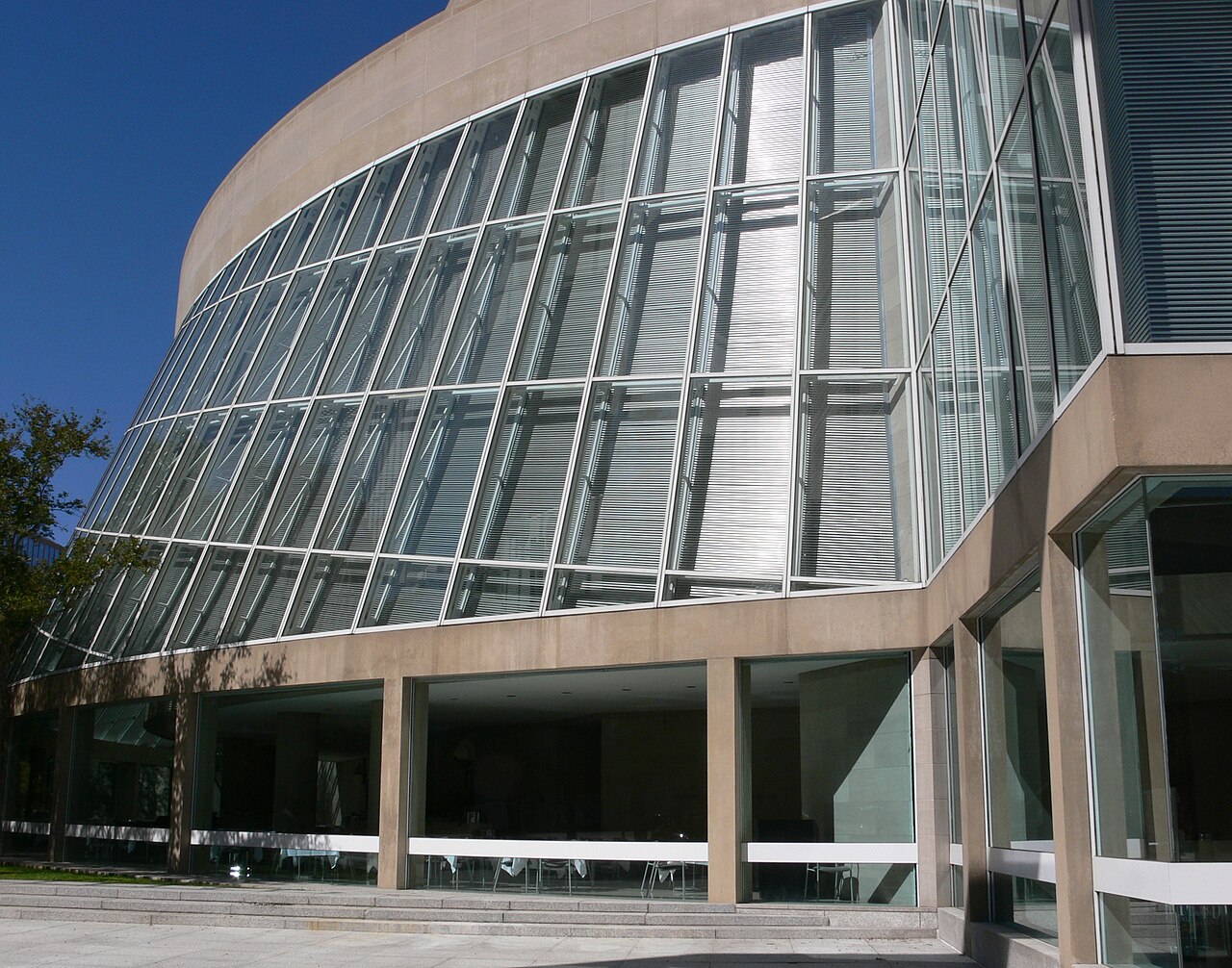
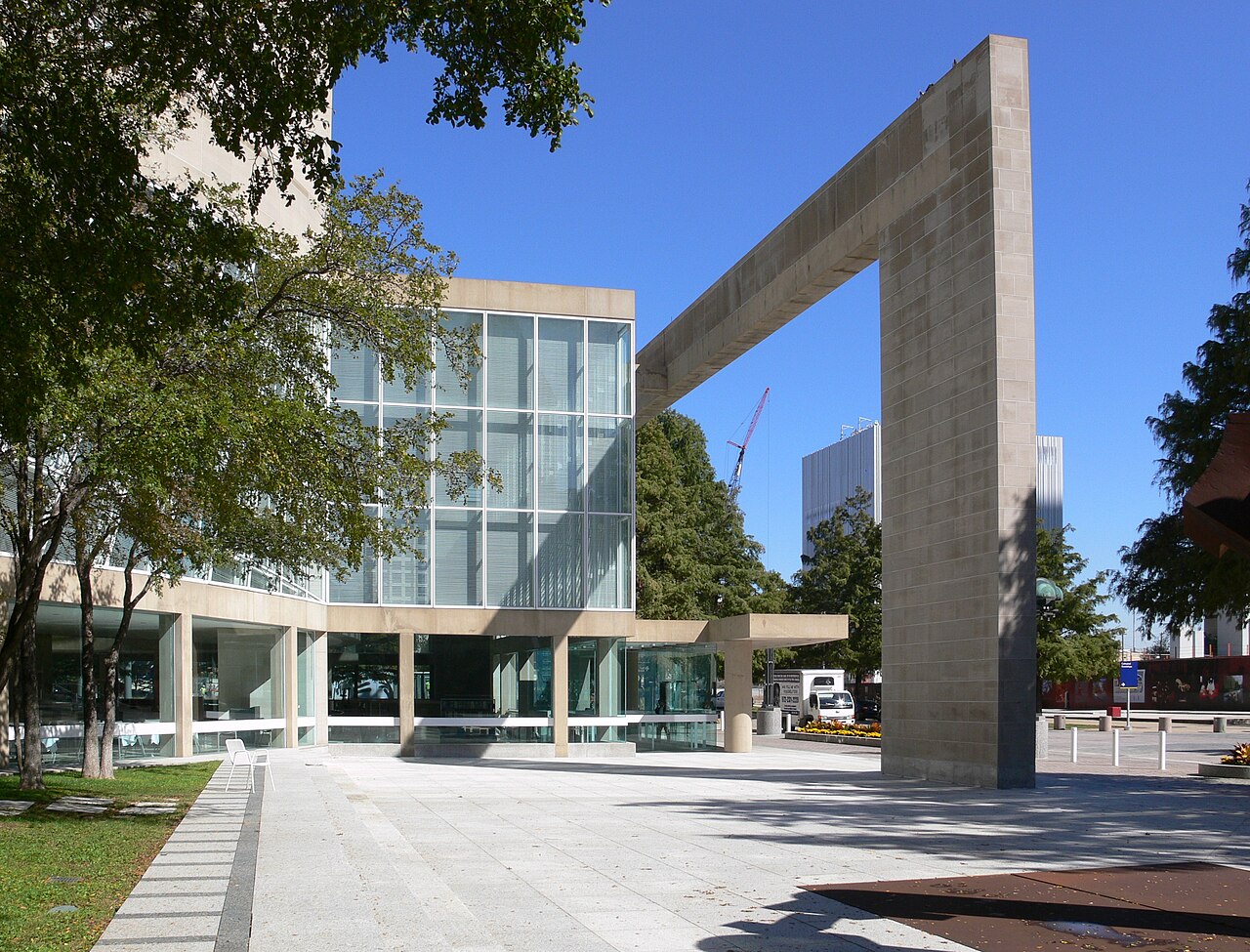
Outside, the cube-shaped structure consists of limestone blocks by the tens of thousands, pierced by large curved windows that bring natural light into the lobby. The large pavilion and the lobby are circular, in glass on metal supports, which contrasts with the hall's solid geometric lines; the conoid windows comprise 211 glass panels, no two alike. Pei juxtaposes squares, circles and a rectangle: the hall is a rectangle, the site is roughly square, and the balconies of the lobby are circles of various sizes. The public spaces are in limestone and travertine marble.
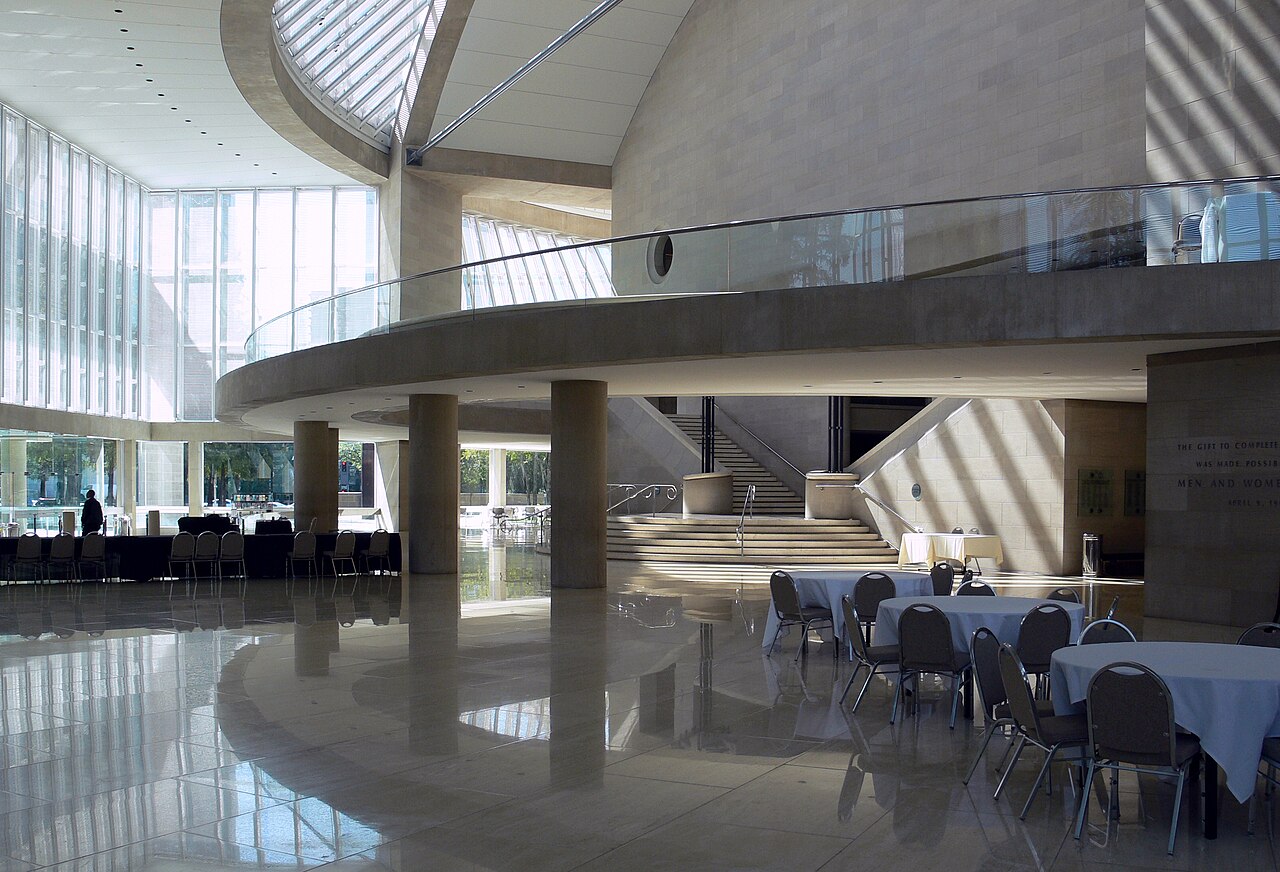
In the lobby, several areas combine onyx, glass, limestone and stainless steel with marble floors and rails. The Renaissance Foyer, the main lobby, covers 24,000 square feet (about 2,200 m²) under a 50-foot ceiling (about 15 m); the Loge Terrace extends the loge level and has two seating areas and a view of the city and of the main floor.
The concert hall has three tiers of horseshoe-shaped balconies and a high ceiling. The wood, purely decorative, is combined with limestone, plain blue walls and onyx details; a grid pattern, suggestive of the Vienna Secession, covers the walls up to the ceiling. A 42-ton acoustical canopy hangs above the two-tiered stage; reverberation chambers ring the hall, hidden behind the grid: 74 concrete doors, each weighing up to 2.5 tons, open and close them to increase or reduce reverberation, and 56 acoustical curtains complete the system. The organ, with more than 4,000 pipes, stands behind the stage. The structural engineer is Leslie E. Robertson Associates.
Use today
The Dallas Symphony Chorus and the Dallas Symphony Orchestra are based at the centre permanently, and the Dallas Wind Symphony gives its main performances there. The City of Dallas owns it, and the Dallas Symphony Association manages it.
The Eugene McDermott Concert Hall is its centrepiece; its organ is the C. B. Fisk Op. 100, known as the Lay Family Concert Organ. The building can also be rented for events: the lobby, and the Hart Symphony Suites on the lower level, four rooms for meetings, private receptions or small gatherings.
Visiting
The Meyerson Symphony Center is at 2301 Flora Street, Dallas. It is mainly visited by attending an orchestra concert: tickets are sold on the orchestra's website, by phone or at the Guest Services Center in the building's lower lobby. Every visitor of any age needs a ticket, and classical concerts do not admit children under 4.
Free public tours are also offered: the schedule is available by phone, as are the arrangements for groups of 15 or more.
Photos
32.79° N, 96.80° W
Greenhouses nearby
Architecture nearby
Sources (11)
- dallassymphony.org/meyerson-rentals/
- dallassymphony.org/about-the-dso/history-of-the-dso/
- dallassymphony.org/plan-your-visit/ticket-information/
- dallassymphony.org/plan-your-visit/guest-services/
- visitdallas.com/directory/morton-h-meyerson-symphony-center/
- tpr.org/arts-culture/2023-02-08/i-m-pei-designed-a-symphony-for-the-eyes-in-dallas
- csmonitor.com/1989/0925/ldallas.html
- en.wikipedia.org/wiki/Morton_H._Meyerson_Symphony_Center
- lera.com/meyerson-symphony-center
- wikidata.org/wiki/Q670323
- openstreetmap.org/way/28544900
Affiliate links — booking through Verrière helps fund our research, at no extra cost to you.