Kurashiki City Art Museum, former City Hall (倉敷市立美術館)
Kurashiki, Okayama Prefecture
Sources checked November 2026
- Year
- 1960
- Architect
- Kenzō Tange
- Type
- Former city hall turned municipal art museum
- Access
- Open to the public (official website, November 2026)
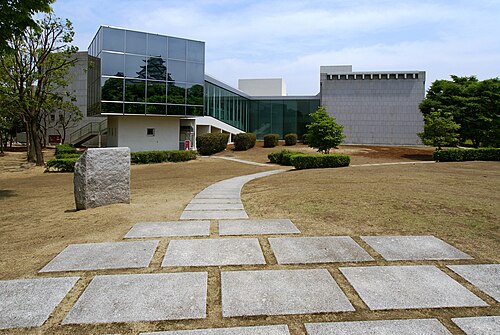
Completed in 1960 from the design of Kenzō Tange's laboratory, this Kurashiki city hall has a reinforced-concrete frame and facades of stacked hollow precast blocks. Only the city hall, the southern end of a scheme planned with a plaza and a public hall, was built. Turned into an art museum in 1983 through a conversion by the architect Shizutarō Urabe, it has been a registered tangible cultural property of the state since 2020.
Affiliate links — booking through Verrière helps fund our research, at no extra cost to you.
History
The project dates from 1958. The city hall was part of the urban plan of a city that meant to grow with the coastal industrial zone within its bounds, and it was to stand in the very centre, on the site left empty when a primary school moved away. The white-walled houses and the willows along the Kurashiki river made up the image of the city; a new symbol was wanted alongside them. Kenzō Tange, who was commissioned to design it, said he had in mind a building "worthy of the tradition and modern development of the city of Kurashiki, and worthy of being the mainstay of its citizens".
Tange's laboratory planned the building together with a public plaza and a public hall; only the city hall, at the southern end, was completed, in 1960. The plaza, planned to the north, and the hall facing it were never built. A model of the city hall, dated 1958-1960, is held by the Metropolitan Museum of Art in New York.
The city government stayed twenty years. In 1967 the merger of three cities raised the population from 170,000 to 300,000; in 1980 the offices moved to a new city hall about a kilometre to the south. A gift of works to the city by the painter Yōson Ikeda, a son of the region, set off the conversion: in 1983 the building became an art museum. Shizutarō Urabe, an architect born in Kurashiki, who designed the conversion, sought to keep the features of Tange's architecture as far as possible, and its high ceilings and wide, unobstructed floors suited the new use. The conversion added an elevator core on the west side, joined the north-west to a newly built library, moved the entrance from south to north, turned the counters of the first two levels into exhibition rooms and the council chamber into an auditorium. The exterior, nicknamed "today's azekura", was hardly altered.
On 17 August 2020 the building was registered as a national registered tangible cultural property.
Architecture
The building is reinforced concrete: three storeys above ground, one basement and two rooftop levels. The main structure is a cast-in-place frame, with beams crossing and columns standing at their junctions; precast concrete elements, assembled like building blocks, complete it. Large horizontal beams span about 20 m, carried by stout columns and thick walls left in exposed concrete, which gives the whole a great deal of power.
The exterior cladding stacks hollow precast blocks pierced by deep horizontal openings, giving the building the look of an azekura, a traditional storehouse built of triangular logs. Japanese joinery motifs are worked in. Le Corbusier's influence shows in several places, and that of the Ronchamp chapel directly in the openings of the hall wall and in the arched ceiling of the council chamber, with its slightly curved inner walls.
Inside, a central void between two cores forms the citizens' hall. The entrance hall, whose void rises more than 10 m, remains one of the attractions of the place. The council chamber, on the second floor, recalls the inside of a church; together with the wide counter space without freestanding columns, it is one of the parts Tange put the most effort into. He even designed the mayor's desk, chairs and shelves. Above it, the roof is stepped as an events space.
Use today
The museum holds more than 12,000 works: those of Yōson Ikeda, an honorary citizen of Kurashiki, and those of other artists linked to Okayama. Many visitors also come to see the building itself.
Visiting
The museum is open from 9 am to 5:15 pm, with last admission at 4:45 pm. It is closed on Mondays (the next day if the Monday is a public holiday or a substitute holiday) and from 28 December to 4 January; extra closures are possible. It stands 15 minutes' walk south of JR Kurashiki station.
34.59° N, 133.77° E
Greenhouses nearby
Architecture nearby
By the same architect
Sources (9)
- city.kurashiki.okayama.jp/kcam/about-museum/1008850.html
- city.kurashiki.okayama.jp/kcam/museum-guide/1008853.html
- bunka.go.jp/kindai/kenzoubutsu/research/okayama/001/index.html
- online.bunka.go.jp/heritages/detail/380424
- tangeweb.com/works/works_no-20/
- collectionapi.metmuseum.org/public/collection/v1/objects/485071
- www2.city.kurashiki.okayama.jp/kcam2/eg/museum/outline1.html
- www2.city.kurashiki.okayama.jp/kcam2/eg/museum/yoson1.html
- id.ndl.go.jp/auth/ndlna/00088882
Affiliate links — booking through Verrière helps fund our research, at no extra cost to you.