Chichu Art Museum
Naoshima, Kagawa
Sources checked October 2026
- Year
- 2004
- Architect
- Tadao Ando
- Type
- Art museum, almost entirely underground
- Access
- Open to the public by date-and-time reservation, closed on Mondays (official site, October 2026)
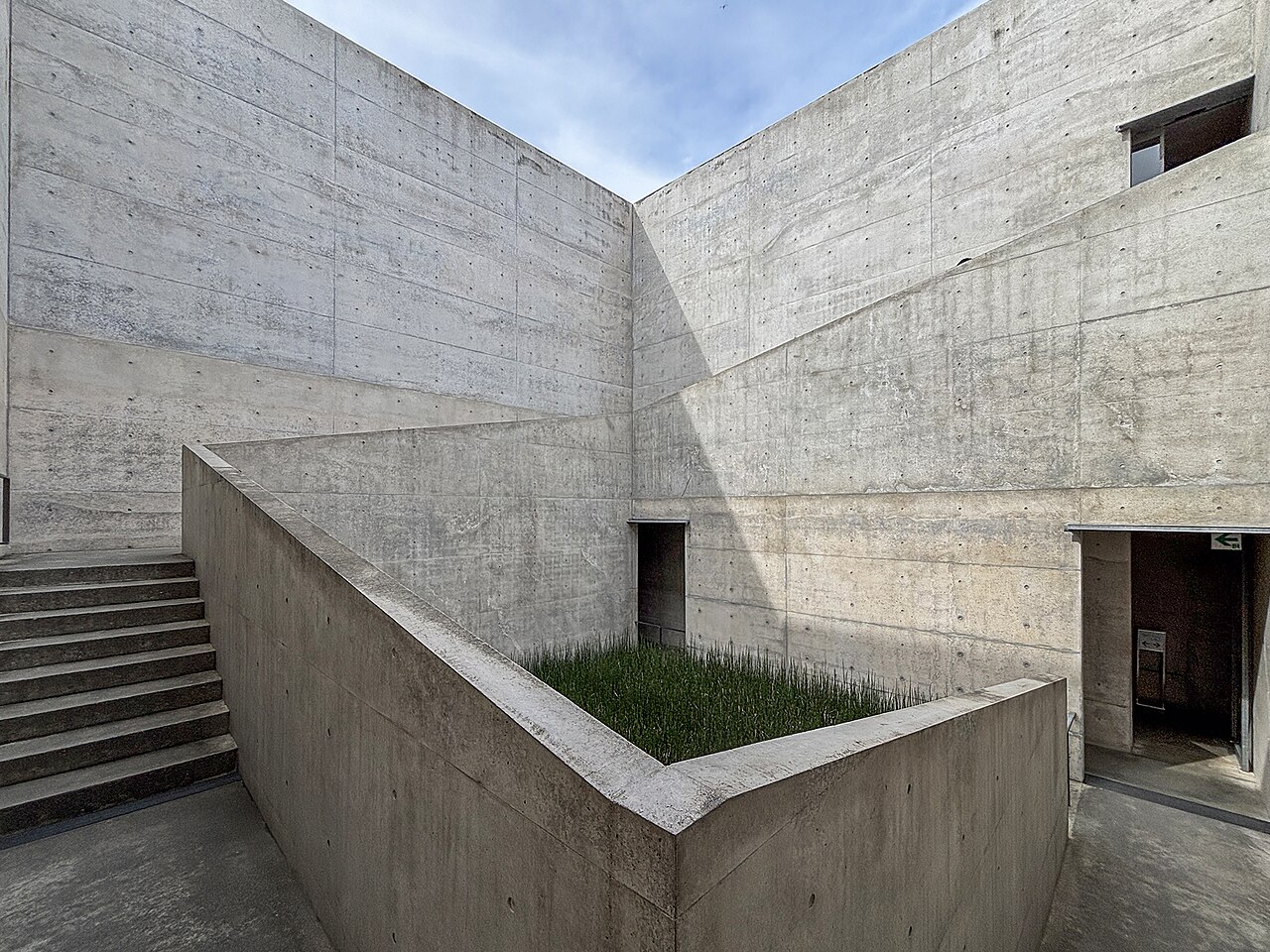
On the island of Naoshima, Tadao Ando buried a concrete museum in a hillside that was once a salt field: of 2,500 square metres of floor area, only 35 come above ground. Triangular and square courtyards, trenches and openings in the ceilings let in the sky and daylight. The museum shows just three artists, Claude Monet as well as James Turrell and Walter De Maria; the Monet and De Maria rooms are lit by natural light alone.
Affiliate links — booking through Verrière helps fund our research, at no extra cost to you.
History
The project began with the purchase of a Claude Monet canvas measuring 2 by 6 metres, a Water-Lily Pond from the same series as the great decorations at the Orangerie in Paris. The aim was to create, in the middle of the Seto Inland Sea, a place to reflect on what it means to live well, and to find a way of showing the Water Lilies in which the paintings and the space become one.
On Naoshima, Benesse House (Tadao Ando, 1992) had opened the way to a method called site-specific work: artists and architects collaborate from the planning stage to create the work and the space that suits it. The Chichu Art Museum, in 2004, is its culmination.
It took about five years from idea to completion. The chosen hill was a sunny former salt field with a view over the sea. Soichiro Fukutake, who heads Benesse Art Site Naoshima, wanted an architecture invisible from outside, so that what matters to the heart and spirit would not be put on display, and asked Tadao Ando to bury the entire building. Ando had already designed Benesse House Museum and the Oval on the island; he pushed further his principle of continuity with the landscape and its topography.
Construction began in April 2002 with the contractor Kajima (site led by Ikumi Toyoda), and was completed in April 2004. The museum opened to the public on July 18, 2004. It is run by the Fukutake Foundation, linked to Benesse. The whole can be read as one very large site-specific artwork that took shape as the artists and the architect exchanged ideas.
Architecture
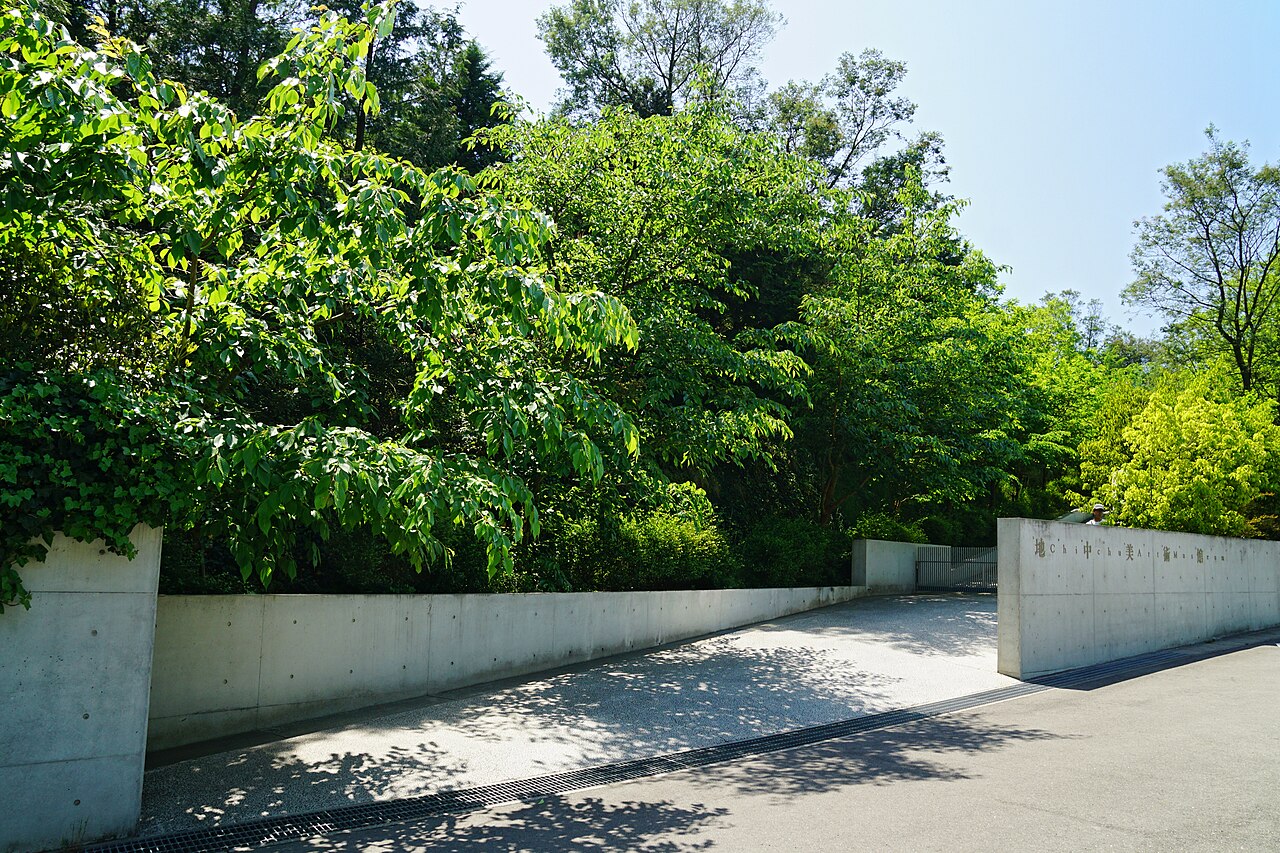
The building is a three-storey reinforced-concrete structure, entirely underground: out of about 2,500 square metres of floor area, only 35 square metres come above ground. The design is reduced to the minimum, using concrete (the basic material of Ando's architecture), steel, glass and wood; the result is both non-monumental and highly architectural. From outside, only the concrete outlines of the courtyards are visible, laid in the hillside like geometric figures; the neighbouring salt-field terraces and the view of the sea are left intact. Inside, the overall shape is never grasped: the visit is a walk through an underground maze.
The route is made of few gestures. Visitors walk beside a reinforced-concrete wall slightly detached from the slope, which serves as the facade and has a single opening; a trench leads to a dimly lit vestibule. In the entrance wing, a sunken square courtyard planted with bamboo-like stems is seen but not entered. A second trench leads to the triangular courtyard, the tallest space in the museum, which links the areas of the three artists and is glimpsed through diagonal slits cut into its sides. Its three walls are 12.8 metres high; the slits let light into the gallery that runs behind them. The concrete is always left exposed: neutral volumes in which light, sky and artworks are what matter.
The concrete is worked down to the smallest detail. The steel frames of the glass doors are cast into the wall together with it, light fittings are kept to a minimum, and the edges of the slits in the triangular courtyard are sharp, as if cut with a knife, because the upper and lower parts of the wall were poured at the same time. Inside the rooms, artificial lighting is likewise kept to a minimum.
Building it was a heavy task. The engineers ruled out tunnelling, which was too difficult given the hardness of the ground and the need for waterproofing; instead they excavated 14 to 15 metres, built, then backfilled. To keep rainwater from building up pressure against the walls, they added retention and drainage tanks and filled the outer zone with crushed stone. No plant on the island could then produce the concrete quality required: the 8,000 cubic metres crossed from Okayama by ferry, six mixer trucks per crossing, limiting pours to about 100 cubic metres a day at most, and the construction joints were closely supervised to obtain a smooth, even surface. Once the building was buried, the shape of the fill and the planting were specified by Ando's office.
The Monet room shows how much care went into the daylight. It takes up Monet's own ideas for his large decorations: natural light, white walls and frames, corners removed so the eye is never interrupted. The walls have a coarse plaster without seams, and the floor is a carpet of about 700,000 two-centimetre cubes of white Carrara marble, laid by hand with the help of local people; the colours of the room are tuned to spread the soft indirect light from the ceiling. The amount of light depends on the size and height of the suspended ceiling, which were settled through model tests carried out on the site itself.
Use today
The museum shows just three artists and has no temporary exhibitions: the works have stayed the same since opening, apart from a few paintings. The spaces for Walter De Maria and James Turrell were designed with the artists themselves; those for Claude Monet, who died in 1926, with the museum's curator, drawing on the ideas Monet had had for his large decorations.
Claude Monet: five canvases from the Water Lilies series, seen by daylight alone. They date from 1914-1919, apart from a diptych, Water-Lily Pond (c. 1915-1926), measuring 2 by 3 metres per panel.
Walter De Maria: Time/Timeless/No Time (2004). A sphere 2.2 metres in diameter and 27 gilded wooden geometric forms fill a large room arranged to the artist's instructions, as a work of art in its own right. It is lit only by natural light falling from the ceiling, which changes markedly from hour to hour.
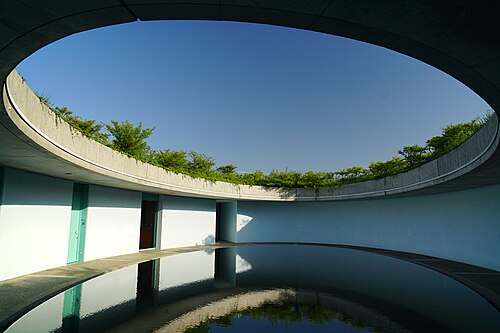
James Turrell: three works chosen from his series, from his early career to today, which are experienced in chronological order: Afrum, Pale Blue (1968), Open Field (2000) and Open Sky (2004). The first two rely on artificial light (a projector for Afrum, Pale Blue; fluorescent and neon tubes for Open Field). Open Sky opens the ceiling to the sky, its opening edge thinned to the extreme, as if cut out of paper. Open Sky can be seen during opening hours; an evening programme also lets visitors watch it seated, for 45 minutes at sunset.
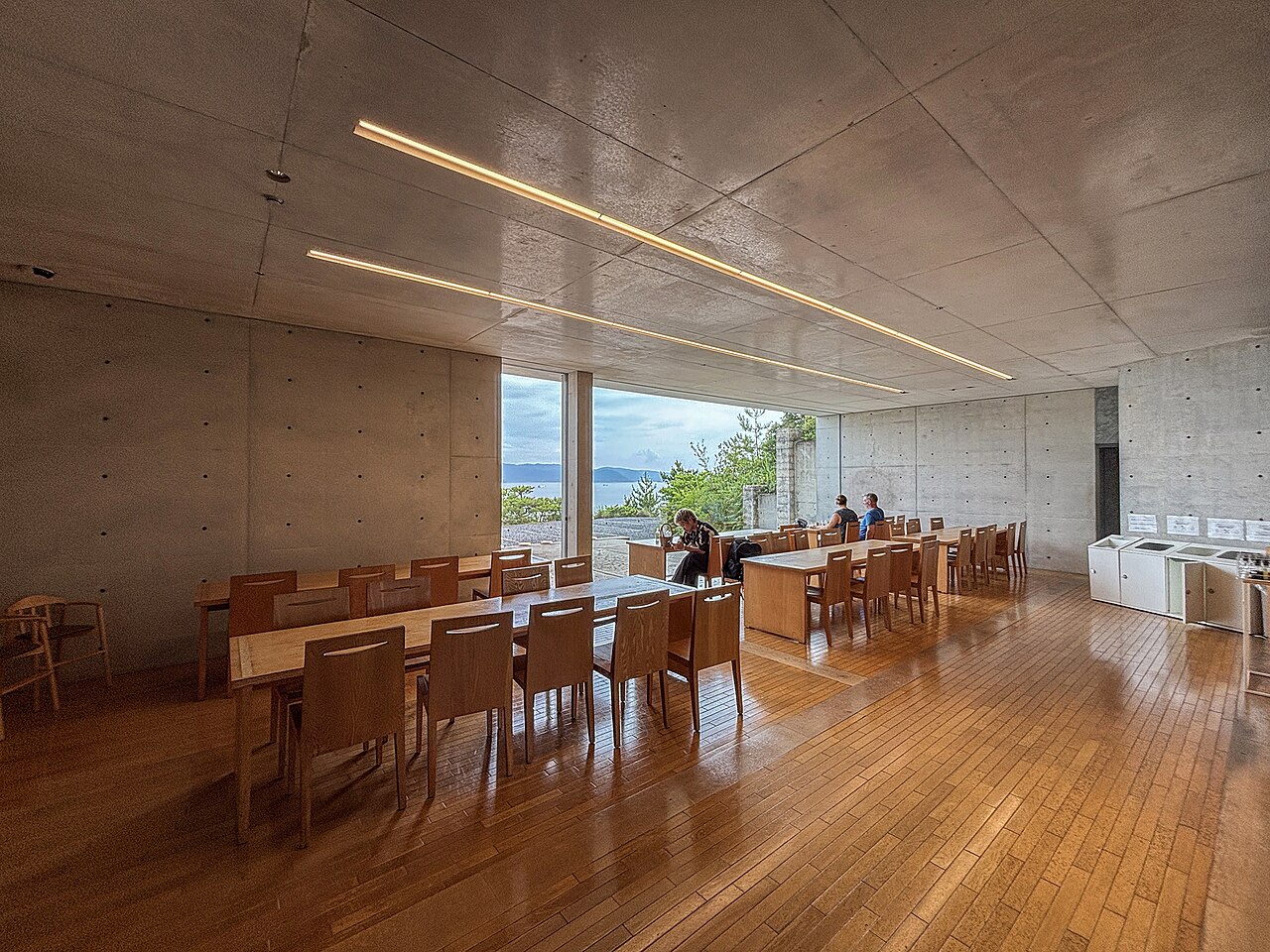
Between the ticket centre and the main building, the Chichu Garden (about 400 square metres) brings together close to 200 kinds of flowers and trees, like those Monet planted at Giverny: water lilies, willows, irises. A cafe looks over the Inland Sea, and from it one can still make out the relief of the former salt field.
Visiting
The museum is open 10:00 to 17:00 (last entry 16:00) and closed on Mondays; when it opens on a Monday that is a national holiday, it closes the next day. A date and time must be reserved in advance, and if online tickets are sold out there are no on-site sales that day. Tickets bought online cost less than at the counter; children 15 and under are free. Check the open-days calendar before travelling.
The Open Sky Night Program runs on Fridays and Saturdays by reservation (an admission ticket "with Night Program") and lasts about 80 minutes including walking time. The other works cannot be seen during it: visitors must enter before last admission and see them before closing.
Shoes are removed in some spaces, so easy-to-remove shoes help. Photographs, videos and sketching are not allowed inside the museum (photography is possible as far as the reception desk inside); food and drink are allowed only in the cafe, which is inside the museum and cannot be visited on its own. Suitcases, umbrellas, tripods and strollers are refused (lockers or storage at the ticket centre), as are pets. Some areas are not accessible to visitors with reduced mobility; the museum asks visitors to contact it beforehand.
Address: 3449-1 Naoshima, Kagawa. The island is reached from Takamatsu (about 60 minutes to Miyanoura) or from Uno (about 20 minutes). From there the town bus runs to Tsutsuji-so, where a free Benesse Art Site Naoshima shuttle serves the museum. The area between the east gate (near Tsutsuji-so) and the north gate (near the Lee Ufan Museum) is private: visitors are asked to refrain from entering it by car, motorcycle or bicycle unless they are staying at Benesse House. Parking is available at the Chichu ticket centre, and bicycle parking near the east gate.
Photos
34.45° N, 133.99° E
Greenhouses nearby
Architecture nearby
Sources (15)
- benesse-artsite.jp/en/art/chichu.html
- benesse-artsite.jp/en/access/naoshima/
- benesse-artsite.jp/en/access/
- benesse-artsite.jp/story/20211207-2198.html
- benesse-artsite.jp/story/20201030-1494.html
- en.wikipedia.org/wiki/Chichu_Art_Museum
- ja.wikipedia.org/wiki/地中美術館
- arquitecturaviva.com/obras/museo-de-arte-chichu-naoshima
- cca.qc.ca/en/search/details/library/publication/61176849
- wikidata.org/wiki/Special:EntityData/Q4556499.json
- benesse-artsite.jp/art/chichu.html
- benesse-artsite.jp/access/naoshima/
- kajima.co.jp/news/digest/nov_2014/feature/chichu/index-j.html
- benesse.jp/kyouiku/202012/20201205-1.html
- bijutsutecho.com/artwiki/24
Affiliate links — booking through Verrière helps fund our research, at no extra cost to you.