Edo-Tokyo Museum (東京都江戸東京博物館)
Sumida, Tokyo
Sources checked November 2026
- Year
- 1993
- Architect
- Kiyonori Kikutake
- Type
- Urban history museum
- Access
- Open to the public (official website, November 2026)
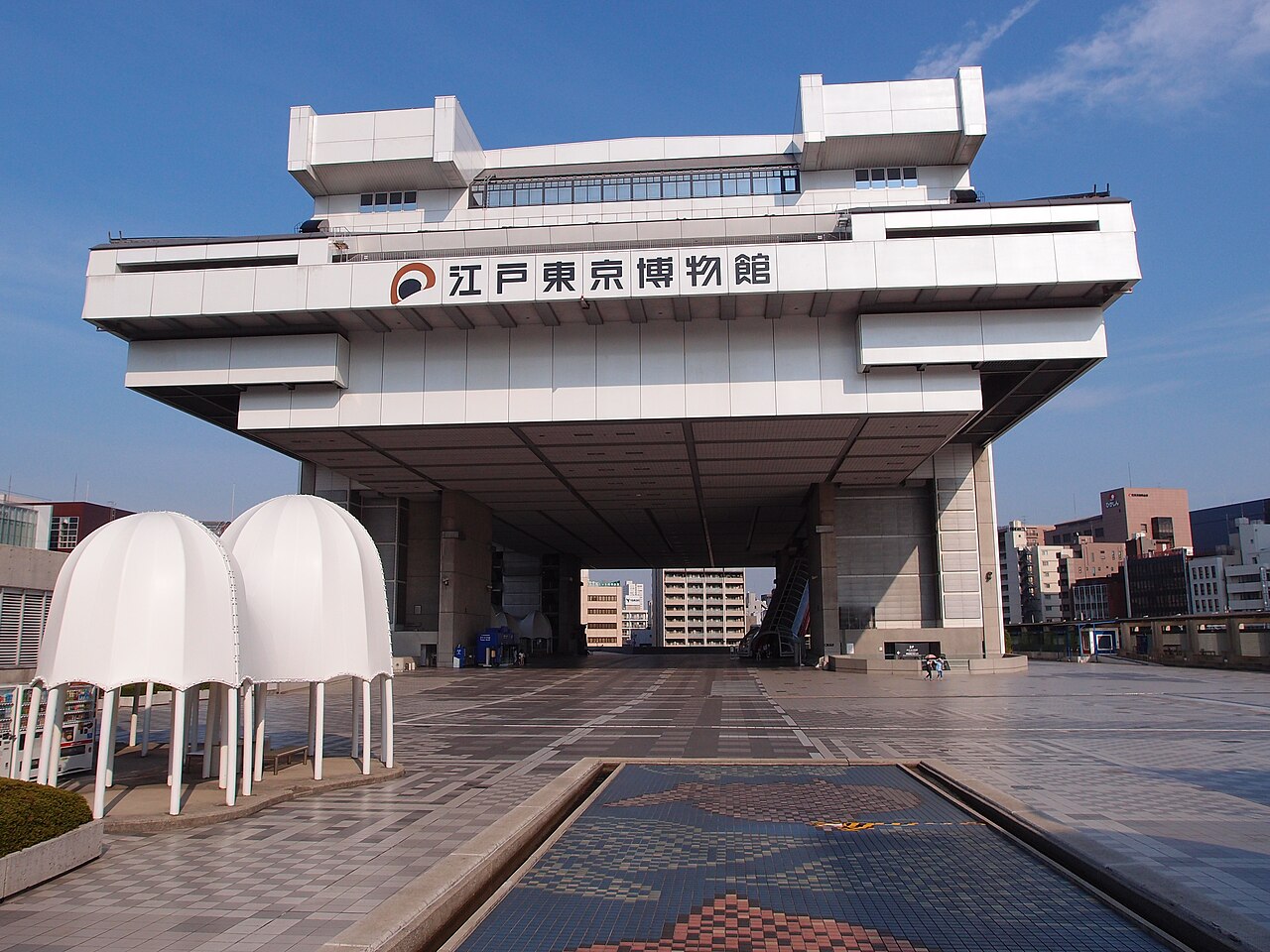
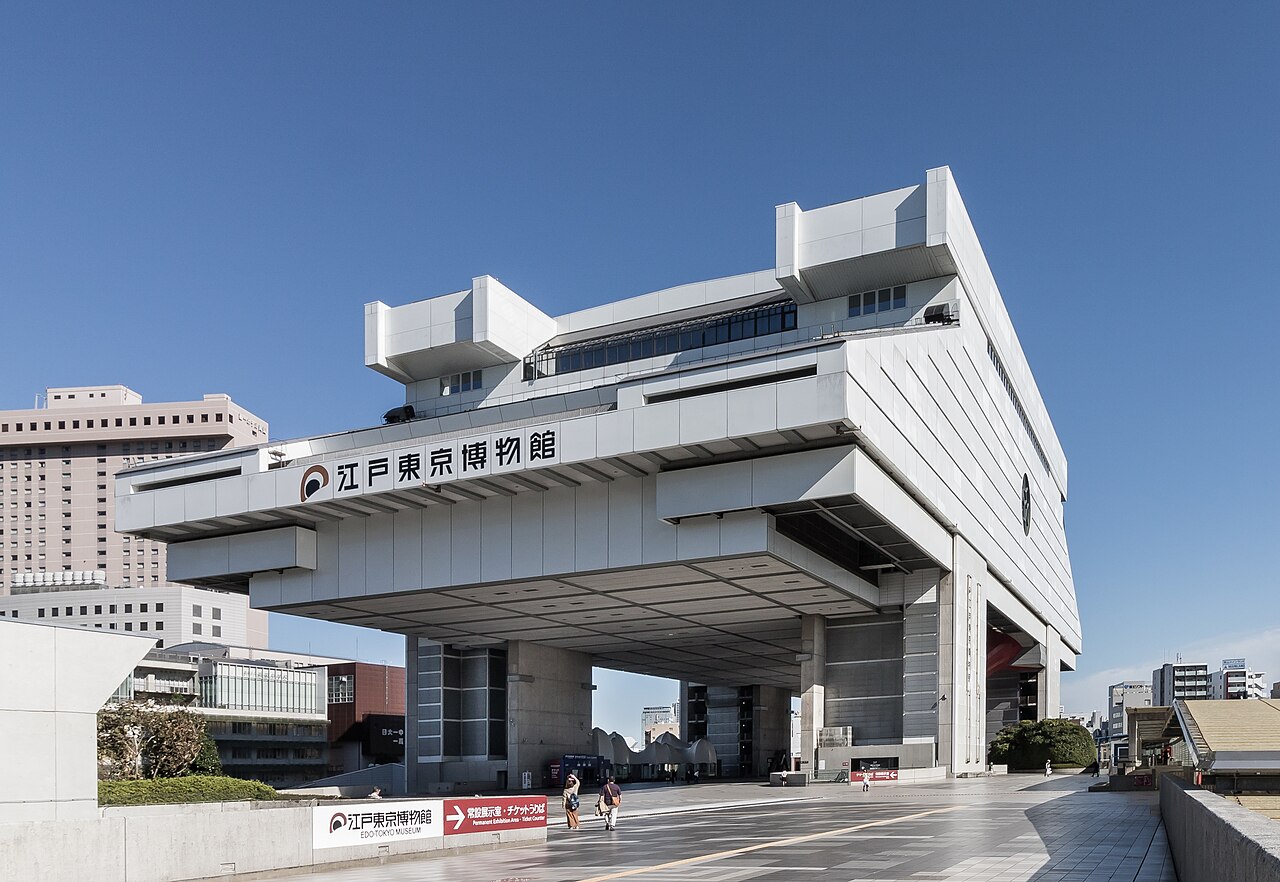
This museum of the history of Edo and Tokyo, opened in 1993 in Sumida, is the work of Kiyonori Kikutake's office. Four large pillars lift its steel building off the ground and carry a large steeply pitched roof that stretches from east to west. After four years of major works, the museum reopened on 31 March 2026.
Affiliate links — booking through Verrière helps fund our research, at no extra cost to you.
History
On 1 September 1987, the Tokyo Metropolitan design selection committee chose Kiyonori Kikutake's office as the design candidate for the museum. On 31 March 1988, a purchase contract was signed with the body winding up the former Japanese National Railways for their land in front of Ryōgoku Station, where a marshalling yard had stood. Construction began on 9 June 1989, the building was completed on 3 November 1992 and the museum opened on 28 March 1993.
On 1 April 2022 it closed for a large-scale renovation, the first since its opening, and it reopened on 31 March 2026. The equipment was renewed throughout, and the large sloping roof was redone, with better insulation and waterproofing. The architect Shohei Shigematsu (OMA) supervised the design of the spaces, inside and outside the museum. A piece inspired by a torii gate was installed on the western approach.
Architecture
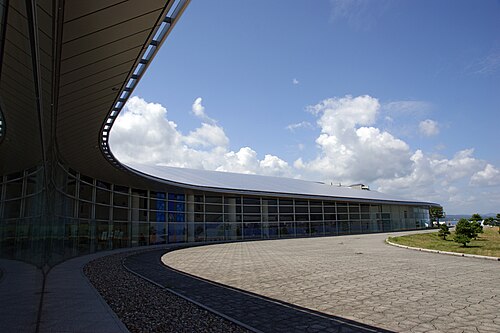
The structure is of steel, with seven storeys above ground, and the building rises 62.2 m. Four large pillars lift it off the ground: its silhouette evokes a storehouse on stilts. They carry a large steeply pitched roof that stretches from east to west.
Under this roof, a space under stilts holds the Edo-Tokyo Terrace, on the second floor. This raised form was designed to sit in harmony with the neighbouring sumo arena, the Ryōgoku Kokugikan.
Use today
The museum traces some 400 years of the history and culture of Edo and Tokyo, from Tokugawa Ieyasu's entry into Edo to the present day, with original objects, reconstructed models and hands-on displays. It aims to be a museum specialising in urban history.
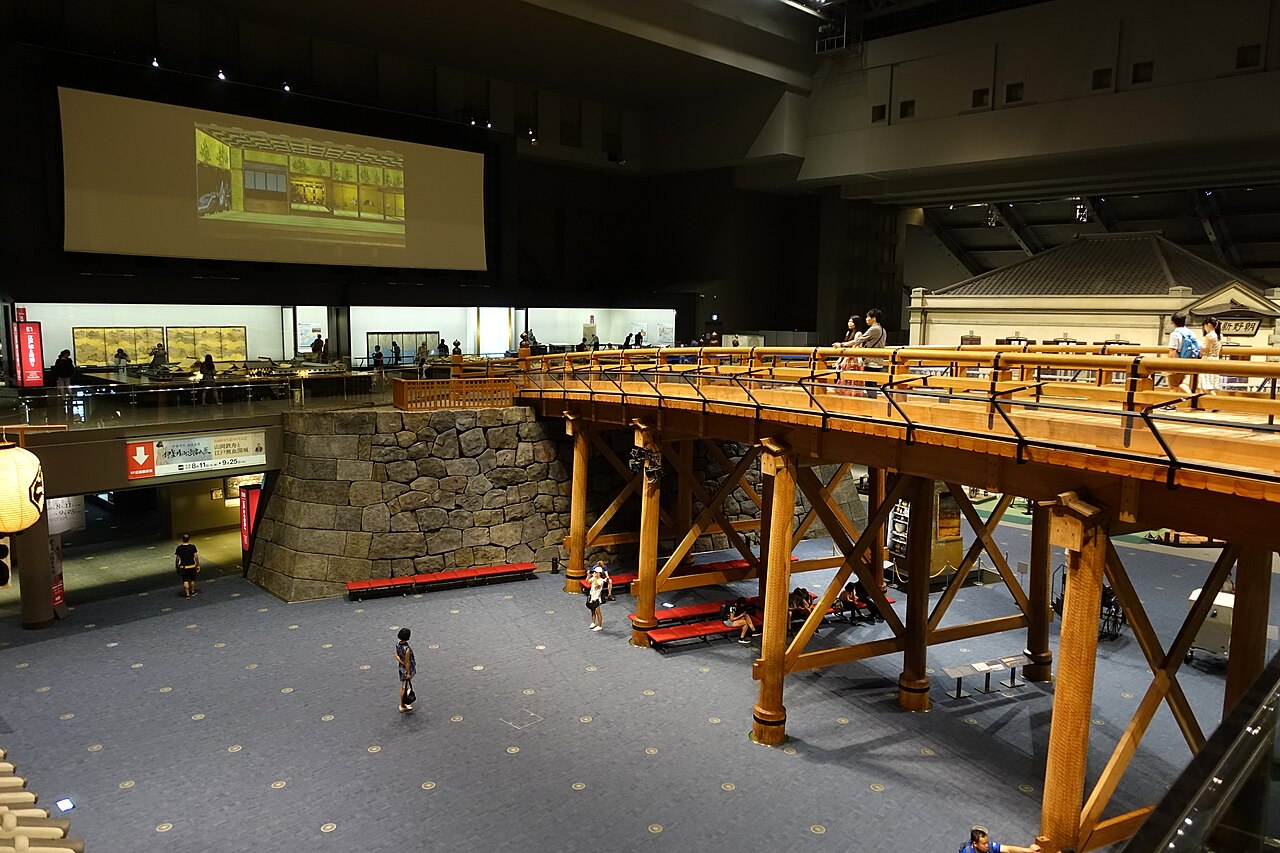
The permanent galleries occupy two levels: the entrance is on the fifth floor and the exit on the fourth. The route runs from the Edo zone to the Tokyo zone and reaches present-day Tokyo. It opens with Nihonbashi bridge rebuilt at full size; the bridge was about 51 m long and 8 m wide, and only its northern half has been reconstructed, from the records of its 1806 and 1829 rebuildings and from paintings. Piles, beams, girders and end posts are of zelkova; the railings and the deck, of Japanese cypress.
The ground floor also holds a main hall and a small hall, the museum shop and a restaurant and cafe; the library is on the sixth floor.
Visiting
The museum is open from 9:30 to 17:30, until 19:30 on Saturdays, with admission until 30 minutes before closing. It is closed on Mondays (the next day when Monday is a public holiday or a substitute holiday) and over the New Year holidays.
Tickets are sold online or, on the day, at the ticket counter on the ground floor.
The museum is a few minutes' walk from JR Ryōgoku Station (Sōbu Line) and one minute from Ryōgoku Station on the Toei Ōedo Line.
Photos
35.70° N, 139.80° E
Greenhouses nearby
Architecture nearby
By the same architect
Sources (19)
- edo-tokyo-museum.or.jp/about/
- edo-tokyo-museum.or.jp/about/facilities/
- edo-tokyo-museum.or.jp/about/history/
- edo-tokyo-museum.or.jp/about/message/
- edo-tokyo-museum.or.jp/information/hours/
- edo-tokyo-museum.or.jp/information/access/
- edo-tokyo-museum.or.jp/information/guide/
- edo-tokyo-museum.or.jp/information/floor-guide/
- edo-tokyo-museum.or.jp/p-exhibition/
- edo-tokyo-museum.or.jp/en/about/
- edo-tokyo-museum.or.jp/en/information/hours/
- edo-tokyo-museum.or.jp/en/information/access/
- edo-tokyo-museum.or.jp/en/information/floor-guide/
- edo-tokyo-museum.or.jp/about/history/pdf/30th-anniversary-edohaku.pdf
- english.metro.tokyo.lg.jp/w/116-101-007403
- chiikishigen.metro.tokyo.lg.jp/introduction/details/introduction_65.html
- xtech.nikkei.com/atcl/nxt/column/18/00154/02695/
- xtech.nikkei.com/atcl/nxt/column/18/00154/02771/
- bunka.go.jp/nama/global/eng/archivalcollections/kikutake/index.html
Affiliate links — booking through Verrière helps fund our research, at no extra cost to you.